Faculty of Science, Technology and Medicine
 Faculty of Law, Economics and Finance
 Faculty of Humanities, Education and Social Sciences
 Interdisciplinary Centre for Security, Reliability and Trust
 Luxembourg Centre for Systems Biomedicine
 Luxembourg Centre for Contemporary and Digital History
 Luxembourg Centre for European Law
 Luxembourg Centre for Socio-Environmental Systems
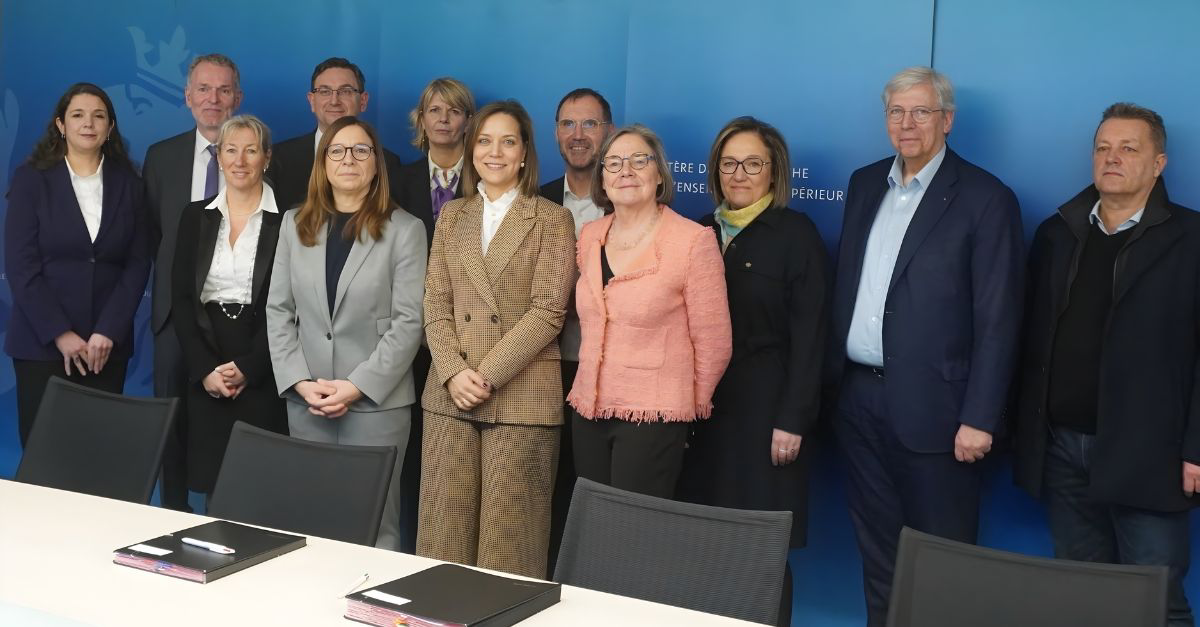
On 5 February, the University signed its sixth multi-year agreement with the Ministry of Research and Higher Education for 2026–2029. The agreement will be taken forward over the period through the University’s four-year plan (P4). The P4 has been developed against a backdrop of rapid technological change, labour market transformations and global pressures on climate, health, and democracy, with a strong commitment to knowledge transfer and societal impact.
The University of Luxembourg plays an important part in these sectors by addressing the major challenges facing society through its three fundamental missions: high-level disciplinary and interdisciplinary research, research-based teaching, and the effective transfer of knowledge and technology to society.
The P4 is based on a strategic framework and structured around three key areas: digital transformation, medicine and health, and sustainable and societal development. Drawing on its strong foundations in disciplinary knowledge, the University will combine the contributions of the social sciences and humanities with those of STEM fields. Interdisciplinarity, one of Uni.lu’s hallmarks, will continue to be supported through its Institute for Advanced Studies (IAS).
Uni.lu is committed to addressing the ever-increasing impact of digitalisation on society, and is playing a pioneering role in scientific discovery and talent development. Its community has the necessary expertise and infrastructure to fully support this ambition.
Uni.lu will notably strengthen its expertise in the field of high-performance computing, train highly qualified talent for Luxembourg, and intensify its activities and collaborations in quantum science. Artificial intelligence, which has a profound impact on society, will be given special attention.
The University has prepared a 10-year strategy outlining its contribution to the evolution of the national healthcare system. It sets out the steps required to launch a Master’s in Medicine, medical specialisation programmes, increased clinical research, and the potential establishment of a Faculty of Medicine. The strategy implementation will be subject to a specific agreement and will notably require the accelerated recruitment of academic staff and the strengthening of healthcare sector partnerships.
The University considers sustainable development a key issue and will develop its contributions outlined in the previous P4. The two recently established interdisciplinary research centres — the Centre for European Law and the Luxembourg Centre for Socio-Environmental Systems — will be fully developed, with the aim of contributing policy-relevant knowledge.
Evolving education, student life, and infrastructure
Contrary to international trends, the number of students at Uni.lu continues to increase. The institution remains committed to cultivating a dynamic, vibrant and inclusive university community, based on a Student Life and Engagement Charter, which was developed in close collaboration with the student delegation.
Investing in people and partnerships
National and international collaboration remains central for the University’s academic excellence, innovation and talent attraction. On the international level, the University will leverage its membership in The Guild, a leading group of European research universities, through collaborations, student mobility, advocacy and multi-institutional insight. To advance its third mission, the University will strengthen partnerships, entrepreneurship and knowledge transfer to society, while developing a strategic fundraising approach. To this end, the University established in 2025 a dedicated Department for Partnerships and Advancement.
The University will continue to promote a culture of inclusion, equity and diversity, including gender equality. Recruiting, retaining and developing excellent academic talent is essential for its mission. Through the new University of Luxembourg Competence Centre, the University will improve its professional development offering for all staff.
Outlook
Through its four-year plan for 2026–2029, the University of Luxembourg aims to remain future-oriented, supporting the advancement of knowledge, talent and solutions to contemporary challenges, and preparing the university community for ongoing change.