
 Faculty of Science, Technology and Medicine
 Faculty of Law, Economics and Finance
 Faculty of Humanities, Education and Social Sciences
 Interdisciplinary Centre for Security, Reliability and Trust
 Luxembourg Centre for Systems Biomedicine
 Luxembourg Centre for Contemporary and Digital History
 Luxembourg Centre for European Law
 Luxembourg Centre for Socio-Environmental Systems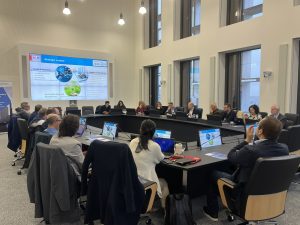
The University has launched its Institute for Innovative Teaching and Learning (I²TL), a new hub that pilots modern approaches to teacher development and digital education, as well as a dedicated fund to support student-centered innovations in teaching and learning.
Rooted in cutting-edge digital education, the I²TL reflects the University’s ambition in education: to offer a dynamic learning environment and to equip students and instructors with innovative methods and knowledge to meet future challenges. The Institute aligns with like-minded institutes across Europe.
On 20 October, Rector Prof. Jens Kreisel and Vice-Rector for Academic and Student Affairs Prof. Philippe Hiligsmann presented the Institute to student and academic communities.
Philippe Hiligsmann underlines that pedagogical innovation is not only about novelty, but also about relevance and impact for learners: “Pedagogical innovation is meaningful only if it responds to what students actually need. And reflecting about what students need only makes sense through dialogue with students. Through I²TL, we aim to actively involve students as partners. They will take part in co-creating, testing, and implementing educational initiatives”.
Jens Kreisel highlighted the need to consider the impact of the way in which access and process of knowledge changes rapidly.
‟ We live in a time of choice. Students expect learning pathways that fit their preferences and open up the best opportunities in life. We also live in a time when the interplay between ideas and digitalisation is critical for innovation, with digital tools and AI acting as key enablers for education.”
Rector
Three interconnected pillars, centered on innovation
Teacher Development
Teacher Development is a core interest of I²TL. Uni.lu educators have access to tailored pedagogical activities, professional teaching qualifications, and communities of practice.
Digital Education
Through the Digital Education pillar, techno-pedagogical support will be available to students and instructors, whether it is to support teaching, learning, assessment or the application of knowledge.
Education Innovation Fund
The Education Innovation Fund will support student-centered initiatives and collaborations, in particular interdisciplinary and multilingual initiatives in which students are partners and co-creators.
Higher education environment is evolving
Prof. Philippe Parmentier, professor of Educational Science and Director of the Administration for Education and Training at UCLouvain, provided the keynote address “Pedagogical Transformation of Higher Education”, pointing to the contemporary tests faced by higher education institutions.
Higher education increasingly operates in a context marked by geopolitical tensions, ecological and social transitions, demographic shifts and rapid technological change, particularly in AI. These developments affect universities’ missions in research, teaching and service. Institutions must therefore be able to project into uncertain futures, to manage the unpredictable, develop clear but flexible strategic visions and build new forms of partnership while remaining true to their educational role.
Prof. Parmentier stressed that the world changes faster than knowledge itself. Universities must both produce and transmit new knowledge, make different forms of knowledge coexist, and combat misinformation. This implies stronger interdisciplinarity, the valorisation of research and open science, attention to impact measurement, and an explicit commitment to lifelong learning. Changing reference systems, such as critical thinking, creativity and the diversification of access to knowledge, are central to this transformation.
Expectations that today’s societies have of university education include:
- Universities must continuously adapt teaching, develop appropriate skills and knowledge and to support graduates’ success.
- Responsible and respectful ways of operating, which include sustainable management of financial and material resources, but also a strong focus on the well-being and mental health of students and staff.
- Increased societal impact of education: teachers, researchers and students should act as positive change-makers in society. Research, whether fundamental or applied, as contributing to society and positive transformation.
These expectations create a “triple injunction”: to do better, often with less, while at the same time responding to new and growing demands on higher education.
Copyright: Prof. Philippe Parmentier, Professor of Educational Science, Director of Education and Training Administration, University of Louvain-la-Neuve.
‟ The world is changing, and the ways in which knowledge and skills are acquired are changing with it. With the I²TL, the University aims to create a holistic environment that consistently enhances student engagement and learning outcomes. Educators make informed use of modern pedagogical tools and share best practices within their communities. For students, it means benefiting from a digitally enriched, globally oriented, and student-centered educational experience.”
Vice-Rector for Academic and Student Affairs