

 Faculty of Science, Technology and Medicine
 Faculty of Law, Economics and Finance
 Faculty of Humanities, Education and Social Sciences
 Interdisciplinary Centre for Security, Reliability and Trust
 Luxembourg Centre for Systems Biomedicine
 Luxembourg Centre for Contemporary and Digital History
 Luxembourg Centre for European Law
 Luxembourg Centre for Socio-Environmental Systems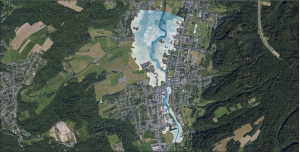
Most of us check the weather to decide whether we need an umbrella or if it’s a good moment for a walk. Yet weather forecasting plays a far more crucial role. Extreme weather events are becoming increasingly frequent across Europe, and Luxembourg is no exception. In recent years, episodes of heavy rainfall and flooding — considered the most destructive natural hazard in Luxembourg — have intensified, causing serious damage to communities and infrastructure.
To address this, Prof. Rebecca Teferle and her team have launched the NPWLux project in collaboration with RSS-Hydro. The project aims to develop the first Numerical Weather Prediction (NWP) model designed specifically for Luxembourg and the Greater Region, providing short-term forecast tailored to local conditions. In addition, the NWP model is also coupled with a flood-simulation model to support more precise predictions of areas at risk.
NWPLux: a forecasting system optimised for Luxembourg
Until now, Luxembourg has mainly relied on European and international meteorological datasets. Although this is already helpful, a tailored system to the country, with very high model resolution, would enable to find solutions adapted to Luxembourg and its specificities. NWPLux helps in this way, building a forecasting system optimised specifically for the country’s unique landscape and hydrological context.
The project applies a six-hour Rapid Update Cycle (RUC) that continuously assimilates new observations, enhancing the accuracy of short-term forecasts.
Why is this important? This hybrid system enables local authorities to monitor severe rainfall with greater precision and to rapidly issue flood warnings. By providing early information on when and where extreme weather may occur, the system helps reduce the risk of floods and protects communities and infrastructure in Luxembourg.
A system powered by Luxembourg’s High-Performance Computing
Over the past three years, Prof. Rebecca Teferle and her team have implemented the NWP system using the open-source Weather Research and Forecasting (WRF) model, deployed on Luxembourg’s high-performance computing (HPC) infrastructure. This model covers Luxembourg and the Greater Region at 1.3 km resolution and Europe at a 12 km resolution. This allows temperature and rainfall predictions to be generated for every 1.3 km square in Luxembourg.
To further improve accuracy, the researchers integrated data assimilation (WRFDA) using regional observations. The model has been carefully tested against multiple datasets, including satellite imagery and radar data and local measurements, for major flood events in 2016, 2018 and 2021, showing clear improvements in predicting both rainfall and temperature. In the case study of the 2021 flood event, a one-month simulation reveals that using local data, compared to not using it, significantly improves precipitation detection. The team achieved a Probability of Detection (POD) improvement of +8.3% and a substantial reduction in False Alarm Ratio (FAR) by −13.7%.
Linking weather predictions to flood simulations
Understanding weather conditions is only one part of managing flood risks. To assess potential impacts, the NWPLux system has been coupled with the LISFLOOD-FP hydrodynamic model, adjusted specifically for Luxembourg. This integration transforms rainfall forecasts into simulations of water movement across rivers, valleys, and urban areas.
The result is a set of high-resolution flood extent and depth maps, providing decision-makers with actionable insights into where flooding may occur and how severe it could be.
‟ The University of Luxembourg leads the scientific development and validation of the WRF model and its data assimilation component, while RSS-Hydro brings expertise in flood modelling and operational forecasting. Together, we are developing tools that can support Luxembourg in preparing for future climate-related challenges.”

Full professor in Geodesy
Looking ahead, the objective is to transition NWPLux into an operational forecasting system. RSS-Hydro plans to integrate the model into its service portfolio, making near-real-time, high-resolution flood forecast available for Luxembourg and potentially the wider region.
Future funding opportunities, for example via the FNR Bridges programme, may be used to support the project’s evolution from a research initiative to a fully operational service.
NWPLUX is funded by the Luxembourg National Research Fund (FNR) under the AFR Industrial Fellowship Call 2022 (Project#: 17130773)