
 Faculty of Science, Technology and Medicine
 Faculty of Law, Economics and Finance
 Faculty of Humanities, Education and Social Sciences
 Interdisciplinary Centre for Security, Reliability and Trust
 Luxembourg Centre for Systems Biomedicine
 Luxembourg Centre for Contemporary and Digital History
 Luxembourg Centre for European Law
 Luxembourg Centre for Socio-Environmental Systems
Gender Equality Action Plan 2026-2031

The University of Luxembourg’s Gender Equality Action Plan 2026–2031 marks a new chapter in our commitment to fairness, inclusion, and academic excellence. Building on the progress achieved between 2020 and 2025, the new plan sets an ambitious, evidence‑driven direction for the next five years.
Five strategic objectives and 15 actions to foster gender equality at Uni.lu
Anchored in the European Research Area and Horizon Europe frameworks, this Action Plan positions gender equality not as a compliance requirement, but as a strategic driver of research quality, institutional culture, and organisational well‑being. It responds directly to findings from the 2025 Gender Equality Survey, which highlighted both meaningful progress and persistent asymmetries in representation, workload, reporting confidence, and perceptions of fairness.
The 2026–2031 plan outlines five strategic objectives: from equitable career progression and balanced workload allocation to strengthened inclusion, visibility, and support structures. With 15 concrete actions, dedicated resources, and clear monitoring mechanisms, the University reaffirms its commitment to a respectful, inclusive environment where all staff and students can thrive, regardless of gender identity, sexual orientation, or family situation.
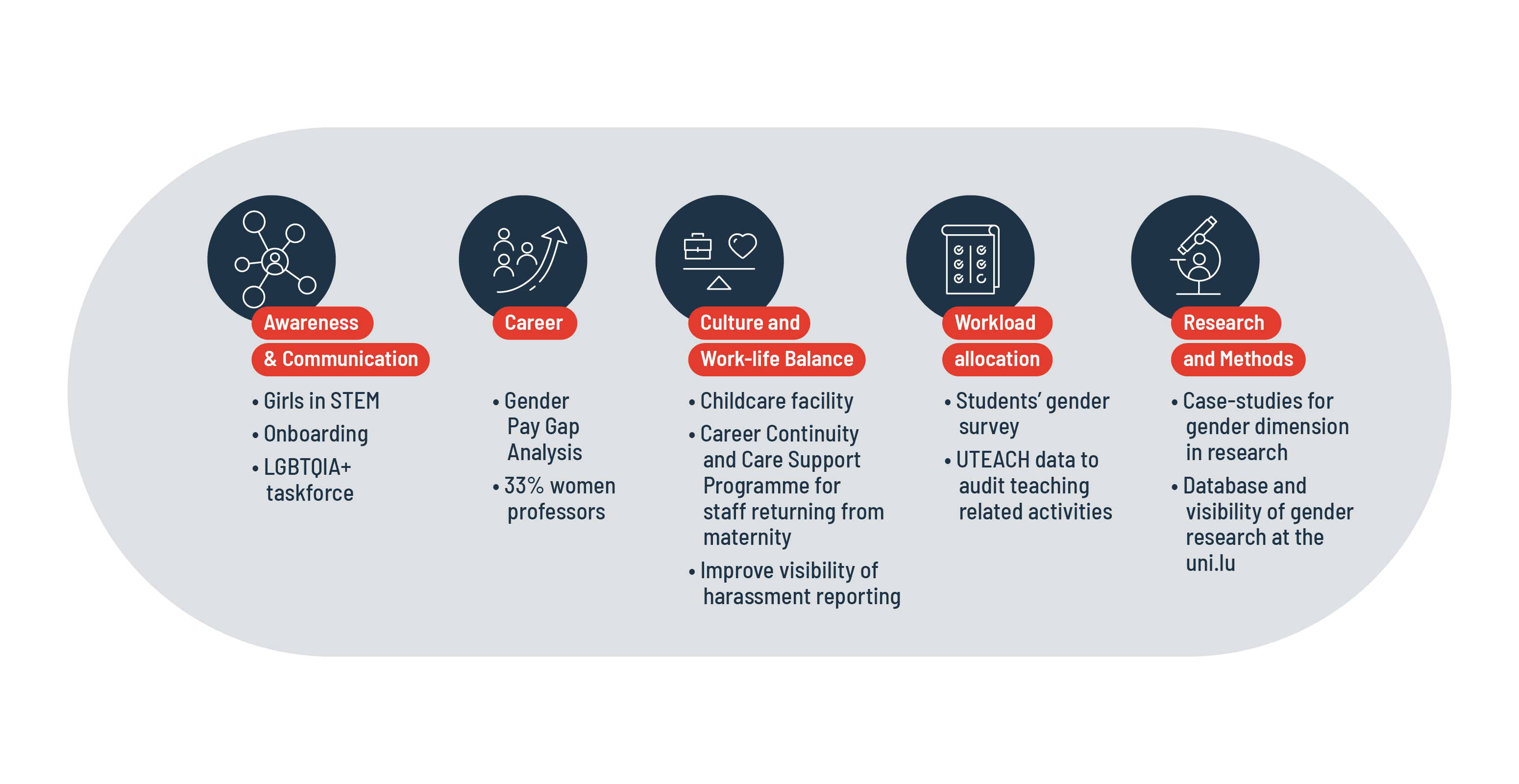
Discover the strategic objectives and related actions:
The University will strengthen the visibility, accessibility, and understanding of gender inequalities and corresponding initiatives to its employees and students. Awareness is not a communication exercise but a driver of institutional culture change. Communication efforts will emphasize transparency, gender disaggregated data dissemination, and engagement with all academic and administrative units.
Planned action 1
Enhance awareness and visibility of gender equality at uni.lu through the regular publication of gender statistics and an updated onboarding process for employees and students.
Planned action 2
Strengthen outreach and engagement activities to encourage girls and young women to pursue studies in STEM fields
Planned action 3
Strengthen further the LGBTQIA+ Task Force to promote a more inclusive university culture (e.g. inclusive language workshops, Ateliers at the Welcome Week, and lectures for students).
The GEAP seeks to further advance parity in career progression and to guarantee equitable access to leadership roles. Building on the closing of the promotion gap observed in the 2025 survey, the next phase will reinforce mentorship, sponsorship, and leadership development schemes. The purpose is to further reduce structural barriers that may lead to limited access to decision-making spaces.
Planned action 4
Ensure that women represent at least 33% of professors by 2031, leveraging the Anne Beffort positions as well as other recruitment and promotion instruments, including structured information and guidance for accompanying partners on career opportunities in Luxembourg.
Planned action 5
Consolidate existing programs like Advance, Marie Speyer Grants and collaborate with the new leadership academy to develop leadership programs for different target groups, including gender bias trainings.
Planned action 6
Develop a comprehensive Gender Pay Gap Analysis across staff categories and career stages to identify potential disparities and inform corrective measures.
Equality relies on trust in institutional mechanisms and on a shared perception of fairness and safety. The University will continue to improve reporting procedures, strengthen follow-up, and foster an environment in which respect is non-negotiable. Well-being at work also depends on balancing professional and personal responsibilities. The University will work with external partners to establish a childcare facility for its employees and students. The aim is to normalise parental leave uptake among men and promote flexible arrangements that help reconcile work and private life.
Planned action 7
Improve visibility of harassment reporting procedures via different instruments (campaign, improved website, onboarding).
Planned action 8
Establish evidence-based training resources on allyship, targeted to all audiences, in particular men.
Planned action 9
Introduce the option for employees and PhD students to use their preferred name across all internal communication tools, directories, and learning platforms.
Planned action 10
Develop a childcare facility for university employees and students, in collaboration with the Ministère de l’Éducation nationale, de l’Enfance et de la Jeunesse.
Planned action 11
Establish a Career Continuity and Care Support Programme to facilitate career continuity for staff returning from parental, sick, or other long-term leaves.
Planned action 12
Strengthen a gender-sensitive and inclusive approach to student safety in social and associative life.
Persistent gendered patterns in task distribution and representation will be addressed through systematically monitoring committee composition and workload allocation. The goal is to ensure fair participation in governance roles and equitable visibility and recognition. Using existing platform, the University will gather data to guarantee gender sensitive workload for academic and administrative staff.
Planned action 13
Audit workload distribution and teaching allocation using data like UTEACH and other internal data to identify and correct gendered asymmetries in administrative and pedagogical duties.
Planned action 14
Conduct a gender audit of students to understand asymmetries in care, mentoring, and supervision demands (“student-care burden”).
The University will develop field-specific case-studies that clarify what it means to introduce a gender perspective across different disciplines. These examples will serve as practical resources that researchers can draw on and adapt to their own projects and methodological choices. To support this effort, training activities, data infrastructure, and collaboration with national and international partners will be further developed to ensure effective and sustained support.
Planned action 15
Strengthen the capacity to develope concrete examples and case studies that help researchers identify when and how gender considerations may matter for their research, in line with EU and IAS funding schemes. In parallel, collect, organise, and make visible the substantial body of gender-related research already produced across faculties and centres.
‟ Anchored in the European Research Area and Horizon Europe frameworks, the Gender Equality Action Plan (GEAP) 2026–2031 treats gender equality not merely as compliance but as a strategic driver of equity and academic quality.”
Key Figures from the Gender Equality Survey
The 2025 Gender Equality Survey shows meaningful progress in perceptions of gender equality, promotion encouragement, and the use of data to guide university strategy compared with 2020.
However, persistent challenges remain, particularly in leadership representation, awareness of equality initiatives, confidence in reporting mechanisms, unequal invisible workloads, and parental leave uptake. The next phase will focus on redistributing workloads, strengthening trust and accountability and fostering an inclusive culture for all staff and students, including LGBTQIA+ communities.
‟ For the first time in its history, in 2025, the University counts 30% of women among its professors, a milestone that reflects steady institutional progress toward balanced representation.”