

 Faculty of Science, Technology and Medicine
 Faculty of Law, Economics and Finance
 Faculty of Humanities, Education and Social Sciences
 Interdisciplinary Centre for Security, Reliability and Trust
 Luxembourg Centre for Systems Biomedicine
 Luxembourg Centre for Contemporary and Digital History
 Luxembourg Centre for European Law
 Luxembourg Centre for Socio-Environmental Systems
Our Research
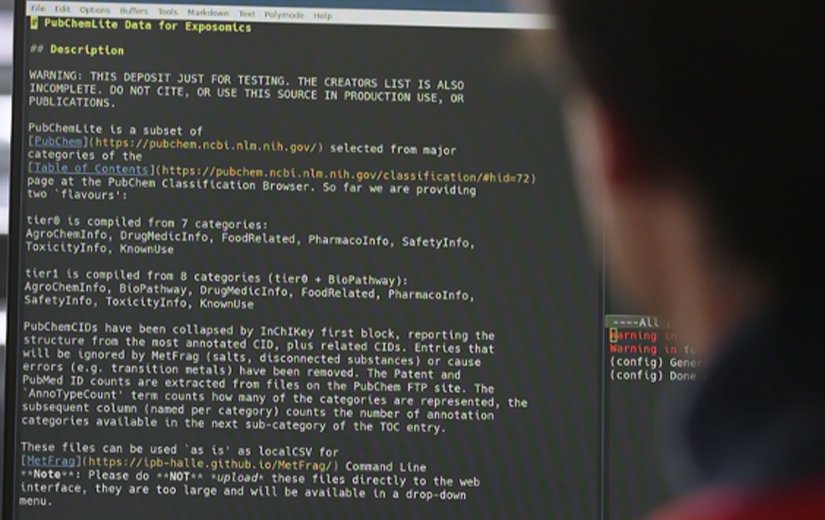
With over 100 million chemicals in the largest databases and over 70,000 in household use alone, identifying the thousands of compounds present all around us is a huge challenge.
All detectable molecules in complex samples can be captured using high resolution mass spectrometry (HRMS). Non-target HRMS provides a “snapshot” of all chemicals present in a sample and allows for retrospective data analysis. While these methods constitute a basis to identify unknowns, they remain time consuming. Prioritising efforts to find potentially toxic substances responsible for observed effects is key, which involves reconciling highly complex samples with expert knowledge and careful validation.
Our group pursues a fundamental shift away from single-substance assessments, towards developing generic approaches scalable to tens of thousands of chemicals, features and samples.
By identifying chemicals in our environment, we hope to provide essential knowledge for unravelling the causes of disease and toxicity.
Find out more about our specific research projects by browsing the list below
The Environmental Cheminformatics group is supported by the Luxembourg National Research Fund (FNR), the European Union Horizon 2020 and Horizon Europe Research Programmes, the NORMAN Network and the University of Luxembourg Institute for Advanced Studies.



Our research projects
The Environmental Cheminformatics group is leading or involved in several national, European and international research projects:
Current projects
-
Duration:
2025-2030
-
Funding source:
Ministry of the Environment, Climate and Biodiversity, Luxembourg Government
-
Researchers:
Emma Schymanski
-
Partners:
LCSES, FSTM
-
Description:
In a landmark move marking the 10th anniversary of the Paris Agreement, Luxembourg’s Ministry of the Environment, Climate and Biodiversity (MECB) and the University of Luxembourg have signed the Climate Nexus Framework Convention. This five-year initiative (2025–2030) aims to make Luxembourg climate-ready by integrating research, education, policy, and public engagement to address climate change, biodiversity loss, and socio-economic challenges.
To achieve its goal, the convention will mobilise Luxembourg scientific, education and policy stakeholders on projects in social, environmental and engineering sciences. The Climate Nexus approach highlights the interdependence between climate, biodiversity, water, food, and social equity. At the heart of the initiative are six “readiness” pillars. LCSB is involved in the Institutional Readiness pillar, which leverages socio-environmental data to enhance climate services in Luxembourg and monitor climate-related systemic risks. This includes mapping of chemical substances in Luxembourg that may be detrimental for human health and the ecosystem.
-
Project details (PDF):
-
Duration:
2024-2027
-
Funding source:
European Joint Programme on Rare Diseases (INTER/EJP-RD/17954361/GENOMIT5)
-
Researchers:
Martin Jakubec, Carole Linster, Emma Schymanski
-
Partners:
GENOMIT consortium partners
-
Description:
Mitochondrial disorders (MDs) are a genetically diverse group of individually rare, but severe diseases for which no causal treatments are available. The GENOMIT consortium assembles the national networks from Germany/Austria, Italy, Spain, Japan, UK and the main centers for MD in Hungary and Luxembourg, collectively building the global registry and following > 9,000 patients with 500 novel cases annually. GENOMIT acts in close collaboration with international patient organizations to improve the diagnosis and care of MD patients.
GENOMIT will advance natural history studies to prepare for clinical trials by
i) continuous recording of digital phenotypes, increasing patient numbers, integrating PROMs and phenotype-specific rating scales in time series
ii) advancing genetic biomarkers in monogenic conditions and beyond
iii) leveraging on metabolic profiles as biomarker
iv) capture and integrate environmental factors from plasma metabolomics
v) apply machine learning for diagnostics, patient stratification and improved prediction of individual prognosisGENOMIT partners are established national hubs for molecular diagnosis and state-of-the-art care for patients with MD. This collaboration led to a global registry and the largest collection of multi-omics data pertaining to MDs worldwide. We incorporate groups with unique expertise in genetics, clinical management and computational science who developed AI models for omics-empowered diagnostics. GENOMIT will improve understanding of variation in the natural history of MDs by AI integration of therapeutic history, environmental exposure, genomics, lifestyle, clinical information, and PROMs and will be an invaluable resource for patient care and future clinical trials.
-
Project details (PDF):
-
Duration:
continuous
-
Funding source:
MassBank activities performed at LCSB are funded with internal funds, NORMAN and PARC and done in partnership with IPB Halle (Germany) and UFZ (Leipzig, Germany), funded by NFDI4Chem and de.NBI
-
Researchers:
Anjana Elapavalore, Emma Schymanski
-
Partners:
IPB Halle (Germany), UFZ (Leipzig, Germany)
-
Description:
The ECI group continues collaborative activities on the European MassBank server, initiated within the NORMAN Network in 2012. This includes the contribution of high-quality mass spectral data as well as uploading of external contributions and continuing input into server and functional developments.
-
Project details (PDF):
-
Duration:
-
Funding source:
MICRO-PATH is supported by the PRIDE doctoral research funding scheme (PRIDE23/18686828) of the Luxembourg National Research Fund (FNR).
-
Researchers:
-
Partners:
-
Description:
-
Project details (PDF):
-
Duration:
-
Funding source:
-
Researchers:
-
Partners:
-
Description:
-
Project details (PDF):
-
Duration:
continuous
-
Funding source:
NORMAN Association, internal funds
-
Researchers:
Bashir Mayahi, Hiba Mohammed Taha (alumni), Emma Schymanski
-
Partners:
NORMAN Network members; international collaborators
-
Description:
The NORMAN Suspect List Exchange (NORMAN-SLE) is a community-driven hub of curated suspect lists and chemical information that supports high-resolution mass spectrometry (HRMS) screening, environmental monitoring, and exposomics.
-
Project details (PDF):
-
Duration:
2021-2027
-
Funding source:
PARC is funded under the European Union’s “Horizon Europe” framework programme
-
Researchers:
Anjana Elapavalore (WP4,7,8), Bashir Mayahi (WP4,7,8), Hiba Mohammed Taha (alumni, WP4,8), Emma Schymanski (WP 4,7,8)
-
Partners:
Coordinated by ANSES, the French Agency for Food, Environmental and Occupational Health & Safety, PARC involves 200 partners in 28 countries and at EU level, national agencies and research organisations working in the areas of the environment or public health, the European Chemical Agency (ECHA), the European Food Safety Authority (EFSA) and the European Environment Agency (EEA).
-
Description:
The European Partnership for the Assessment of Risks from Chemicals (PARC) was launched in May 2022 and seeks to develop next-generation chemical risk assessment in order to protect health and the environment. PARC aims to advance research, share knowledge and improve skills in chemical risk assessment. By doing so, it will help support the European Union’s Chemicals Strategy for Sustainability, paving the way for the “zero pollution” ambition announced in the European Green Deal. The Environmental Cheminformatics group are involved in work packages 4 (Monitoring and Exposure), 7 (FAIR Data) and 8 (Concepts and Toolboxes). Anjana Elapavalore is now a qualified GO FAIR Three-Point FAIRification Framework Facilitator within PARC.
-
Project details (PDF):
-
Duration:
2024-2027
-
Funding source:
European Commission MSCA COFUND (101081455), University of Luxembourg Institute for Advanced Studies
-
Researchers:
Federica Piras, Emma Schymanski
-
Partners:
Joachim Hansen, Silvia Venditti (University of Luxembourg), international collaborators
-
Description:
PFAS-QUEST, hosted by the Institute for Advanced Studies (IAS) of the University of Luxembourg, will aim to develop standardised semi-quantitative non-targeted screening workflows to identify and quantify per- and polyfluoroalkyl substances (PFAS) in effluents from wastewater treatment plants. PFAS-QUEST will also systematically assess the performance of a new advanced remediation scheme combining ozonation with nature-based constructed wetlands to help design sustainable and energy-efficient treatment approaches for reducing PFAS emissions from wastewater plants in rural Luxembourg. The outcomes of PFAS-QUEST will support public and private stakeholders to help tackle the immense challenge of the PFAS “forever chemicals” in our environment.
-
Project details (PDF):
-
Duration:
2024-2031
-
Funding source:
Xpose is supported by the PRIDE doctoral research funding scheme (PRIDE23/18356118/Xpose) of the Luxembourg National Research Fund (FNR).
-
Researchers:
Vasiliki (Vana) Gkanali, Emma Schymanski
-
Partners:
LIH, LISER, Uni.lu
-
Description:
The Xpose doctoral programme will train the next generation of exposome scientists and extend our understanding of the relationship between the exposome and the associated biological processes leading to diseases. Xpose brings together Luxembourg experts jointly collaborating on exposome research programmes consisting of 12 PhD projects organized into three specific research axes: (1) Environmental factors, (2) Social and behavioural factors and (3) Biological processes.
-
Project details (PDF):
-
Duration:
2021-2026
-
Funding source:
EU project funded under the H2020 research and innovation call “Building a low-carbon, climate resilient future: Research and innovation in support of the European Green Deal: Innovative, systemic zero-pollution solutions to protect health, environment and natural resources from persistent and mobile chemicals” (grant 101036756).
-
Researchers:
Parviel Chirsir, Emma Palm, Emma Schymanski
-
Partners:
The project involves 15 partners and is led by the Norwegian Geotechnical Institute (NGI) coordinated by Prof. Hans Peter Arp.
-
Description:
ZeroPM launched in 2021 to interlink and synergise prevention, prioritisation and removal strategies to protect the environment and human health from PM substances. ZeroPM will establish an evidence-based multilevel framework to guide policy, technological and market incentives to minimise use, emissions and pollution of entire groups of PM substances. The Environmental Cheminformatics group is involved in the Substance Grouping work package of ZeroPM, collaborating with Prof. Hans Peter Arp (NGI), work package lead, and Dr Zhanyun Wang (EMPA). The Substance Grouping team will look at ways to prioritise all groups of PM substances and transformation products on the global market for prevention and remediation prioritisation, integrating this information into open resources for maximal dissemination.
-
Project details (PDF):
Former projects
-
Duration:
2018-2023
-
Funding source:
ATTRACT fellowship from the Luxembourg National Research Fund (FNR)
-
Researchers:
Emma Schymanski, Lorenzo Favilli (alumni), Anjana Elapavalore, Todor Kondic (alumni), Adelene Lai (alumni), Randolph Singh (alumni)
-
Partners:
This project involves several internal partners within the LCSB, including the Enzymology and Metabolism group, Systems Ecology group and the Bioinformatics Core, as well as the Cheminformatics and Computational Metabolomics group from FSU Jena.
-
Description:
Started in 2018, ECHIDNA aims to build computational methods suitable for investigating and elucidating unknowns and causes of effects using HRMS of small molecules. Computational and experimental developments will improve structure elucidation, including cheminformatics approaches as well as stable and dynamic labelling of samples. New cheminformatics methods will improve our understanding of the fundamentals of HRMS and work towards the “holy grail” of a full Computer- Assisted Structure Elucidation (CASE) system for HRMS. A microbiome-PD cohort study will yield complex samples with patient/early stage/control information allowing a discovery-based prioritisation of potential neurotoxins amongst these samples. Single cell biological systems will yield additional information on known and unknown metabolites in well-understood systems.
-
Project details (PDF):
-
Duration:
2020-2023
-
Funding source:
LuxTIME is a pilot project in the University of Luxembourg’s Institute of Advanced Studies (IAS).
-
Researchers:
Dagny Aurich (alumni), Emma Schymanski
-
Partners:
LuxTIME fosters the energies and skills across two interdisciplinary centres (LCSB, C2DH) at the university, in cooperation with the Luxembourg Institute of Science and Technology (LIST).
-
Description:
The “Luxemburg Time Machine” (LuxTIME) project explored new ways for analysing and interpreting factual evidence of the past using an interdisciplinary framework for investigating “big data” of the past, inspired by the conceptual premises of the “European Time Machine” Flagship project. The LuxTIME digital dataset includes information from three different fields and scientific perspectives (eco-hydrology, medicine and history) and used a local showcase (i.e. the industrialisation of Belval / Minette region) as a testbed to study the impact of environmental changes on the health of the local population in a long term perspective.
-
Project details (PDF):
-
Duration:
2019-2023
-
Funding source:
SinFonia is an EU funded H2020 project
-
Researchers:
Corey Griffith (alumni), Emma Schymanski, Carole Linster
-
Partners:
SinFonia is conducted in collaboration with the Enzymology and Metabolism group at LCSB and several international partners
-
Description:
SinFonia aims to integrate the non-native element fluorine into the metabolism of Pseudomonas putida to produce novel fluorinated polyhydroxyalkanoates (PHAs), ideally in such a way that bacterial growth will become dependent on this incorporation. Fluorine is common in industrial chemicals with versatile applications from electrical insulation to waterproofing, yet it is seldom present in biological systems. The current production processes for fluorochemicals often negatively affect the environment, and there is a great need for more sustainable and less harmful alternatives. If successful, SinFonia will provide a less hazardous and more sustainable solution to synthesising fluorochemicals.
Our role is to identify fluorinated and undesirable metabolites in engineered bacteria using non-targeted mass spectrometry. Engineered systems may lack sufficient metabolite repair capacity, which we aim to counteract by screening for metabolite damages in our cell factories and envisaging strategies to repair them. Metabolite repair may be particularly important in SinFonia due to the load of adding heterologous pathways and a non-native element to create new-to-nature products.
-
Project details (PDF):
-
Duration:
2018-2024
-
Funding source:
MICROH is supported by the PRIDE doctoral research funding scheme (PRIDE17/11823097) of the Luxembourg National Research Fund (FNR).
-
Researchers:
Begoña Talavera Andujar, Emma Schymanski
-
Partners:
PhD candidates will conduct their research projects either at the LCSB, LSRU, PHYMS-RU, LIH, LNS, IBBL and/or LIST.
-
Description:
MICROH, which stands for “Microbiomes in One Health”, is a competitive, interdisciplinary PhD training programme. MICROH aims to study interactions within and between microbiomes in relation to two major healthcare challenges of our time, i.e. the spread of antimicrobial resistance genes and the increasing prevalence of chronic diseases. MICROH bridges microbiology and big data analytics in a structured doctoral training environment.
By tackling frontier research questions of immediate public health relevance, the research-intensive programme responds to the unmet need of training the next generation of microbiome scientists in an interdisciplinary environment covering integration and analysis of multi-omics data, as well as basic and translational biomedical knowledge, and its practical application to the diagnosis of diseases and ultimately their treatment. The programme includes transferable skills training, support in career development, lectures and teaching by international experts and annual PhD symposia.
-
Project details (PDF):
-
Duration:
2022-2023
-
Funding source:
Internal funds
-
Researchers:
Dagny Aurich, Emma Schymanski
-
Partners:
Jamie Perera (JPML)
-
Description:
The story of our chemical past, present and future made into a sonification piece that demonstrates the immense scale of the chemical problem, exemplified with DDT and PFAS, based on the figure created by Dagny Aurich as part of Arp et al (2023) DOI: 10.1021/acs.est.3c01735.
The heartbeat tracks time, the clicking noise represents the growth in chemical numbers (right axis), the chords the patent numbers (stripes), while key events (blue/purple) have their own distinct sound.
-
Project details (PDF):
-
Duration:
2021-2023
-
Funding source:
Source Control is funded by Le Gouvernement du Grand-Duché de Luxembourg (Eau-2021-015)
-
Researchers:
Parviel Chirsir, Emma Schymanski
-
Partners:
Source Control is coordinated by the Luxembourg Institute of Science and Technology (LIST).
-
Description:
Source Control is a case study on industrial emitters of micropollutants in a waste water treatment plant catchment, including identification of candidate compounds through process-related data mining and non-target analysis.
-
Project details (PDF):