

 Faculty of Science, Technology and Medicine
 Faculty of Law, Economics and Finance
 Faculty of Humanities, Education and Social Sciences
 Interdisciplinary Centre for Security, Reliability and Trust
 Luxembourg Centre for Systems Biomedicine
 Luxembourg Centre for Contemporary and Digital History
 Luxembourg Centre for European Law
 Luxembourg Centre for Socio-Environmental Systems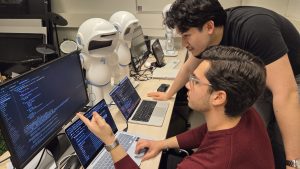
Asking AI for ready-made answers may feel efficient, but a growing body of research suggests it can come at a cost to how we think and learn. Research on “cognitive debt” -outsourcing of mental tasks- suggests that turning to AI for direct answers can lead to a shallow memory of facts but no real grasp of the underlying concepts. When using AI for research, we are effectively signaling to our brain that the information is disposable. However, one cannot deny the effectiveness and the usefulness of AI in research and education. So, the question isn’t whether to use AI, it’s how to use it well.
ATLAS: a tutor that asks instead of answering
University of Luxembourg Bachelor in Computer Science students Anthony Stassart and Hedi Tebourbi decided to tackle the problem by developing ATLAS (Adaptive Tutoring and Learning via AI Scaffolding), an Agentic Socratic Tutor. This AI chatbot refuses to give easy answers. When you ask a typical LLM a question, its single goal is to provide a predictive answer that satisfies your request with minimal effort on your part. When you ask the Socratic Tutor a question, it won’t give a direct answer and instead acts as a digital mentor that guides you toward the solution through dialogue.
This approach leverages the concept of “desirable difficulties”, which is the term for the mental effort your brain needs to actually remember what it learns. By forcing you to piece the answer together yourself, the tool ensures you build real understanding instead of just a shallow memory.
Beyond a single chatbot
The technical foundation of the Socratic Tutor is built upon utilising a Multi-Agent System (MAS) architecture. Instead of a single chatbot, specialised AI agents collaborate using structured knowledge graphs and Retrieval-Augmented Generation (RAG) over educator-provided course materials to guide learners through complex topics via targeted questioning. Such setup helps to ensure that the AI remains grounded in verified facts rather than relying solely on the probabilistic next-token prediction of Large Language Models (LLMs).
Bringing teachers back into the loop
Additionally, the project stands out by including “teacher-intervention loop” in the workflow .Students currently use AI extensively in academia, but teachers often cannot tell how or how much they use it, and neither side shares a common framework for its use. ATLAS, on the other hand, allows educators to oversee the AI agents, allowing them to steer the experience. Teachers feed the platform with their own course materials, which the system uses as grounded references to ensure that interactions remain anchored in verified content. Aggregated analytics provide an overview of classroom-level patterns, highlighting concepts that generate persistent difficulties, moments where dialogue tends to stall, or topics that may require further reinforcement. Rather than exposing individual conversation logs, this gives educators a steering mechanism without turning the system into a surveillance system.
ATLAS and tools like it could set a new standard for academic AI use: a shared space where teachers and students are aligned on how AI is being used for learning.
The project was originally born in a Natural Language Processing course under the guidance of Dr. Salima Lamsiyah. But Anthony and Hedi have a clear vision of the tool’s future and are planning to expand much further. Currently, they are preparing an application for the Education Innovation Fund (EIF) led by the Institute for Innovative Teaching and Learning (I²TL), with Prof. Leon Van der Torre serving as Principal Investigator and Dr. Salima Lamsiyah as Project Manager. On the technical side, they are working on a significantly more powerful knowledge graph, a refined teacher dashboard, and a much richer library of exercise types that goes well beyond Socratic dialogue.