

 Faculty of Science, Technology and Medicine
 Faculty of Law, Economics and Finance
 Faculty of Humanities, Education and Social Sciences
 Interdisciplinary Centre for Security, Reliability and Trust
 Luxembourg Centre for Systems Biomedicine
 Luxembourg Centre for Contemporary and Digital History
 Luxembourg Centre for European Law
 Luxembourg Centre for Socio-Environmental Systems
The modern workplace demands that our brains perform at their best every day. A campaign offers information and advice for work and daily life to help maintain a healthy mind and memory.
Are you mentally in top form, or are you unfocused and distracted? Keeping your brain healthy is worthwhile at any age. The performance of our brains is influenced by many habits. With this in mind, “GetBrainHealthy” is a project supported by the National Research Fund that aims to promote science to the general public. As part of International Brain Awareness Week occurring in mid-March, the project is launching a national campaign aimed at young adults and middle-aged people. At the University of Luxembourg, Dr Anja Leist, Professor of Public Health and the project’s initiator, and Dr Laure Pauly, the project lead, explain what everyone can do to support their brain health.
Some people manage to stay focused and maintain good mental health well into old age, whilst others quickly become distracted. Is this inevitable?
Anja Leist: No. Ten years ago, it was still widely believed in research circles that cognitive impairment and dementia were inevitable consequences of ageing. When the Lancet Commission on Dementia Prevention, Intervention and Care published its first report in 2017, it estimated the proportion of risk that can be influenced by lifestyle. It was found that the genetic risk was much lower than expected in comparison to the modifiable risk.
Recent research suggests that up to 45% of all cases of dementia could, at least in theory, be prevented by making changes to our lifestyle. Brain health is therefore not a random occurrence, but rather something we can build and maintain throughout our lives.
Are people aware of this?
Anja Leist: No. Surveys conducted in the UK and the US indicate that many people do worry about developing dementia at an older age, but remain unaware that brain conditions, such as strokes, can be related to lifestyle. This is precisely where our ‘Get Brain Healthy’ project plays a role. Our aim is to share knowledge that is easy to understand, to debunk common misconceptions and to encourage people, from a very young age, to take active steps to support their brain health, long before any problems arise. And there you have it: there’s huge interest, whether among young adults, working people, employers or local authorities. We’re preaching to the converted!
What are the main risk factors?
Anja Leist: There are currently 14 known modifiable risk factors. Vascular factors, in particular, are very well documented – that is, anything that damages the blood vessels: high blood pressure, high cholesterol, diabetes, overweight, smoking and alcohol. I would therefore always advise middle-aged or older people to have a health check-up with their GP. It is also proven that a lack of physical activity is a risk factor. However, all you need to do is follow the World Health Organisation’s recommendations, which advise two hours of moderate physical activity per week. There is no need to engage in intense sport: brisk walking is sufficient.
‟ What is bad for the heart is also bad for the brain.”
Research and Development Specialist
Laure Pauly: That might be the best way to remember it. Other modifiable risk factors include low levels of education, social isolation, or head injuries, for example when heading the ball in football, boxing matches, rugby matches, or falls from electric scooters. Hearing loss, which is affecting an increasing number of young people, is often underestimated. According to studies, around 38% of people with hearing loss are under 50. This is alarming.People who cannot hear well receive fewer auditory stimuli, which results in less mental stimulation, and they tend to withdraw socially. Hearing-impaired people also have to concentrate intensely to follow a conversation, which draws on additional resources in the brain.
But does the genetic risk still exist?
Laure Pauly: Yes, we cannot reverse the biological processes of ageing. But we can proactively take care of our brains, and it’s still worth doing! Think of it like wearing a car seatbelt: it doesn’t prevent an accident, but it protects against serious consequences. Dementia may develop later in life or progress more slowly with age.
So what should be done in mid-life to remain mentally healthy?
Laure Pauly: Our answer is B.R.A.I.N.P.O.W.E.R². This acronym summarises, in accessible language, the main scientifically proven factors affecting brain health. It covers all the areas where we can take action ourselves. Indeed, brain health is the result of countless everyday decisions. B.R.A.I.N.P.O.W.E.R. turns complex research into practical advice and is proof that it is possible to develop and maintain mental well-being throughout life.
*B.R.A.I.N.P.O.W.E.R. 2 – What strengthens the brain
| B for ‘physical activity’ |
| R for ‘regulating’ or ‘reducing’ salt, sugar and fat intake |
| A for ‘avoid’ alcohol and tobacco, as these substances promote inflammation and accelerate brain ageing |
| I for ‘interaction’, i.e. maintaining social relationships |
| N for ‘sufficient night-time sleep’, as lack of sleep significantly reduces cognitive abilities |
| P stands for preventing head injuries: wear a helmet when riding a scooter or cycling |
| O stands for protecting your ears and eyes |
| W stands for well-being and mental health |
| E stands for learning, education and lifelong learning |
| R stands for breathing clean air (air pollution) and reducing screen time |
Do you have three very concrete tips?
Laure Pauly: Those reading this interview are already following the first tip: never stop learning, stay curious! Research shows that intellectually stimulating activities, such as reading, learning new things or speaking more than one language, boost cognitive reserve and can provide long-term protection against cognitive decline.
If you’re sitting down right now, get moving, preferably straight away. Just a few minutes’ walk is enough to trigger a cascade of positive processes in the brain. Physical activity immediately improves concentration, mood and mental performance. In the long term, it helps the brain to age healthier.
Tip number three: breathe mindfully. Two or three deep, slow breaths, ideally in the fresh air, can reduce stress and improve focus. A brief moment with significant and immediately noticeable effects. The brain thanks us for it now and for the future!
‟ The brain is not capable of true multitasking. After every interruption, it takes about a minute to regain full concentration.”
Research and Development Specialist
What exactly is cognitive reserve?
Laure Pauly: You can compare it to a savings account. On the one hand, we build up our brain’s reserves by learning languages or cultivating social connections, for example. On the other hand, we spend from these reserves, for instance by spending too much time in front of a screen or by drinking alcohol. The balance at the end of the month should be positive.
What role does professional life play?
Anja Leist: Executives and managers are, on average, under greater cognitive strain than those who only perform tasks and bear no responsibility over staff. It has been proven that a sense of personal efficacy, control and responsibility slows cognitive decline in older people.
What if I have a routine job?
Laure Pauly: In that case, you can make up for the lack of stimulation through hobbies, travel, learning languages, volunteering or, above all, reading. A chapter a day keeps the doctor away!
Concentration suffers with certain constant streams of information. What happens in the brain?
Laure Pauly: We can picture the human brain as follows: the prefrontal cortex is the CEO, responsible for concentration, planning and self-control. The limbic system, on the other hand, is more like the ‘inner chimpanzee’: emotional, impulsive, always seeking novelty and immediate rewards. In the digital world, the CEO is constantly interrupted, whilst the chimpanzee is stimulated by ‘likes’ and messages. The result is distraction.
After each interruption, it takes the CEO about a minute to refocus fully on a task. So, when doing homework, at university or at work, it is best to turn off notifications and only enable those that are truly important.The CEO can then take back control. If we deprive the inner chimpanzee of stimulation for a while, for example by turning off notifications, the CEO can once again train and strengthen their ability to concentrate.
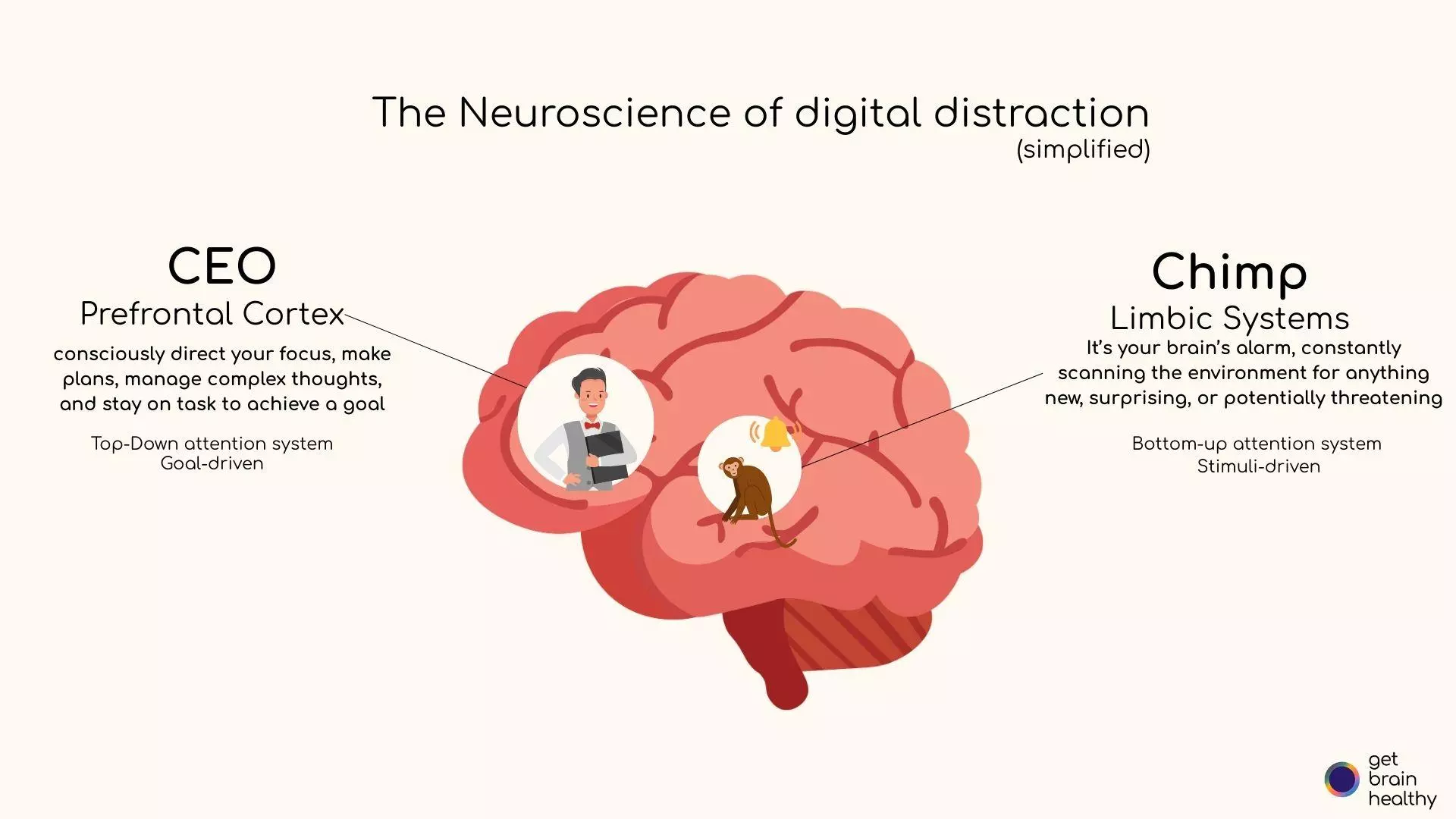
Figure 1: Illustration of the human brain and the concept of the CEO (prefrontal cortex) and the chimpanzee (limbic system). ©getbrainhealthy
So multitasking is not effective?
Laure Pauly: No. Over thousands of years, our brains adapted to survive in a world dominated by hunting, gathering and direct social interactions. But today, they have to cope with constant digital overstimulation. This rapid evolution has created a disconnect between our evolutionary makeup and the demands of modern daily life.
Every message interrupts our attention and forces the brain to constantly switch from one task to another. This is a constant switching of tasks, not multitasking, as the brain cannot focus on several things at once. It therefore becomes more and more difficult to stay focused for a long period. We become mentally more restless.
Can a digital detox help, and if so, how should it be tailored?
Laure Pauly: That’s the million-dollar question: the studies aren’t unanimous. Some studies show that taking deliberate breaks from digital media can improve mood and concentration, reduce stress and enhance social relationships for some people. One study even suggests that, in cases of heavy smartphone use, the brain reacts to withdrawal and stimuli in the same way as with other addictions.
Other studies, however, show no change, but rather negative effects, such as increased anxiety or the fear of missing out (FOMO). The effects depend on the intensity of digital exposure, the strictness of the digital detox and its duration. For some, short screen-free periods can be soothing, whilst for others, a complete digital detox can cause restlessness or FOMO.
There is no rule of thumb for determining the optimal time to spend offline. The key is to adopt a balanced approach to technology. Even short, regular breaks can help the brain to relax. Balance is more important than giving it up entirely.
To find out more, check out the trilingual blog ‘Brain-healthy guide to using technology wisely’.
With ‘GetBrainHealthy’, you are specifically targeting young people and those in the prime of their working lives. Why is that?
Laure Pauly: It is now particularly urgent to raise awareness of brain health as early as possible, as the number of brain disorders is constantly rising, at a time when we are expected to live longer and remain productive for longer. Our daily lives are filled with stress, a lack of physical activity and sleep, as well as digital overstimulation – all factors that take a toll on the brain in the long term. Preserving brain health enables each individual to remain independent for longer and promotes the well-being of society as a whole.
Anja Leist: We avoid talking about dementia, as it is not yet a topical issue for young adults. We talk about brain health, as young people can also benefit from a lifestyle that favours brain health. In our interconnected world, sharp critical thinking, effective problem-solving skills and sustained concentration are essential. The demands placed on the brain at school, university, in training or at work are greater than ever.
It is indeed difficult to change old habits. How can we truly change our behaviour in the long term?
Anja Leist: Behavioural research confirms that knowledge alone is not enough to break old habits. We all know that to be healthy, we need to eat well and exercise, but it is challenging to implement this in our daily lives. Researchers suggest that to achieve lasting behavioural changes, it is essential to define a specific goal, such as cycling, and then identify the obstacles preventing us from doing so, such as winter weather. The solution could be an indoor bike.
You then need to tie this good resolution into existing routines, for example doing 15 minutes of cycling or push-ups every morning, straight after brushing your teeth. It’s important to focus on just one change at a time. Only once this has become part of your routine should you tackle others.
So does that mean New Year’s resolutions to start exercising every day from today don’t work?
Anja Leist: Generally speaking, no. It’s easier for the mind and body to create the right conditions for routine activities than to consciously regulate one’s behaviour. For example, by placing your running shoes right next to the bed. Of course, it still takes some effort. It’s also helpful to associate the new activity with positive stimuli, such as going for a jog with friends or learning a language using digital apps.
Laure Pauly: Developing a new habit is like walking through a cornfield every day. The first time is a struggle but, at some point, the path becomes recognisable and a trail emerges. Brain research calls this neuroplasticity. This process is behind the way we process information, acquire new skills and form memories. Through repetition and association with positive feelings, our brain adapts.
And does this neuroplasticity still exist after the age of 50?
Laure Pauly: Absolutely. It is greater in children, but it remains with us throughout our lives. You can learn at any age!
How Get Brain Healthy’s content is created
We started with co-design sessions where we would sit down with people from industry, healthcare, academia, and students to identify their needs and interests. That allowed us to break down complex topics in brain health into something accessible. From there, we develop the content and bring in external experts. One of them is Melissa Chan, who trained at the Brain Health Institute in Dublin and has extensive experience working with health and care professionals. When it comes to implementation, we follow tried-and-tested science communication strategies: we use vivid analogies and metaphors – like the “path through a cornfield” image for neuroplasticity – and tailor the materials to each audience’s needs. Whether it’s nursing staff, businesses, or young people, every group comes with its own questions. Our job is to deliver evidence-based information in a way that’s clear, motivating, and immediately actionable.
Author: Britta Schlüter / Editors: Michèle Weber, Linda Wampach (FNR)