

 Faculty of Science, Technology and Medicine
 Faculty of Law, Economics and Finance
 Faculty of Humanities, Education and Social Sciences
 Interdisciplinary Centre for Security, Reliability and Trust
 Luxembourg Centre for Systems Biomedicine
 Luxembourg Centre for Contemporary and Digital History
 Luxembourg Centre for European Law
 Luxembourg Centre for Socio-Environmental Systems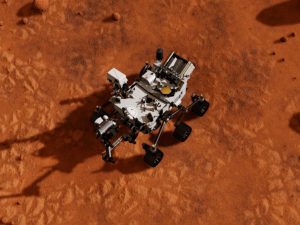
NASA has awarded an SnT Doctoral researcher at a competition for programming space robot operating systems.
Learning to learn rather than storing data – this is the original approach developed by Andrej Orsula. The Doctoral researcher from SnT at the University of Luxembourg is working to enable robots to learn by themselves to gain autonomy and efficiency during space missions. He won second prize last summer during the NASA space robot programming competition. His work explores how robots can be trained and tested in realistic simulated worlds, so that they can adapt to unfamiliar conditions rather than relying only on pre-defined data.
The challenges of space robots
With the NASA space robot programming competition, the agency aims to speed up research on space robot operating systems (Space ROS).
Space robots face a big challenge: they deal with very different weather and climate than we know. They work in isolated areas without important signals like GPS. Plus, there’s a delay in instructions because of the distance from ground control. In these conditions, autonomy becomes essential. Robots need to be able to make decisions locally, without waiting for constant input from humans.
To enable autonomy space robots need to be trained to respond to these novel environments they will find themselves in. Their missions will send them to places we have never been before, such as the Moon, Mars, or even an asteroid or another planet. Yet, exactly because these environments are novel we don’t have infinite data to train them with. That is why synthetic data is so useful, but currently even those datasets are limited.
A tri-dimensional solution
In Orsula’s project for the NASA space robot programming competition he addressed this challenge. His project, titled “Parallel ProcGen Environments”, combined three different AI training approaches:
1. Parallel: the ability to run thousands of simulations simultaneously. This allows researchers to scale up training and testing, exposing robots to many different scenarios in a short time.
2. ProcGen: Procedural generation creates synthetic data. This helps overcome the limits of available data for recreating a space environment. “Procedural generation offers a way to randomise data sets, so that we can simulate diverse scenes with infinite variation,” explains Orsula. “This is especially important for reinforcement learning, as it depends on millions of test-runs to train an AI model that runs a Space ROS.”
3. Environments: Robots can use this simulation to learn tasks. They experience the environment through a reward system that encourages positive behaviour. By exposing the robots to environments that are continuously varied, the robots learn skills that are useful even when conditions change.
By combining these three aspects Orsula was able to create a Space ROS approach that is robust and flexible.
A step towards space robots’ independence
Space and alien environments are mostly unknown and unpredictable. “This makes traditional control methods less appealing. They don’t work well in many cases,” says Orsula. To progress, space robots need to be able to learn about their environment independently of any controller on earth. That is why AI training tools, like the three Orsula combined, are critical. AI enables the robots to execute on their mission independently, opening-up new possibilities for space exploration.
For this particular NASA challenge Orsula created two examples, the Moon and Mars. He worked with a simulator called NVIDIA Isaac Sim to generate new environments quickly. Orsula’s approach automated the steps needed to bring assets into NVIDIA Issac Sim, making it possible to use this widely-used simulator in a more efficient way.
“I’m interested in research that combines robot learning with space robotics,” comments Orsula, who should finish his doctoral thesis on this theme this year. For him, this NASA award is a great chance to increase the visibility of his work.
Space robots have much to learn. They continue to explore and enrich research across many environments. By training robots in diverse simulated settings researchers can help them become more resilient, adaptable, and capable of operating independently during future missions.
About SpaceR
The Space Robotics research group (SpaceR) conducts research in autonomous planetary and orbital robotics for space exploration, in-situ resource utilisation and orbital servicing. In addition, the group also focuses on aerial and ground robotics and multi-robot cooperation.