

 Faculty of Science, Technology and Medicine
 Faculty of Law, Economics and Finance
 Faculty of Humanities, Education and Social Sciences
 Interdisciplinary Centre for Security, Reliability and Trust
 Luxembourg Centre for Systems Biomedicine
 Luxembourg Centre for Contemporary and Digital History
 Luxembourg Centre for European Law
 Luxembourg Centre for Socio-Environmental Systems
METIS Lecture Series
Please note that you will have to register individually for every session. Each partner has their own lecture registration page.
AI and Diagnostic Assistance

This lecture introduces students to the role of artificial intelligence in medical diagnostic assistance. It explores core AI concepts, including machine learning and pattern recognition, and demonstrates how these technologies support clinicians in interpreting medical data, identifying anomalies, and improving diagnostic accuracy.

26/03/2026 at 18h00
Prof. Christophe SCHOMMER
45 minutes
Emerging Technologies in Health Professionals’ Education

This lecture will examine the impact of emerging technologies on health professionals’ education. We will discuss the limitations of traditional training methods and explore how tools like simulations, virtual reality (VR) and artificial intelligence (AI) enhance learning experiences. The lecture will cover the benefits and challenges of these technologies and their potential to improve training outcomes and support continuous learning.

30/03/2026 at 09h15
Prof. Jaana-Maija KOIVISTO (University of Helsinki)
45 minutes
Dr. Jaana-Maija Koivisto is a respected scholar in health pedagogy and nursing science, emphasizing multidisciplinary research. She earned her Doctor of Philosophy degree from the University of Helsinki, focusing on advancing health care education and practice. Currently, Dr. Koivisto serves as the Programme Director in the Master’s Programme in the Development of Health Care Services at the University of Helsinki, Faculty of Medicine. She is also the Chief Nursing Officer for the Social Services, Health Care and Rescue Services Division of the City of Helsinki, working part-time. In addition, Dr. Koivisto is a Visiting Professor in Health and Wellbeing at Northumbria University, United Kingdom. She is a scholar of the Global Nursing Leadership Institute (GNLI)™ programme, organized by the International Council of Nurses. Her research focuses on health care education, particularly innovative educational strategies such as immersive learning environments and the latest advancements in AI-powered learning. Her interests span effective health care practices and the intersections of health and social work. Through her work, she contributes to best practices in nursing education and health care delivery playing a key role in shaping the future of interdisciplinary research and practice.
A Stroll Along AI

This talk will present the historical development of Artificial Intelligence, highlighting its major milestones. It will provide a clear definition of AI and outline the relationships between its principal subfields, including Machine Learning, Deep Learning, and Generative AI. Concrete examples will be explored, along with an examination of current challenges and risks associated with AI, followed by a perspective on future developments. The overall objective is to contribute to a clearer and more accessible understanding of the concept of AI.
01/04/2026 at 10h00
Prof. Christophe LEY
45 minutes
Where ethics meets the machine: ethics of AI and digitalisation in healthcare

A clinical risk score shapes a treatment decision. A monitoring device guides care throughout a hospital shift. These tools are trusted — but how well do we understand their limits, or whose needs they were designed for? As digital technologies move into hospitals, and health systems, the ethical questions they raise don’t fit neatly into existing frameworks. These are not just questions for doctors or engineers — they concern anyone who will one day sit as a patient in a waiting room, or live in a society where critical decisions are increasingly shaped by data and algorithms. This lecture is the first of three METIS lectures dedicated to the ethics of AI and digitalisation in healthcare. It brings together the foundational principles of medical ethics and the emerging ethics of technology to ask: what does it mean to design and use digital health tools responsibly? Using real cases as our entry point, we’ll develop a shared language for thinking critically about the technologies reshaping healthcare — and explore why ethical reflection needs to happen inside the design process, not after the fact. Several of the themes introduced here will be explored in greater depth in the lectures and the hands-on workshop to come.

02/04/2026 at 16h00
PD Dr. Nadia PRIMC
45 minutes
Virtual dissections in human anatomy teachings

This lecture will present a possible virtual approach to human anatomy teachings that both students and staff can employ to enhance the learning experience.

09/04/2026 at 16h00
Prof. Dr. Paola ALBERTI
45 minutes
Introduction to Cybersecurity Trends in Healthcare

This lecture introduces students to the growing importance of cybersecurity in healthcare. It highlights how cybersecurity risks evolve alongside the digitalization of hospitals and health systems, and it outlines the most common cybersecurity risks currently affecting healthcare organizations. The session further emphasizes the role future clinicians will play in protecting patient data and fostering a culture of cybersecurity awareness within clinical environments.
14/04/2026 at 13h00
Associate Prof. Elina Niemimaa
45 minutes
Dr. Elina Niemimaa is a scholar of cybersecurity leadership and organizational cybersecurity practice. She earned her Doctor of Technology degree from Tampere University of Technology, where her research examined how organizations develop cybersecurity policies and translate them into everyday practice. Dr. Niemimaa currently serves as an associate professor of information systems at the University of Agder, Norway. Her research focuses on cybersecurity management practices and the related organizational change.
Gamification approach in human anatomy teachings
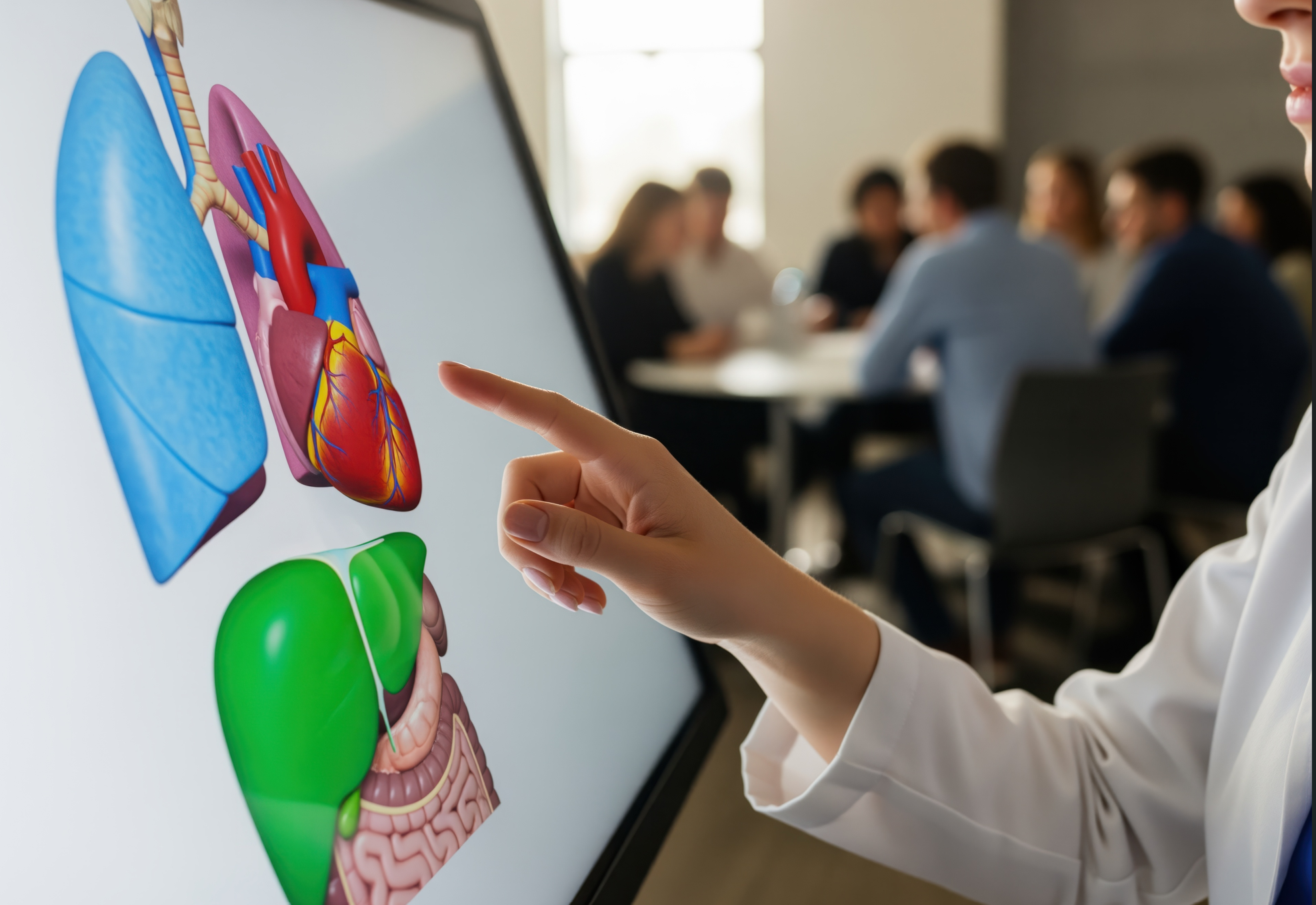
This lecture will provide a possible exploitation of virtual dissections in human anatomy teachings embedding gamification into the didactive activities.
15/04/2026 at 16h00
Prof. Dr. Paola ALBERTI
45 minutes
The patient in the loop: autonomy, privacy and responsibility in digital healthcare

Digital health technologies are reshaping the relationship between patients, clinicians, and the systems they navigate — in ways that existing frameworks of consent, trust, and accountability struggle to keep pace with. This lecture examines, from an ethical perspective, what digital health technologies do to the individual patient-clinician relationship, through four interconnected lenses. First, the black-box problem: when the reasoning behind a clinical AI tool is opaque, what does meaningful informed consent even look like? Second, automation bias — the tendency to defer to algorithmic outputs — and what it means for both clinical judgment and patient agency. Third, the responsibility gap: when opacity and automation bias combine and something goes wrong, who is accountable — the developer, the hospital, the clinician? And why is this not simply a legal question? Fourth, privacy and data: where health data comes from, who owns it, and what consent realistically means when individual records feed into population-scale models, raising difficult questions about the tension between personal privacy and collective benefit.
20/04/2026 at 17h00
PD Dr. Nadia PRIMC
45 minutes
Mobilising citizen science in support of health research and health services provision

This lecture explores how citizen science can support health research and improve health service delivery by engaging patients and citizens in data collection, knowledge production, and community-based research. It highlights practical examples where participatory approaches contribute to more inclusive and responsive health systems.

23/04/2026 at 13h00
Anna Berti SUMAN (PhD)
45 minutes
Medical Education in the Age of ICT and AI: Rethinking Learning and Teaching Beyond Directed Instruction

Information and Communication Technology (ICT), and especially Artificial intelligence (AI), fundamentally changes the conditions under which learning and teaching in higher education take place. When access to information, explanations, and procedural guidance becomes instantly available, traditional models of directed instruction centered on knowledge transmission lose much of their educational rationale. This transformation is particularly consequential for medical and health sciences education, where professional competence depends not only on knowledge acquisition but on clinical reasoning, ethical judgment, collaboration, and adaptive expertise. This keynote examines how ICT, and specifically AI, reshapes learning environments, student practices, and academic expectations in higher education. Drawing on socio-constructivist perspectives on learning and teaching, the talk argues that the central task of medical education is shifting from teaching students what to know toward designing learning environments in which students learn how to think, interpret, decide, and act under uncertainty.
27/04/2026 at 17h00
Prof. Robert REUTER
45 minutes
Who Benefits? Justice, discrimination, and better health outcomes in digital healthcare

Who benefits from digital health technologies and who risks being left behind? This lecture examines, from an ethical perspective, the systemic and societal consequences of AI and digitalisation in healthcare. It approaches these questions through four interconnected lenses. First, bias in training data: most large health datasets come from a small number of countries and populations, meaning that the inequities of the past get quietly encoded into the systems of the future. Second, digital divides and unequal access: the promise of AI to improve health outcomes is real, but so is the risk that it widens existing disparities — between social groups, between regions, and between high-income and low-and-middle-income countries. Third, the tension between accuracy and fairness: a system optimised for overall performance may systematically underperform for underrepresented groups — and deciding which tradeoff is acceptable is not a technical question but an ethical one. Fourth, the regulatory landscape: what tools currently exist to govern these challenges — from the EU AI Act and FDA guidance to the WHO ethics guidelines. Taken together, these themes point to a central argument: ethical AI in healthcare is not only a technical or clinical problem, but a structural and political one, shaped by who has the power to build these systems, whose data they are built on, and whose needs they are designed to serve.
04/05/2026 at 17h00
PD Dr. Nadia PRIMC
45 minutes
Immersive Surgical Edu

The surgical education learning process significantly relies on hands-on experience and the development of tactile abilities. Access to surgical training, however, is limited, and typical teaching techniques may not give the essential experience to acquire these abilities. Immersive technologies, including VR and AR, offer the potential to improve surgical training by allowing learners to practice and perfect their abilities in a safe and controlled setting. Haptic feedback may allow students to experience a realistic simulation of surgical operations by giving them with a feeling of touch, helping them to gain the essential motor skills and confidence in real-world surgical scenarios. Immersive learning may also be utilised in surgical education to address ethical issues. The main goal of this project is to design, build, and test a haptic-enabled immersive tool for surgical education. These tools will integrate cutting-edge VR and AR capabilities with wearable haptic devices, giving students a realistic and immersive learning experience in a safe and controlled setting, resulting in enhanced learning outcomes and patient care.
05/05/2026 at 11h00
Prof. Filippo Sanfilippo
45 minutes
Filippo Sanfilippo holds a PhD in Engineering Cybernetics from the Norwegian University of Science and Technology(NTNU), Norway. He is a Professor at the Faculty of Engineering and Science, University of Agder(UiA), Norway, and heads the Artificial Intelligence, Biomechatronics, and Collaborative Robotics research group. His research focuses on Human-Robot Teaming(HRT). He is an IEEE Senior Member, former Chair of the IEEE Norway Section, and current Chair of the IEEE Robotics and Automation, Control Systems, and Intelligent Transportation Systems Joint Chapter. He serves on several IEEE Region 8 committees and leads the Norway Section Life Members Affinity Group. He has published widely in leading journals and conferences and serves as a reviewer for international publications.
Peer-to-peer tutoring activities in human anatomy with virtual tools and flipped classroom approaches

This lecture will provide a possible exploitation of virtual dissections in human anatomy teachings, empowering students making them the protagonist of the learning process via actions such as peer-to-peer tutoring and flipped classroom.
06/05/2026 at 16h00
Prof. Dr. Paola ALBERTI
45 minutes
The “personalization from below” paradigm: citizen science-based data altruism practices to rethink health services and personalization.

This lecture introduces the concept of “personalization from below”, examining how citizen-driven data sharing and data altruism initiatives can reshape personalized healthcare. It discusses how patient communities and citizen science practices challenge traditional top-down models of health data governance.
13/05/2026 at 13h00
Anna Berti SUMAN (PhD)
45 minutes
Medical citizen science: From data awareness to advocacy

This lecture examines the evolving role of citizens in medical research, from developing awareness and literacy around health data to actively advocating for research priorities and policy change. It highlights how citizen participation can strengthen transparency, accountability, and patient-centered innovation in healthcare.
05/06/2026 at 17h00
Stefania OIKONOMOU
45 minutes
Hands-on Workshop Series
Leveraging AI Agents to Simulate Your Interaction with Patients

Do you find it challenging to start a meaningful conversation with patients? Do you wish it would be possible to practice this interaction early in your study? In this session, we will learn how to use AI Agents to simulate your interaction with patients. The purpose is to practice how to start a meaningful patient-centered conversation while respecting ethics and social responsibility. No prior knowledge or technical skill is required.
19/05/2026 at 10h00
Prof. Leona CHANDRA KRUSE, Associate Prof. Sofie WASS
90 minutes
Citizen science-based data altruism practices to rethink health services and personalization.

This workshop investigates how citizen science and data altruism can enable more participatory and transparent health data ecosystems. Participants will co-design practical pathways toward improved personalization and citizen-driven health services.
27/05/2026 at 13h00
Anna Berti SUMAN (PhD)
Intelligent Assistant for Student Inquiry Support (IASIS)

IASIS (Intelligent Assistant for Student Inquiry Support) is an educational innovation designed to enhance the learning experience of undergraduate medical students through the integration of Generative AI (GenAI). It addresses the challenge of limited personalised academic support by offering an in-house, open-source GenAI tool that provides accurate, context-aware responses to student questions based on course materials.
28/05/2026 at 15h00
Alfredo CAPOZUCCA, Maria PAVLOU
A principle-based approach to the ethical evaluation of digital and AI-based healthcare applications

Digital health technologies raise profound ethical questions — but how do you actually go about evaluating them in a structured and reflected way? This hands-on workshop introduces a principle-based approach to the ethical evaluation of digital and AI-based healthcare applications. The approach guides participants through different steps of ethical analysis: identifying who is affected by a technology, mapping what is ethically at stake for each stakeholder, and reasoning through how competing interests should be balanced. The approach is designed as a reusable tool — for students encountering a new digital health technology, for clinicians navigating decisions about AI-assisted care, and for educators looking for a structured way of teaching ethics in digital health contexts.
29/05/2026 at 16h00
PD Dr. Nadia PRIMC
Virtual dissection tool for anatomy learning

This hands-on session will simulate how virtual tools can be beneficial in human anatomy teachings, exploiting a live virtual dissection.