

 Faculty of Science, Technology and Medicine
 Faculty of Law, Economics and Finance
 Faculty of Humanities, Education and Social Sciences
 Interdisciplinary Centre for Security, Reliability and Trust
 Luxembourg Centre for Systems Biomedicine
 Luxembourg Centre for Contemporary and Digital History
 Luxembourg Centre for European Law
 Luxembourg Centre for Socio-Environmental Systems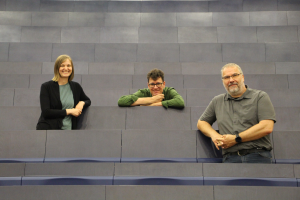
For the general public, the world of scientific research can often feel elitist, defined by complex jargon, complicated formulas and countless references to other works. When science is inaccessible, it creates a void where misinformation spreads.
To actively fight this problem, the Doctoral Education in Science Communication (DESCOM) project at the University of Luxembourg is training the next generation of researchers to speak a language everyone can understand. Founded by Professor Serge Haan and Oliver Glassl, and managed by Nicole Paschek, the initiative is built on the reality that scientists are not natural born communicators and need training to turn complex theories into understandable ones.
Training the next generation of communicators
The project aims to provide researchers with the essential tools to engage with the public and policy makers. This includes everything from specialised courses and professional internships to high-energy Science Slams and entertaining science comics. The impact of this training is designed to be long-lasting: by equipping doctoral candidates with these skills early on, the project ensures they can effectively communicate the value of their work throughout their entire careers.
‟ Science communication is a skill that you need to learn, and in order to learn that skill, you need to have opportunities to practise it. Our approach is truly hands-on; we provide the ‘how-to’ instructions at the start and then ‘let them loose’ to try out their new skills in the real world where communication actually happens.”
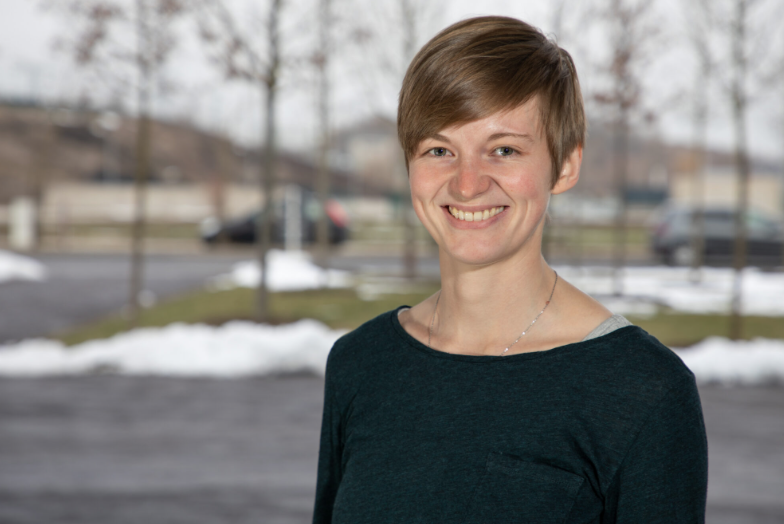
Project Officer
From local initiative to international recognition
What began as a local initiative in Luxembourg has grown into an internationally recognised best-practice example for training the next generation of scientists, particularly those taking their first steps in outreach. In 2023, DESCOM was invited to present at the European University Association’s Council for Doctoral Education as a leading model for science communication training. This global reputation is further cemented by the success of the Open Access handbook, “50 Essentials on Science Communication.” In a forward-thinking move, the authors even included a “not entirely serious” 51st chapter written by ChatGPT to prompt critical reflection on the role of generative AI in the field.
One of DESCOM’s most popular projects is its series of science comics, which have reached a massive audience with over 56,000 copies distributed to date. They are available in English, German, French, Luxembourgish and Portuguese, ensuring that the University’s research is accessible to both the diverse population of Luxembourg and an international audience alike. A surprising “side effect” has been that these comics are also reportedly being used by readers to learn and practice new languages.
‟ With this project, we want to show that science communication isn’t just a ‘nice add-on’; it is actually a fundamental part of a scientist’s work.”
Currently, the team is working to integrate science communication trainings into potentially the entire academic career, expanding from doctoral candidates to Bachelor’s and Master’s students as well as to PostDocs.
DESCOM is supported by the Luxembourg National Research Fund (FNR), the Faculty of Science, Technology and Medicine (FSTM) and the André Losch Fondation. Training offers are also supported by the Doctoral School in Science and Engineering (DSSE) as well as the Doctoral School in Humanities and Social Sciences (DSHSS).