

 Faculty of Science, Technology and Medicine
 Faculty of Law, Economics and Finance
 Faculty of Humanities, Education and Social Sciences
 Interdisciplinary Centre for Security, Reliability and Trust
 Luxembourg Centre for Systems Biomedicine
 Luxembourg Centre for Contemporary and Digital History
 Luxembourg Centre for European Law
 Luxembourg Centre for Socio-Environmental Systems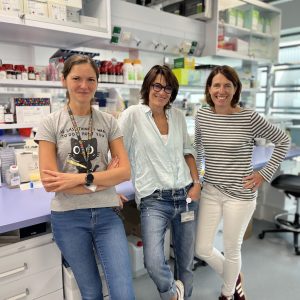
From left to right: Dr Joanna Wroblewska, Prof. Stephanie Kreis, Dr. Christiane Margue. Dr. Sabrina Bréchard -not in the picture- is working on calcium signaling.
Melanoma, a serious form of skin cancer, poses a significant global health challenge. In 2024 alone, an estimated 330,000 people were diagnosed worldwide, and 60,000 died from the disease. With incidence rates rising due to factors like increased UV exposure, the World Health Organization projects the number of patients could reach half a million per year by 2040.
The problem of drug resistance
While major therapeutic breakthroughs like targeted therapy and immunotherapy have been developed over the last 15 years—many pioneered through melanoma research, a critical hurdle remains: drug resistance. Patients often show amazing initial responses to treatment, with tumors shrinking, only for the cancer to return months later, stronger and resistant to the drugs. At the University of Luxembourg, Professor for Molecular Biology Stephanie Kreis and her research group are tackling this problem head-on. As co-head of the Signal Transduction Research Group, Professor Kreis’ work has increasingly focused on developing innovative models to understand and overcome drug resistance, ultimately aiming to provide better treatments for patients.
Gaps in current treatments
Modern melanoma treatments face two key issues. First, highly effective targeted therapies are only available for about 50% of patients who have specific genetic mutations, like the BRAF mutation. The other half, including those with NRAS mutations or “wild-type” melanomas, lack these specialised options. Second, even for the patients who can receive these targeted therapies, the cancer cells adapt and learn to work around the drugs, becoming resistant. This rapid development of resistance is a major clinical problem, leaving doctors with limited second- and third-line treatment options beyond standard chemotherapy, which has severe side effects and is not a cure.
‟ Our main goal is to develop treatments that are much better than standard chemotherapy—more targeted, with fewer side effects, and capable of truly prolonging life with quality of life.”
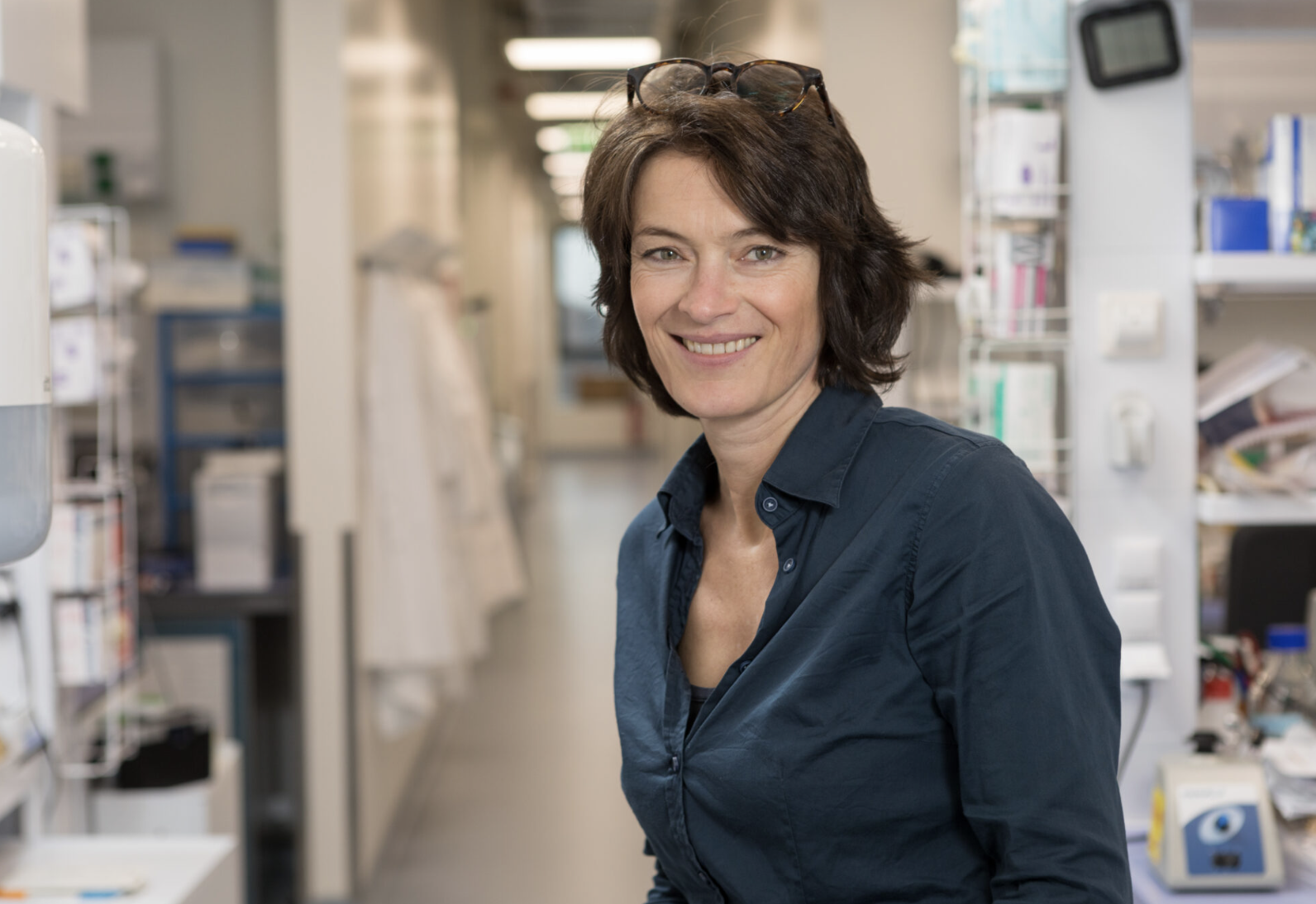
Professor for Molecular Biology and Chief scientist 2
3D tumor models: a closer look at cancer
To address this, Prof. Kreis and her research team have spent years developing innovative 3D models that more accurately mimic the complex environment of a real tumor. These sophisticated “spheroids” are created by growing different cell types found in a patient’s tumor; melanoma cells, immune cells, fibroblasts, and endothelial cells, together in a three-dimensional structure. This advanced platform allows for large-scale drug screening. In a recently conducted study, Prof. Kreis’ team tested over 1,200 drugs on 3D models based on melanoma cells. This approach led to an important breakthrough: the identification of two new, promising drugs for NRAS-mutated melanoma, a subtype for which no targeted therapies currently exist.
The team further validated these findings using a novel zebrafish model. By injecting fluorescent red melanoma cells into tiny zebrafish larvae and then administering the drugs, they could visually track the tumor’s response. The results were striking: within just three days, the tumors almost completely disappeared. This zebrafish model is not only effective but also aligns with a global trend to reduce reliance on traditional animal experiments for ethical and scientific reasons.
Beyond finding new drugs, Prof. Kreis’s team is investigating the fundamental mechanisms of resistance, asking how it “travels” from the first resistant cell to the entire tumor. The researchers are exploring two novel areas: extracellular vesicles, which are suspected of transporting molecules that “communicate” drug resistance between cells, and calcium signaling. The team has made a new finding that manipulating calcium signaling in melanoma cells changes their response to drugs; a brand-new avenue of research that could unlock new ways to make treatments more effective.The ultimate goal is to delay the onset of resistance from months to years, transforming melanoma into a manageable chronic illness and significantly extending patients’ lives with good quality of life.
‟ It’s unrealistic to prevent drug resistance; cancer cells will almost always be faster than us. The real goal is to become much better at delaying it. If we can turn nine months into a good five years, I would be happy with our achievements.”
This research is supported by Fondation Rosborg under the aegis of the Fondation du Luxembourg and FNR PRIDE programme CanBio2 and NextImmune2.