

 Faculty of Science, Technology and Medicine
 Faculty of Law, Economics and Finance
 Faculty of Humanities, Education and Social Sciences
 Interdisciplinary Centre for Security, Reliability and Trust
 Luxembourg Centre for Systems Biomedicine
 Luxembourg Centre for Contemporary and Digital History
 Luxembourg Centre for European Law
 Luxembourg Centre for Socio-Environmental Systems
Resource Efficient Steel – recycled aggregate concrete – timber Hybrid Slim Floor Systems (ReStart)
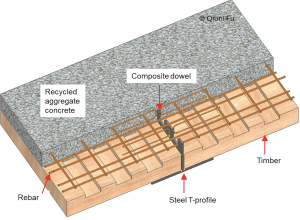
ReStart develops an eco-friendly floor system that combines steel, RAC, and timber, aiming to reduce material use, minimise waste, and lower carbon emissions.
The project at a glance
-
Start date:01 Jan 2026
-
Duration in months:30
-
Funding:Fonds National de la Recherche (FNR), CORE (Junior)
-
Principal Investigator(s):Qiuni FU
About
The construction industry is a major contributor to global resource consumption and CO₂ emissions, making it a prime target for circular economy strategies. This project, ReStart, introduces a novel hybrid slim floor system integrating steel, recycled aggregate concrete (RAC), and timber to enhance resource efficiency and reduce carbon emissions. The system utilizes puzzle-shaped composite dowels to connect RAC slabs with steel beams and incorporates timber as both permanent formwork and part of timber-concrete composite slabs. The overarching aim is to enable a reliable and cost-effective nonlinear design of slim composite beams using RAC, with particular attention to time-dependent effects due to creep and shrinkage. The research is structured into three main objectives: (1) characterizing the shear behaviour of steel-RAC composite dowels and developing a mechanics-based resistance model; (2) investigating the impacts of RAC creep on dowel performance and ultimate shear resistance under varying stress levels and loading sequences; and (3) assessing the strain-limited plastic resistance of composite beams using steel-RAC composite dowels at the cross-section and member levels, considering the influence of compact cross-sections with a steel T-profile and long-term effects. The project will deliver new knowledge and analytical tools — including a shear resistance model for steel-RAC composite dowels, reduction factor for long-term effects, a moment reduction factor at the cross-section level — along with design recommendations for strain-limited plastic (nonlinear) design of composite beams using composite dowels.
Organisation and Partners
- Department of Engineering
- Faculty of Science, Technology and Medicine (FSTM)
- Structural Engineering & Composite Structures (SECS)

Project team
-
Qiuni FU
-
Markus SCHÄFER