

 Faculty of Science, Technology and Medicine
 Faculty of Law, Economics and Finance
 Faculty of Humanities, Education and Social Sciences
 Interdisciplinary Centre for Security, Reliability and Trust
 Luxembourg Centre for Systems Biomedicine
 Luxembourg Centre for Contemporary and Digital History
 Luxembourg Centre for European Law
 Luxembourg Centre for Socio-Environmental Systems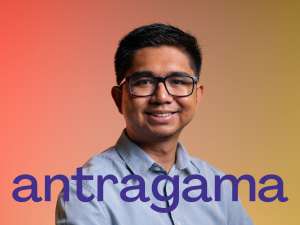
‟ Our understanding of truth is shaped by society and personal experience. So what we see as truth can differ from person to person. ”
Meet Antra Abbas, a researcher from Indonesia who bridges the worlds of business and technology at SnT. With a PhD in information systems, his interest in data began with a curiosity sparked by his teenage love of video games. Today, Antra explores how data marketplaces could transform the way organisations share information. His research addresses crucial questions about privacy, data sovereignty, and innovation. It also reflects a unique perspective shaped by one of the world’s most diverse countries – Indonesia. For Antra, truth isn’t binary: what works in one cultural context may need complete rethinking in another.
Relive the conversation – transcript below!
Tell us about your background and how you ended up in Luxembourg?
I’m from Indonesia, specifically from Banjarmasin in South Kalimantan. I’ve been in Luxembourg for 18 months now. I got my PhD in information systems from Delft University of Technology in the Netherlands in September 2024. Previously, I completed my Master’s at the University of Sussex in Brighton, United Kingdom, also in information systems.
What is your research about in simple times?
I’m driven by the desire to understand how data and artificial intelligence can be combined and designed to make organisations work better. Currently, I’m investigating data marketplaces: Think of them as Amazon or eBay exchanging data products between organisations. I’m interested in whether there are viable business models for such marketplaces and what societal concerns might emerge when organisations engage in them.
What’s one key societal concern your research addresses?
Data sovereignty. Imagine you’re an organisation sharing your data with another organisation: You might lose control over your data, right? The question is: what technology can prevent you from losing that sovereignty?
What inspired you to pursue tech research?
I liked playing video games during my teenage years. I was curious why developers could develop such high-quality games in terms of narratives, storytelling, performance, and graphic design. It was so cool. I knew back then that I would want to focus on IT tech.
What’s a surprising skill you developed as a researcher?
During my PhD, especially during coffee breaks in 2021-2022, I found unexpected enjoyment in washing my dishes. After a long day of research, it turned out to be quite an enjoyable activity. Cleaning up my dishes also helped me clean up my mind. I would never have expected that!
‟ Cleaning up my dishes also helped me clean up my mind. I would never have expected that!”
Who is your role model in research?
My doctoral supervisors, Mark and Anneke. They really showed me that you could do high-quality research without necessarily giving up your personal life. They taught me that “slow science” also works. As a researcher, publications matter, but these supervisors taught me you cannot just publish everywhere; it’s a matter of priority. You need to prioritise quality and balance.
‟ As a researcher, publications matter, but these supervisors taught me you cannot just publish everywhere; it’s a matter of priority. You need to prioritise quality and balance.”
How does your background influence your research approach?
I was born and raised in Indonesia, one of the most diverse countries in the world, and I really appreciate diverse perspectives. This influenced how I interpret my research; I became more sensitive about it. For example, one business model might work in the European context, but it definitely needs rethinking in the Southeast Asian context. I believe that truth depends on people’s perspectives and social context, so it can be different for different individuals.
Can you give an example of how context shapes research findings?
Take privacy in personal data marketplaces: in the European context, privacy concerns could be very sensitive and even a deal breaker that prevents marketplaces from existing. But in other contexts, like Southeast Asia, there may be different judgments or sensitivity toward privacy. It’s quite interesting that one truth in one context could be interpreted differently in another context.
What’s a common misconception about your field?
People think Information Systems is equal to information technology or computer science. Yes, it shares some elements, but Information Systems is not 100% the same. We take a sociotechnical perspective. We care about tech, math, and code, but we also consider how people perceive whether this technology is useful or not. We can think of it as a bridge between business research and tech research. That’s why we have people with business backgrounds, law people, computer scientists – everyone. This diversity generates innovation.
Supported by the Luxembourg National Research Fund.