Faculty of Science, Technology and Medicine
 Faculty of Law, Economics and Finance
 Faculty of Humanities, Education and Social Sciences
 Interdisciplinary Centre for Security, Reliability and Trust
 Luxembourg Centre for Systems Biomedicine
 Luxembourg Centre for Contemporary and Digital History
 Luxembourg Centre for European Law
 Luxembourg Centre for Socio-Environmental Systems
Rogue drones are bringing chaos to airspace. In a recent case in Belgium, air traffic controllers scrambled to respond as an unauthorised aircraft threatened commercial flights and emergency services. The incident exposed a serious problem: it only takes one drone to disrupt an entire system.
But what happens when dozens or even hundreds of drones work together?
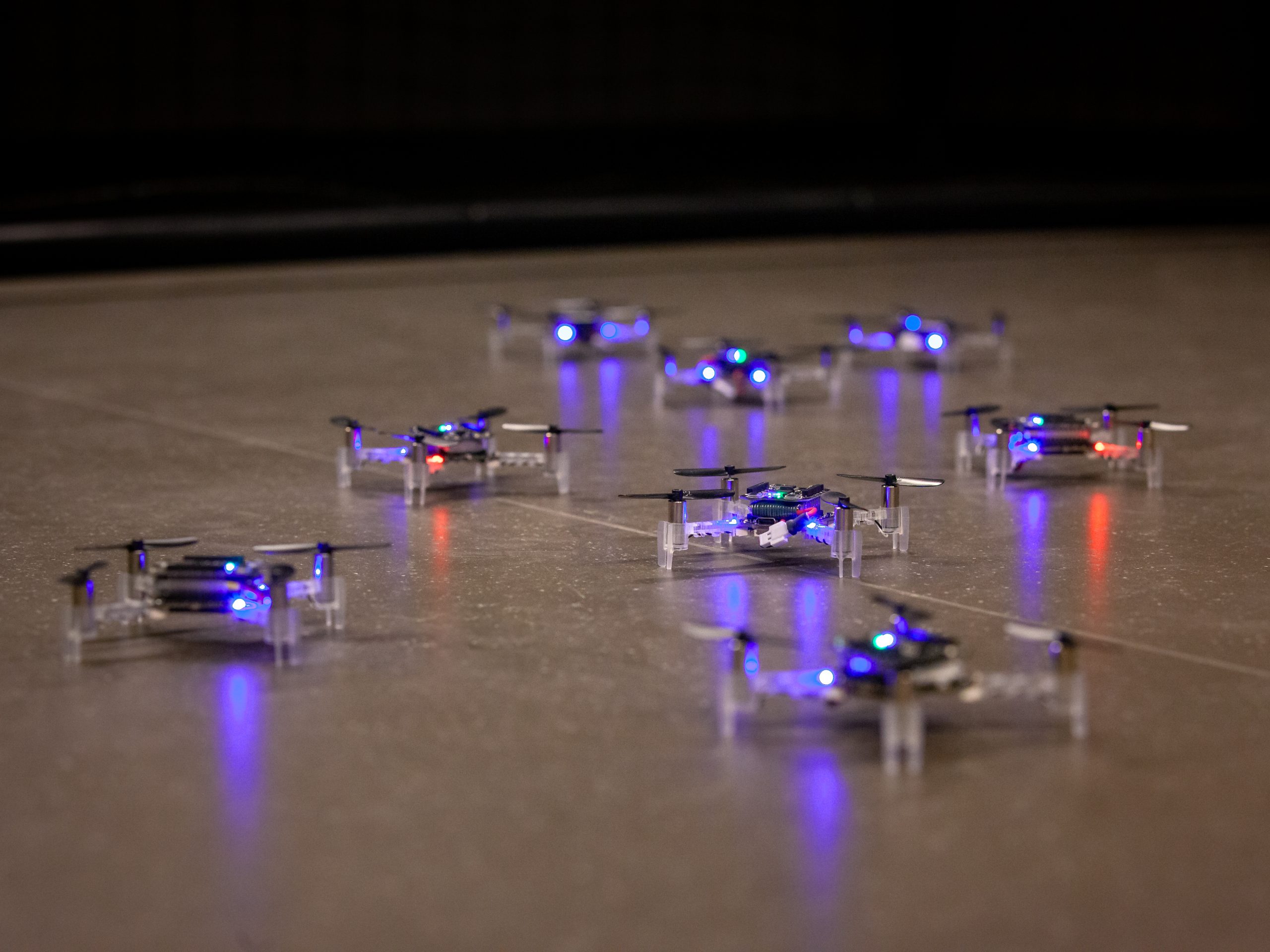
PCOG drone swarm on the floor in their lab
Researchers at the Parallel Computing and Optimisation Group (PCOG) are tackling this exact challenge. As drone intrusions become more sophisticated, the team is developing artificial intelligence methods that enable coordinated drone swarms to respond to complex aerial threats. They teach drones how to work as a team through advancing multi-objective reinforcement learning (MORL) by drawing on concepts from multi-objective optimisation. The goal is to support systems that can assist human operators in intercepting, containing, and escorting hostile drones away from sensitive areas.
Training drone swarms to act as a team
Current drone defense systems focus on stopping a single intruder. Once the drone appears, the system tracks it, identifies it, and neutralises it. But coordinated drone swarms are different. Multiple drones can split up, regroup, and change their strategy in real time. Stopping them requires defenders that can do the same.
This is where reinforcement learning helps. Reinforcement learning trains decision-making models by letting them try actions and learn from the results in a simulated environment. “By applying this approach to drone swarms, our team improves swarm coordination by running large numbers of simulated missions,” said Dr. Grégoire Danoy, head of the PCOG research group. Every simulation provides feedback on what worked and what didn’t, allowing swarm behaviours to be refined before they are used in real-world experiments.
The technology works like training a dog, but here it’s applied to drones at massive scale and entirely in simulation. In early test runs, drones tend to cluster together and leave gaps in coverage. The AI gets a low performance score. As training continues, feedback helps drones move and work together more efficiently, which results in a better score for the AI. After millions of simulated practice runs, the swarm learns to maintain good coordination, adapt to failure, and respond to threats without the drones getting in each other’s way.
The challenge grows when drones need to balance competing goals at once. A surveillance drone might need to maximise area coverage while conserving battery power and staying in contact with the swarm. Traditional reinforcement learning often turns all goals into one score, which makes it harder for the system to balance goals that conflict with each other. Within the PCOG research team, Dr. Florian Felten explored how combining multi-objective optimisation with reinforcement learning could help drone swarms handle the competing needs that arise during flight.
How one PhD project redefined what drone swarms can learn
Felten carried out his doctoral research within the FNR-funded ADARS project (Automated Design of Autonomous Robot Swarms) led by Danoy, to explore how artificial intelligence can support the automated design and coordination of drone swarms.
Felten focused on a central challenge: how could drone swarms learn to cooperate more effectively while balancing competing objectives?
His work improved multi-objective reinforcement learning by helping AI systems think more clearly about trade-offs like safety, energy use, and mission performance. Instead of condensing everything into a single score, Felten’s approach helped learning systems understand how choices affect different goals.
This work led to several high-impact scientific publications, including papers in the Journal of Artificial Intelligence Research and NeurIPS, and to the development of an open-source simulation environment for MORL used worldwide.
In October 2025, he won the Outstanding PhD Thesis Award from the Luxembourg National Research Fund (FNR).
‟ While large language models currently receive much public attention, reinforcement learning plays a crucial role when AI systems must control real robots and help automate complex systems”

Former SnT Doctoral Candidate, now at ETH Zurich
From theory to protecting our skies
Felten has completed his PhD, but the research on swarm-based airspace protection and counter-drone systems continues in the PCOG research group. Building on their recent work, the team is now developing AI-based systems that will ultimately help authorities respond quickly and safely to aerial threats. This involves intercepting, containing, and escorting drones away from sensitive areas. As in earlier projects, the team first evaluates new approaches extensively in simulation before validating them in the SwarmLab – a controlled indoor environment where small drones practice the behaviour they learned virtually. This is a unique training space that only exists in a handful of locations in the greater region.
Looking ahead, the team will continue exploring swarm-versus-swarm defense. “Our goal is to create a strong defensive tool that can handle complicated airborne threats while keeping people and infrastructure safe,” said Danoy. One promising direction is enabling drones to continue learning during missions, adapting to new situations instead of relying only on pre-programmed responses.
‟ “Our goal is to create a strong defensive tool that can handle complicated airborne threats while keeping people and infrastructure safe.”
Head of PCOG Research Group
The research connects to broader efforts in Luxembourg’s broader cyberdefence, as autonomous drones are cyber-physical systems where resilience is just as important as flight skills.
Through SnT’s participation in the Cyber Research Hub with the Directorate of Defense, researchers tackle this intersection of robotics and cybersecurity.