

 Faculty of Science, Technology and Medicine
 Faculty of Law, Economics and Finance
 Faculty of Humanities, Education and Social Sciences
 Interdisciplinary Centre for Security, Reliability and Trust
 Luxembourg Centre for Systems Biomedicine
 Luxembourg Centre for Contemporary and Digital History
 Luxembourg Centre for European Law
 Luxembourg Centre for Socio-Environmental Systems
Resource Management in Satellite Communications with Dynamic Topologies: Machine Learning Algorithms for Variable Input-Output Dimensions (ReadyVioSat)
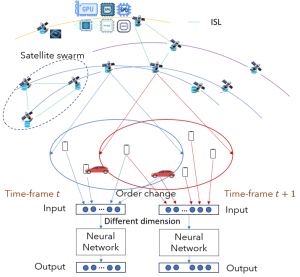
As satellite networks become increasingly dynamic and complex, traditional optimisation approaches struggle to keep pace. This project develops advanced machine learning models designed specifically for these evolving environments, enabling networks to adapt to changing conditions while maintaining performance and reliability. The research focuses on creating solutions that are feasible to deploy, adaptable across scenarios, and generalisable to future satellite network architectures.
The project at a glance
-
Start date:01 Jun 2026
-
Duration in months:36
-
Funding:FNR – CORE
-
Principal Investigator(s):Ti Ti NGUYEN
About
Satellite technology is undergoing a significant transformation, with advancements set to redefine global connectivity. The growing shift toward low Earth orbit (LEO) and very low Earth orbit (VLEO) satellites, alongside the surge in small satellites and multi-orbit networks, presents several challenges. Managing network resources efficiently is more critical than ever to ensure the reliability and sustainability of satellite communications. Traditional resource management methods are often limited in adapting to the dynamic changes in both time and space of today’s satellite environments, when they are designed for static or slow-changing networks. While machine learning (ML) techniques have been introduced to tackle resource allocation problems, many current models are constrained by the assumption that training and inference inputs share the same structure, limiting their adaptability to dynamically changing network conditions. This project, Resource Management in Satellite Communications with Dynamic Topologies: Machine Learning Algorithms for Variable Input-Output Dimensions (ReadyVioSat), aims to address this gap. Its goal is to design adaptive ML models capable of handling dynamic network topologies, where the number and arrangement of nodes may vary over time, without needing to retrain the model from scratch. A key focus of the project is leveraging permutation equivariance (PE) and permutation invariance (PI) to design scalable ML models. However, simply enforcing PI/PE properties is not sufficient to ensure that these models will generalize across networks of varying sizes. To bridge this gap, the project will introduce a comprehensive framework that links PI/PE theory to practical scalability. Beyond scalability, ReadyVioSat will explore key aspects such as feasibility, adaptability, and generalization. It will combine machine learning with optimization strategies, unify graph neural networks (GNNs) and deep reinforcement learning (DRL), and the fusion of unsupervised learning with optimization techniques. By providing universal ML frameworks, ReadyVioSat will improve satellite communication performance, enabling a wide range of critical satellite services. Additionally, the project fosters cutting-edge research and development, driving technological advancement and innovation in Luxembourg.
Organisation and Partners
- Interdisciplinary Centre for Security, Reliability and Trust (SnT)
- Signal Processing and Communications (SIGCOM)
Project team
-
Ti Ti NGUYEN
-
Ons AOUEDI
-
Vu Nguyen HA
-
Muhammad AWAIS
Keywords
- Satellite Communication
- Resource management
- Scalability
- Generalizability
- Joint Optimization and Machine Learning
- Machine Learning for Dynamic Systems
- Spectrum management
- Algorithms for Beamforming
- Routing