
 Faculty of Science, Technology and Medicine
 Faculty of Law, Economics and Finance
 Faculty of Humanities, Education and Social Sciences
 Interdisciplinary Centre for Security, Reliability and Trust
 Luxembourg Centre for Systems Biomedicine
 Luxembourg Centre for Contemporary and Digital History
 Luxembourg Centre for European Law
 Luxembourg Centre for Socio-Environmental Systems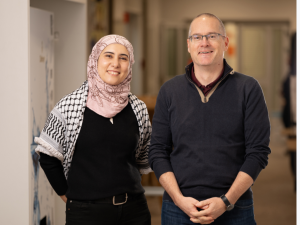
In this edition of Across Disciplines, we speak with Dr Sallam Abualhaija from SnT and Prof Michael Halling from the Faculty of Law, Economics and Finance (FDEF). Together, they explore how collaboration between engineering and finance is shaping the next generation of trustworthy, AI-driven financial systems and what it takes to make innovation work across disciplines.
1. Luxembourg wants to stay competitive as a financial hub. What role do you see for interdisciplinary research in keeping its ecosystem innovative and trustworthy?
Sallam Abualhaija: Interdisciplinary research is an essential ingredient for building the shared understanding that would lead to excellence and long-term success. Today, competitiveness in finance is not driven only by performance— it equally depends on trust, transparency, and technological excellence.
By bringing together expertise from law, finance, and software engineering, our interdisciplinary research creates the best ground to interpret complex evolving regulations, understand practitioners’ pain points, and develop cutting-edge technologies to enhance trustworthiness in the financial sector.
Michael Halling: To stay competitive as a financial hub, Luxembourg needs to tackle the most relevant challenges that the financial services industry is facing, and those happen to be inherently interdisciplinary. In FinTech, for example, understanding the impact of generative AI or the role of crypto-assets and tokenisation within investment portfolios requires insights from finance, engineering, and law. Another key challenge is sustainable finance, which also demands collaboration across environmental sciences, social sciences, legal studies, and engineering, alongside finance.
What this means: Interdisciplinary thinking fuels competitiveness. When finance meets law, engineering, and sustainability, innovation is often times spurred.
2. AI is leaving more and more decisions in the hands of machines instead of humans. How do we ensure that public trust in financial institutions remains high?
Sallam Abualhaija: The involvement of AI in automated decision-making has become inevitable – not only in finance but across all domains. Ensuring trust in AI is one of the most pressing challenges of our time. Before the public trusts AI decisions, the financial institutions themselves trust AI enough to delegate critical decisions to it. This challenge has two sides:
On the public side, we need methods to ensure that AI aligns with (AI is behaving according to) societal norms and human values — a problem, broadly known as the alignment problem. Values such as fairness or safety are central to building such trust.
On the institutional side, financial institutions should operationalisze the legal requirements described in regulations, such as the EU AI Act, and incorporate ethical guidelines like the EU guidelines on trustworthy AI in their processes, which emphasize human oversight, transparency, and auditability.
Michael Halling: Actually, I don’t think that AI will automate decision making in finance because making decisions in finance is fundamentally different from the decisions that, for example, a self-driving car makes. I think that we will move towards a world in which AI will assist asset managers, bankers and other professionals in finance in making better decisions by, for example, providing them with signals extracted from text, images or sound recordings – while financial professionals remain ultimately responsible for the decisions.
Having said that, AI technologies and systems must adhere to societal norms and values, as Sallam has already pointed out. Developing interpretable and transparent AI tools will be essential for building the trust financial institutions need to adopt these technologies.
In a nutshell: Trust in AI starts with people. Transparent systems, clear accountability, and human oversight are the foundation of confidence in financial innovation.
3. Is regulation a barrier or a catalyst for FinTech innovation?
Sallam Abualhaija: It can be both. In my view, regulations are necessary to ensure finance serves the social good. Ensuring compliance is a challenge that institutions are still struggling to achieve for various reasons. Among other benefits, compliance drives trust building and customer base expansion, which in turn improves profits and competitive advantage.
Regulations can sometimes impose limitations, such as restrictions on high-risk innovations under the AI Act. Yet, these boundaries are important to ensure that FinTech innovation happens responsibly. At FutureFinTech, we explore how to achieve this balance.
Michael Halling: This is the classic question in regulatory design — and particularly relevant in finance, which is already a heavily regulated sector. I would like to stress two main points. First, despite differing opinions on specific rules, most participants agree that regulation is essential given finance’s systemic role and the potential consequences of institutional failure. Second, we must ensure a level playing field for FinTechs and traditional institutions so they can compete fairly.
A well-designed regulation in FfinTtech will act as a catalyst in the long run: it builds trust, ensures accountability, and provides understandable frameworks – and all of that will lead to higher adoption rates and more profound integration of AI within the finance industry. In the short term, such regulation might create barriers and frictions, but in the long run it will pay off.
Why it matters: Clear, fair regulation creates the trust and stability needed for AI and FinTech to flourish responsibly.
4. Has working across disciplines changed how you think about your own field of research?
Sallam Abualhaija: Absolutely. Coming from an engineering background, I once saw compliance in binary terms, building automated tools that output a yes-or-no answer.
Collaborating with colleagues in finance and law has broadened my view.
I now better understand the real-world challenges in FinTech and the need for solutions that are usable by non-technical experts and aligned with legal interpretations.
In my ongoing interdisciplinary research, I have better understanding of what innovative solutions are needed, how such solutions should be usable by non-technical experts, and aligned with legal interpretations. The collaboration has also enhanced my understanding of regulatory compliance and how difficult, yet crucial, it is to engineer and operationalise compliance requirements effectively within software systems.
Michael Halling: Interdisciplinary work broadens your horizon and prompts you to reflect on your own discipline. It’s fascinating how research and publication processes vary between fields. Sometimes, different fields even approach the same problem in fundamentally different ways. For example, if we consider the case of adversaries in cryptography, very broadly and simply speaking, then engineers usually assume that these adversaries simply exist; economists on the other hand would ask,” What are the incentives of an agent to actually become an adversary?” I find precisely such situations to be very rewarding because they show how much we can learn from one another.
What we learned: Interdisciplinary work challenges disciplinary assumptions and sparks fresh ideas that can make each field stronger.
5. If you had unlimited resources for one joint project, what idea would you pursue together?
Sallam Abualhaija: We would develop GenAI-enabled Dynamic Compliance and Transparency of Mutual Funds, focusing on three main pillars:
- Quality and Transparency of Fund Policies.
This pillar focuses on developing GenAI-driven document understanding techniques capable of comprehensively capturing the nuanced semantics specific to the financial domain. It will further introduce automated quality scoring methods to assess the transparency of fund documents, with strong involvement of human experts in the loop. - Machine-Analysable Representation of Compliance Rules.
This pillar addresses the development of automated rule extraction and parsing methods using GenAI to identify obligations that can be translated into requirements within a compliance engine. These requirements will then be formalized in a way that enables verification of the compliance of fund activities. - Adaptive Regulatory Intelligence.
This pillar investigates the ever-evolving regulatory landscape to better assess its impact on existing systems. It will be extended with automated agent-based adjustment proposals to maintain compliance across fund policies, business processes, and software systems.
Michael Halling: Nothing to add. This is exactly the project that I would like to pursue together with Sallam.
Takeaway: Integrating GenAI into compliance could redefine how transparency and regulation work together in the financial sector.
6. What would you say to a PhD student who wants to work across disciplines but doesn’t know where to start?
Sallam Abualhaija: I would say, hang in there. The path is quite challenging, even more so at the beginning. However, speaking for junior engineers, the experience is absolutely worth it. It connects our research with practical challenges. Nothing beats the joy of addressing a complex challenge beyond the lab and developing a solution that will be actually used in practice.
Michael Halling: I agree with Sallam – follow questions you care about and enjoy. But for a PhD-student in finance, the answer to that question is relatively simple: focus on research that you will be able to publish in the best finance journals if you want to start a career in academia.
That said, FinTech offers growing opportunities for interdisciplinary research in areas such as crypto-assets, central bank digital currencies, machine learning, and natural language processing. Research related to these topics has also achieved strong publication success in top finance journals. More generally speaking, however, finance PhD-students need to be aware that academic research in finance is still not very supportive of interdisciplinary work.
Good to know: Compared to disciplinary research, interdisciplinary work takes more patience and, especially, persistence, but it often tackles more impactful questions.
About FutureFinTech
FutureFinTech, founded by researchers from the Interdisciplinary Centre for Security, Reliability and Trust (SnT) and the Faculty of Law, Economics and Finance (FDEF) at the University of Luxembourg, takes a holistic approach to fintech innovation. By combining technical expertise with financial knowledge and regulatory understanding, FutureFinTech develops practical solutions that address real-world needs in our rapidly evolving financial landscape.
FutureFinTech is supported by the Luxembourg National Research Fund and the Ministry of Finance.