
 Faculty of Science, Technology and Medicine
 Faculty of Law, Economics and Finance
 Faculty of Humanities, Education and Social Sciences
 Interdisciplinary Centre for Security, Reliability and Trust
 Luxembourg Centre for Systems Biomedicine
 Luxembourg Centre for Contemporary and Digital History
 Luxembourg Centre for European Law
 Luxembourg Centre for Socio-Environmental Systems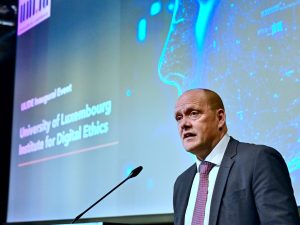
A recent article published on 31 March 2026 in Tageblatt highlights a discussion on the growing concerns about the societal impact of artificial intelligence, and particularly its implications for democratic processes and public discourse. In the article, Prof. Georg Mein, head of the University of Luxembourg Institute for Digital Ethics (ULIDE) , discusses how AI systems and social media platforms are reshaping how individuals access information and form opinions. He points to the rise of “cognitive offloading”, where users increasingly rely on AI to generate knowledge and arguments, potentially weakening critical thinking skills. The interview also touches on the fragmentation of the public sphere, driven by algorithmic filtering, which undermines the shared informational space necessary for informed democratic debate.
The article further addresses the broader political and cultural consequences of these developments, including the spread of disinformation and the structural conditions enabling populism. Prof. Mein advocates stronger regulatory approaches, and calls for renewed emphasis on education and critical judgement. At the same time, he questions uncritical technological optimism, warning that the rapid evolution of AI makes its long-term economic and social effects highly uncertain.
The article also reflects the increasing visibility of ULIDE in public debates, positioning the institute as a voice in Luxembourg’s ongoing discussion about ethics, technology, and the future of democratic societies.