

 Faculty of Science, Technology and Medicine
 Faculty of Law, Economics and Finance
 Faculty of Humanities, Education and Social Sciences
 Interdisciplinary Centre for Security, Reliability and Trust
 Luxembourg Centre for Systems Biomedicine
 Luxembourg Centre for Contemporary and Digital History
 Luxembourg Centre for European Law
 Luxembourg Centre for Socio-Environmental Systems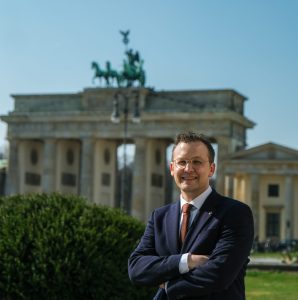
Philip M.A. Hoffmann is a Member of the German Bundestag and a double alumnus of the University of Luxembourg. Following an apprenticeship in banking, he pursued two degrees at the University of Luxembourg, graduating with a Bachelor en Gestion and a Master in Finance and Economics – Banking (previously called Master in Banking and Finance). He also studied at the Université de Lorraine, the University of New York, the University of Saarland, and the College of Europe in Bruges.
After completing his studies, Philip spent ten years working in the Luxembourg financial industry before entering politics. Since 2025, he has been serving as a Member of the German Bundestag, where he sits on the Finance Committee, the Budget Committee, and the Committee on Economic Cooperation and Development. He also chairs the Parliamentary Friendship Group for Belgium and Luxembourg of the German Parliament.
In this Q&A interview, he reflects on his time at the University of Luxembourg, sharing key takeaways from his studies and offering advice to students just beginning their journey.
If you think back to when you first chose to study your Bachelor en Gestion at Uni.lu, what convinced you that it was the right place for you?
I wanted to study internationally — but without leaving the Greater Region, where I was rebuilding a political youth organization from the ground up. The University of Luxembourg offered exactly what I needed: a rare combination of multilingualism, internationality, and regional rootedness. The curriculum was, in my view, the best possible preparation for a career at one of Europe’s most important financial centres. It was the right place — and it proved me right.
How did your Bachelor experience influence your decision to continue with a Master in Banking and Finance?
During my Bachelor, I realized that the University of Luxembourg’s strengths are not just on paper — they are lived every day. The practice-oriented teaching, the mix of professors from business and academia, and the vibrant international community convinced me to return after my Maîtrise in France. Coming back was a good decision.
You studied in several countries. What were the main differences between studying here and at other universities?
I studied in Germany, France, Belgium, Luxembourg, and the United States. Each country has its own academic culture, its own teaching philosophy, its own way of challenging you. I would not rank one above another — every framework taught me something the others could not. What I can say is this: the ability to learn across different systems is itself one of the most valuable skills you can develop. Luxembourg gave me that perspective early.
Can you recall any memorable moments from your time studying here?
The people. Without question, the people. In my Master program, 34 students from 25 countries sat in the same room. Classmates from New York, Sydney, Paris, San Salvador, São Paulo, Ho Chi Minh City — and many more. That diversity was not a statistic, it was daily life. Those encounters became friendships that I still carry with me. As I answer this question, I am actually on my way to visit one of those friends from New York. That says everything.
After graduating, you spent nearly a decade working in the financial sector in Luxembourg. How did your Master’s degree prepare you for your first steps in that world?
It prepared me completely. The combination of deep financial knowledge, intercultural competence, and European thinking gave me a foundation I could build on from day one. What stood out most was that the University of Luxembourg did not just teach theory — it taught us how to apply it. That is rare, and it matters enormously when you enter a competitive, international financial centre. I felt ready. And I was.
Looking back today, which skills from your time at Uni.lu are still part of how you make decisions — whether in politics or in your business?
Cultural intelligence. That is what I carry with me every day. At the University of Luxembourg, I learned to move between cultures — not just to tolerate differences, but to genuinely enjoy them. That skill matters in the Bundestag, where colleagues come from every corner of Germany, each with their own perspective and background. And it matters at my winery too. We are a small, local producer — and yet our guests come from around the world. When Americans find their way to my parents’ kitchen and sit down with a glass of our wine, I still marvel at it. That openness, that curiosity about people — that started at Uni.lu.
From being a student in Luxembourg to becoming a member of the Bundestag, how do you think your time here contributed to the person you’ve become today?
The University of Luxembourg did not just educate me — it transformed me. I arrived as a young banker with local roots and left as a European economist. It expanded my understanding of markets, regulation, and culture. But more than that, it gave me a way of thinking — rigorous, open, international — that I bring to every decision I make in Parliament. Luxembourg shaped the politician I am today. And it is my declared will to give back – as head of the German-Luxembourg-Belgian parliamentary group, I’m working on bringing our nations together, across all political fields, to benefit from our mutual strengths.
What advice would you give to students who are about to start their careers?
Be curious. Be brave. Never forget where you come from — but never let it limit where you go. Talk to the person next to you, especially if they come from a different country, a different background, a different world. Do not default to the familiar. The most important conversations of your life will happen outside your comfort zone. Rest when you need to — recharging is not a weakness, it is a strategy. But never stop growing. The moment you think you have learned enough is the moment you start falling behind.