

 Faculty of Science, Technology and Medicine
 Faculty of Law, Economics and Finance
 Faculty of Humanities, Education and Social Sciences
 Interdisciplinary Centre for Security, Reliability and Trust
 Luxembourg Centre for Systems Biomedicine
 Luxembourg Centre for Contemporary and Digital History
 Luxembourg Centre for European Law
 Luxembourg Centre for Socio-Environmental Systems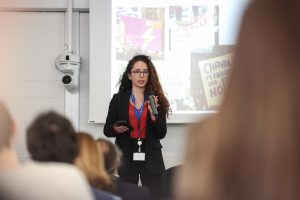
“Research is an unfamiliar career path: it’s often difficult to explain and it’s also a little mysterious,” says Dr Salomé Lannier, a postdoctoral researcher within the Department of Law at the University of Luxembourg. For the past three years, Dr Lannier unveiled some of the mystery of her profession and criminology during the initiative “Researchers at School”, organised by the Luxembourg National Research Fund.
Visiting classrooms around Luxembourg, academics spoke with secondary school-aged children about their life as a researcher. Dr Lannier, who comes from a family of teachers, understands well how young people could benefit from learning about careers within higher education and research.
“The kids want to talk about this”: helping to lift taboos
Yet there is another layer to Dr Lannier’s participation in Researchers at School. This is also an opportunity to engage with young adults on the topics of her research: human trafficking, human exploitation, sexual violence and gender-based violence with a queer/feminist perspective.
Pulling examples from real life, Dr Lannier uses interactive games and scenarios to connect to students and start conversations around privacy and consent. Some of the activities that Dr Lannier introduces include examining myths about rape or determining the limits of consent in cases of image-based sexual abuse.
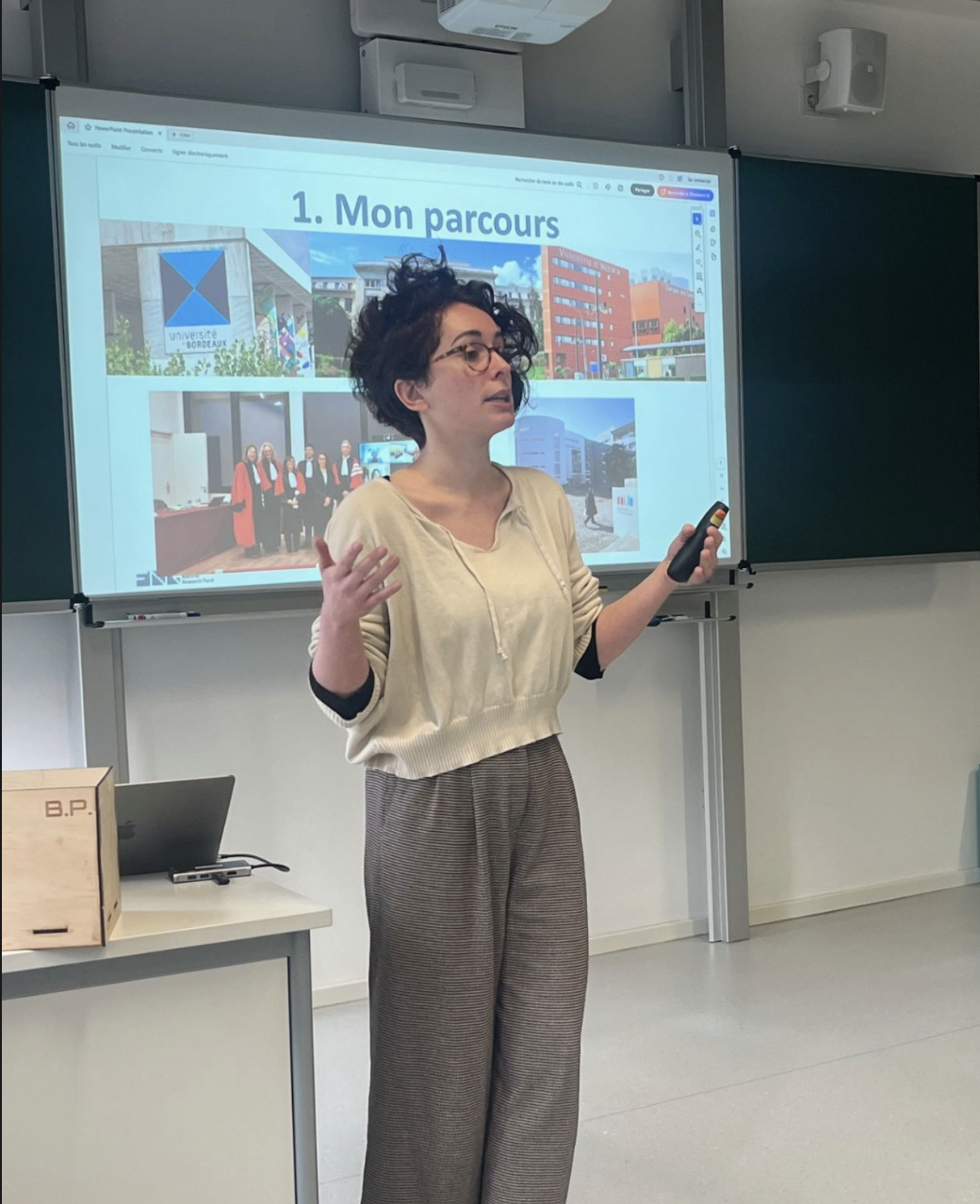
Dr Lannier talks to students at the Lycée Hubert Clément in March 2026.
“The kids want to talk about it,” says Dr Lannier, “They want to talk about what it is like to be a young adult discovering sexuality and relationships.” In a world where social media and other digital platforms expose younger and younger children to extreme content, privacy, consent and open communication are important tools that young adults can use to counter harmful effects.
Skills that benefit researchers
The positive effect of her outreach is not limited to the students. “I self-reflect in the process,” explains Dr Lannier, “I must explain concepts in a way that is understandable for kids. It forces me to go back to the basics.” Dr Lannier’s interdisciplinary field of criminology is often shared with sociologists who have no legal training. As a co-author on papers or part of a project team, she has found it very useful to be able to explain legal theory in laymen’s terms.
‟ “It pushes you to go beyond your system of legal research, and when research becomes more accessible, it also becomes more impactful.”

Postdoctoral researcher
Unfortunately, the social sciences are often missing from these outreach initiatives which tend to attract more academics from the hard sciences, like STEM. However, Dr Lannier maintains that it is important for the social sciences to be represented. Firstly, to inform students about the possible career paths, and secondly to promote skills such as critical thinking and qualitative research which are highly developed and valued within these fields.
Serving society, serving the future
“Some people might see it as a waste of time,” concedes Dr Lannier, “but it is a way to give back to society.” Dr Lannier says that she views her involvement in outreach initiatives as a means of passing on knowledge to the next generation, “when you do this kind of outreach, you need to see the bigger picture.”
“I try to be my most optimistic self,” she explains further. “Sometimes the topics of my research can make me feel desperate about the state of the world, but I can act by giving these students the ideas and tools to make things better.”