

 Faculty of Science, Technology and Medicine
 Faculty of Law, Economics and Finance
 Faculty of Humanities, Education and Social Sciences
 Interdisciplinary Centre for Security, Reliability and Trust
 Luxembourg Centre for Systems Biomedicine
 Luxembourg Centre for Contemporary and Digital History
 Luxembourg Centre for European Law
 Luxembourg Centre for Socio-Environmental Systems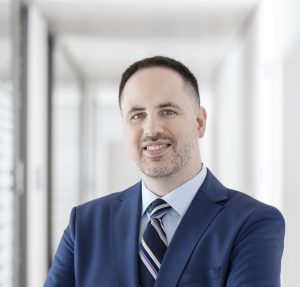
University of Luxembourg Master in European Law alumnus Florent Kling is now a Commissioner at Luxembourg’s data protection authority CNPD, after a career path that included several unexpected turns.
Finding the right fit
Florent Kling’s career didn’t follow the path he initially imagined. Now serving as Commissioner at the Luxembourg National Commission for Data Protection (CNPD), he got there by trying different roles and figuring out what worked for him.
“People shouldn’t be afraid of changing their minds, especially in the beginning,” he says. “I changed my mind twice.”
With a Franco-German background and a double degree in French and German law from Saarbrücken, Florent had long been interested in how legal systems interact. His studies in Strasbourg deepened that interest, particularly in competition law and the free movement of goods.
His journey toward Luxembourg began in 2008, when a friend encouraged him to apply to the University of Luxembourg’s Master in European Law. Luxembourg wasn’t his first choice as Florent thought it was expensive and was worried about the cost. When he eventually explored the University of Luxembourg’s website, he was surprised by how affordable the programme was.
What convinced him, however, was the programme itself. Especially that some courses were taught by judges from the European Court of Justice. “For a student interested in European law, it’s like meeting the prophets,” he says.
The experience met his expectations. Professors such as Herwig Hofmann and ECJ judges Marc Jaeger, Melchior Wathelet and Joseph Azizi stood out for their clarity and accessibility. “They were very approachable, very down to earth. And what is most important for a teacher: very clear.”
Testing different paths
After completing his Master’s degree, Florent interned at the European Court of Justice. While he found the experience intellectually interesting, he understood that it was not what he wanted. Working as a référendaire, he realized that he wanted more influence over legal arguments and outcomes. “You must bake the cake with the ingredients the parties give you. Sometimes I was frustrated because I wished they had used a different argument.” He wanted to be more involved in shaping outcomes.
Florent then decided to pursue a career as a lawyer. After completing the CCDL, a mandatory series of courses for individuals who wish to practice law, he joined a leading law firm. Six months later, he left.
“The problem wasn’t the people or the quality of the work,” he explains. “My experience as a lawyer was more about addressing punctual needs of a client that comes to you with a specific request. You don’t have the entire process. Often the client comes too late and as you work on a specific item you don’t always have the end of the story.” It was not exactly what he wanted.
Finding his role
In-house legal work turned out to be more what he was looking for. It allowed Florent to combine legal expertise with operational involvement.
“You’re in the middle of it all,” he says. “It was a very operational job. It’s more than just law – you need to know also your product, a little bit of accountancy, a little bit of marketing. You cannot be the person always saying no. You have to say yes, but…”
He worked for a Luxembourg industrial company for several years before moving to a multinational corporation operating across five continents. It was there that data protection, and later the GDPR, became central to his work. Implementing GDPR compliance across a listed company with non-European board members and mostly non-European staff was both exciting and challenging.
“Europe was the first mover and this can never be celebrated enough,” Florent says. The regulation came with significant operational challenges, also in the industrial sector. “Back then, you could think GDPR might not be that challenging to this sector because it is not processing huge amounts of data. Spoiler alert: it was, they often just didn’t know it.”
This experience eventually led him to the CNPD’s inspection department. Florent wanted to apply all of his legal and operational knowledge and help build bridges between companies and authorities. He remained in the inspection team for five years before being appointed Commissioner.
Becoming a CNPD Commissioner
As Commissioner, Florent’s responsibilities broadened significantly. Instead of focusing on inspections, he now oversees both the complaints and inspection divisions and participates, through the College of Commissioners, in decisions across all areas of the authority’s work – advisory opinions on draft bills, certification, policy, European relations, police and justice matters.
“You are suddenly exposed to a much more complex information landscape where you need to know much more,” he says. “You discover an entire new universe which totally broadens your horizon and understanding of data protection.”
The role also involves representing the CNPD at national and European levels and carries a substantial decision-making responsibility. Florent highlights three key requirements for the position, beyond extensive job experience: management skills, knowledge of National and European institutions, and a genuine passion for the work. “These positions don’t stop at 5:00 PM,” he says. “They don’t stop on weekends or holidays. You can only do this job if you are passionate.”
Advice for students
Florent’s advice to students is straightforward: do not be afraid to change direction when something isn’t working. Looking back, his career unfolded differently than he once imagined, guided by interests he explored over time.
“There are many jobs you only discover along the way,” he says. “That’s something worth remembering.”
He also encourages students to apply for competitive programmes and opportunities. “If it’s your passion, you should try,” he says.
Florent sees artificial intelligence (AI) as a major development for the legal profession. On practical skills, he recommends developing AI literacy through experimentation and freely available resources, including the AI Data protection basics training course provided by the CNPD. “Just like with the internet, the best way to learn is to use it”, he says. Many law firms are already using AI tools, and he expects this to become standard practice. “We all need to develop our prompting skills,” he adds, comparing the shift to the early days of internet search.
At the same time, he emphasises the importance of critical assessment. AI-generated output may look polished, but that does not guarantee any accuracy. Universities, he believes, have a key role to play in teaching students how to evaluate AI-assisted work critically.
*****
Photo credit: ANN SOPHIE LINDSTRÖM