

 Faculty of Science, Technology and Medicine
 Faculty of Law, Economics and Finance
 Faculty of Humanities, Education and Social Sciences
 Interdisciplinary Centre for Security, Reliability and Trust
 Luxembourg Centre for Systems Biomedicine
 Luxembourg Centre for Contemporary and Digital History
 Luxembourg Centre for European Law
 Luxembourg Centre for Socio-Environmental Systems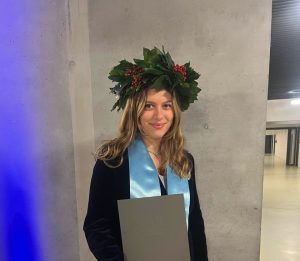
Meet Carola Caporali, a recent graduate from the Class of 2025 who completed both her Bachelor’s degree in Economics and her Master’s degree in Finance and Economics – Sustainable Finance, at the University of Luxembourg. She is now beginning her career in Luxembourg’s financial sector.
During her Master’s studies, Carola gained hands-on experience through an internship at J.P. Morgan Asset Management in Luxembourg, where she worked in anti-money laundering and compliance. Her academic work was also recognized at our latest Partnership Event, where she received the Faculty Prize for the Best Thesis in Sustainable Finance.
Carola has recently joined BlackRock as an Associate in Financial Crime & Compliance. In this interview, she shares what motivated her to specialize in sustainable finance and how she successfully balanced demanding studies with the early steps of her professional career.
Carola, why did you choose economics for your Bachelor’s, and then sustainable finance for your Master’s?
The bachelor really gave me a broad foundation that prepared me well for specialized Master’s studies.
I chose sustainable finance for my Master’s for several reasons. While I was finishing my Bachelor’s degree, I started working at J.P. Morgan Asset Management here in Luxembourg. Staying in Luxembourg meant I could keep gaining professional experience alongside my studies, so it felt natural to continue my Master’s here as well.
Another reason, why I chose the specialization in Sustainable Finance because it offers a rigorous foundation in financial theory while effectively integrating sustainability into core financial topics. The curriculum is particularly compelling as it combines traditional finance with contemporary sustainability-related themes, ranging from the regulatory framework governing sustainable finance to applied courses in which students work in teams to design and manage portfolios aligned with sustainable investment strategies. I highly recommend the sustainable finance course to everyone.
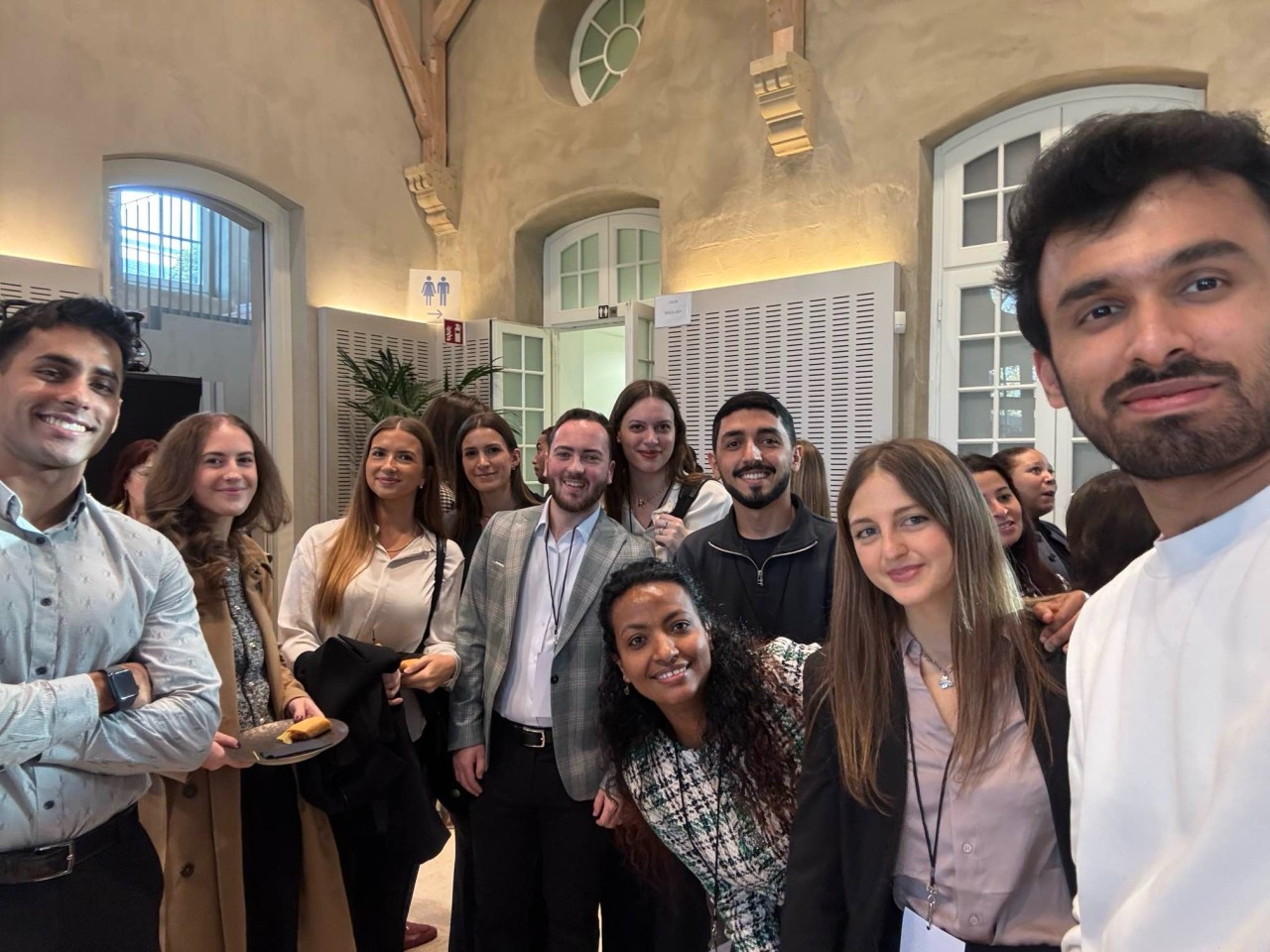
Carola with classmates in the Master’s programme in Finance and Economics (Sustainable Finance track)
What were the most inspiring or useful courses that prepared you for your professional life?
Overall, all courses were relevant and useful for building a strong foundation for a career in finance. What I found particularly inspiring was the opportunity to learn from highly respected professionals who regularly taught or gave guest lectures. Professors such as Dr. Peter Mathis and Professor Dr. Hakan Lucius shared valuable practical insights, and attending lectures by senior figures such as the Governor of the Central Bank of Luxembourg was especially motivating.
Group projects also played an important role in preparing me for professional life. Working in teams highlighted how essential clear communication is to being effective and meeting deadlines. In addition, engaging with complex academic material helped me develop the ability to read carefully, analyse information, and extract what is relevant — skills that translate directly into day-to-day work, even if applied in a different context.
Tell us more about your first job in J.P. Morgan
I started as a working student in 2022. In asset management, the team focused on client onboarding for funds, making sure that all investors in Luxembourg-domiciled funds are AML and KYC compliant under Luxembourg and EU regulations.
Until 2025, I continued developing my academic background while gaining hands-on experience. Later on, as an Anti-Money Laundering Specialist Analyst, I took on more responsibility, although the core of the role stayed the same.
My main tasks included conducting AML checks and ensuring that clients investing in Luxembourg funds, or entering into contractual relationships, met all regulatory requirements. We also managed existing client relationships by maintaining accounts, updating documentation, and making sure compliance standards continued to be met. A large part of the role involved collecting and reviewing documentation.
On a day-to-day basis, I worked closely with different teams at J.P. Morgan Asset Management, including compliance, client services, and client advisors, to ensure smooth onboarding processes and a positive client experience.
How did you manage working and studying at the same time?
It was definitely a matter of organization – I know it sounds basic, but that’s what it is. You have to be organized because on days you’re in the office, you can’t really study effectively. After a full day finishing at six, it’s difficult to go home and study for five hours.
I organized my time so that on days I was working, I focused on work – the team entrusted me with important tasks, and I was fully operational fairly quickly. On days that I wasn’t working, I had to compensate for the study time I missed.
What was crucial is that my team was always very flexible. Sometimes I had classes, so I’d split my days – maybe working in the morning and going to university in the afternoon, or vice versa. That flexibility made everything work smoothly.
You are taking a new job at BlackRock. How will it differ from the one you had at J.P. Morgan?
At BlackRock, my role will be more focused on financial crime and compliance activities within the second line of defense. In contrast, at J.P. Morgan I worked in investor onboarding for investment funds, with a strong operational focus on AML/KYC processes as part of the first line of defense.
This new position allows me to move from execution and controls to oversight, advisory, and risk assessment, while leveraging my hands-on experience in AML operations.
What are some memorable experiences from your studies?
One of the best aspects of my studies was the international environment at the University of Luxembourg. Being surrounded by students from many different countries made it easy to build meaningful connections and exchange perspectives, both academically and personally. The University of Luxembourg really represents what Luxembourg is: everyone from everywhere.
As for specific moments, I graduated in August of this year, and I had my official graduation ceremony in December. And at the end of 2025, I have received an award for the best thesis in sustainable finance from the FDEF (LuxFLAG Award in Memory of Sachin S. Vankalas).
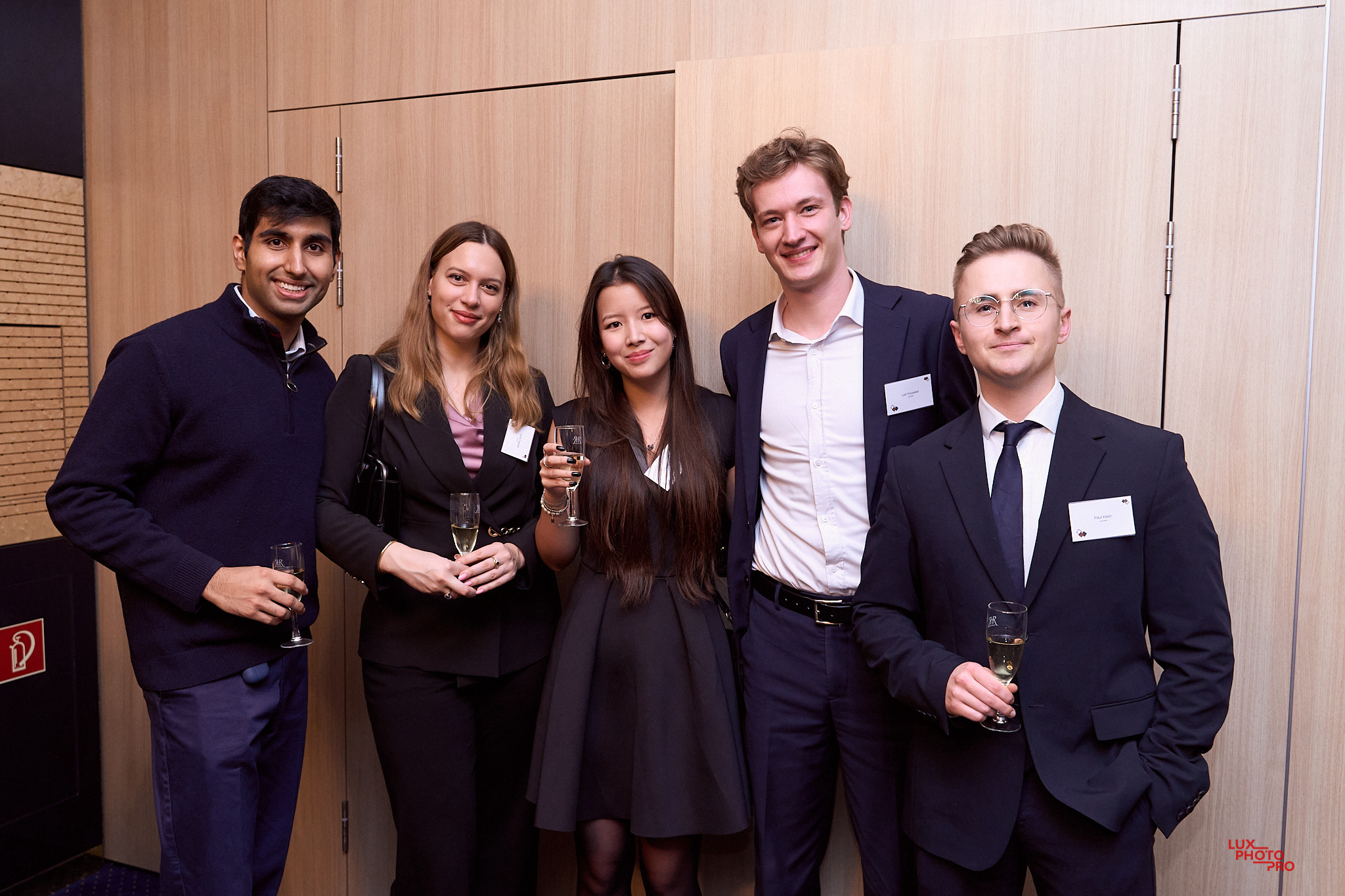
Carola (second from the left) with other student award winners during the FDEF Partnership Event 2025
Why is this award important to you?
It’s definitely a personal achievement. I wasn’t expecting it – not that I didn’t do a good job, but I always tried to get maximum grades without necessarily anticipating recognition like this.
My thesis focused on the integration of ESG risk scores into the traditional AML risk-rating framework. The thesis was a very meaningful experience for me, as I was genuinely interested in its academic relevance and practical implications. I completed the thesis under the supervision of both my academic supervisor and my professional supervisor, who is my former manager at J.P. Morgan.
This award means the work I did was not only personally rewarding but also meaningful to the university and the Association LuxFLAG, which grants the award. It’s a proud moment for me, but also for everyone who assisted me, including Professor Xu, my academic supervisor, with whom I had a wonderful, smooth working relationship.
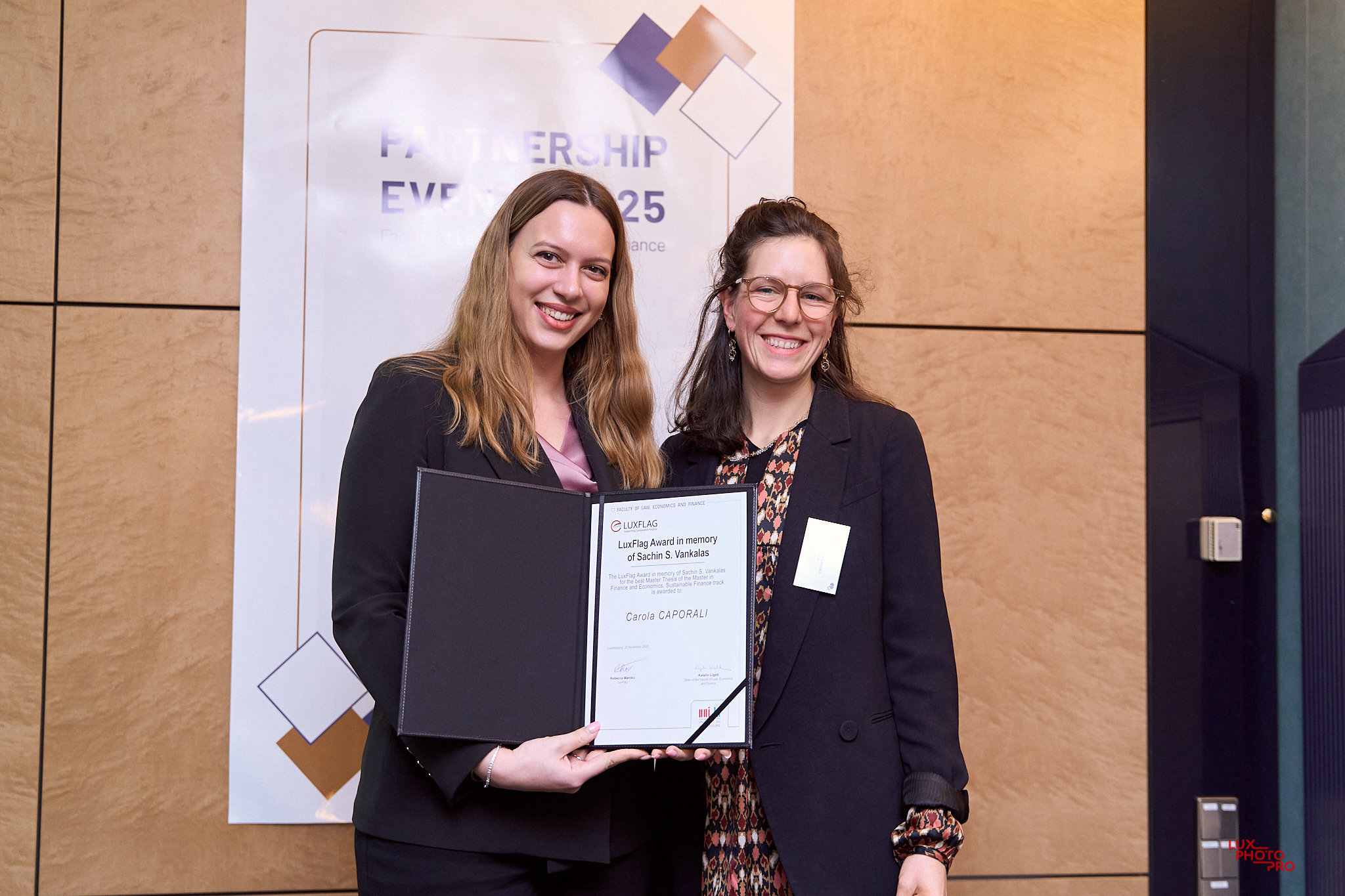
Carola receives The LuxFLAG Award in Memory of Sachin S. Vankalas for the Best Master Thesis of the Master in Finance and Economics, Sustainable Finance track during the FDEF Partnership event 2025
What advice would you give to current students who want to work in the AML field?
For AML specifically, you have to be conscious of the regulations, which change very often. You need to understand complex client structures – sometimes we deal with financial institutions that are quite complex. You have to be curious and have a genuine interest in everything related to financial crime, compliance, and regulations. It’s not just AML and KYC, but a broader view of the world of compliance and financial crime.
This is especially important given the developments after the 2008 crisis, where the regulatory framework became more and more complex and restrictive, particularly in Luxembourg. You have to understand it, have an interest in it, and always be curious.