

 Faculty of Science, Technology and Medicine
 Faculty of Law, Economics and Finance
 Faculty of Humanities, Education and Social Sciences
 Interdisciplinary Centre for Security, Reliability and Trust
 Luxembourg Centre for Systems Biomedicine
 Luxembourg Centre for Contemporary and Digital History
 Luxembourg Centre for European Law
 Luxembourg Centre for Socio-Environmental Systems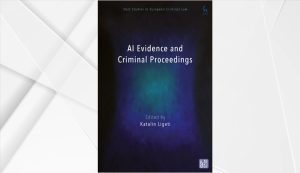
The CRIM_AI project, funded by a CORE grant from the Luxembourg National Research Fund (FNR), sought to answer the question: “Are current criminal procedure rules — particularly evidence law and procedural safeguards — sufficient to address the unique challenges posed by AI evidence?” Prof. Katalin Ligeti, principal investigator, brought together a team of interdisciplinary experts and national rapporteurs to examine European and international initiatives related to AI, as well as how different national jurisdictions are responding to the use of AI evidence in criminal proceedings.
One year after the project officially ended, the book “AI Evidence and Criminal Proceedings” from Bloomsbury (Hart Publishing) is now available in Open Access. Edited by Katalin Ligeti, the book features contributions from Katalin Ligeti, Sabine Gless, Paul De Hert, Andreas Kanakakis, Juraj Sajfert, Juliette Lelieur, Dominik Brodowski, Nicole Visco Comandini, Brandon Garrett, Rudi Fortson KC, Valsamis Mitsilegas, Clementina Salvi, Pieter Liefrink , Rick Robroek, and Tess Veldhoven.
A deep dive into the evidentiary use of AI
The widespread presence of devices collecting, storing and processing data related to citizens’ behaviour has opened new pathways for criminal justice systems to detect, investigate and prosecute crime. Law enforcement authorities no longer limit their searches to information and clues related to offences that have been reported to them; instead, they use these new digital investigative techniques to look for interesting people, patterns or subjects that could potentially suggest an offence has occurred. The shift away from classic, retrospective investigative work towards a more predictive and preventive approach has been amplified by the arrival of AI technology using machine learning and deep neural networks. In response to the growing volume of collected data, law enforcement authorities have begun employing more powerful AI tools to quickly filter relevant information and establish links and relationships between data points.
Within AI’s wide presence in the criminal justice system, this volume investigates only the evidentiary use of AI: when law enforcement authorities rely on AI for investigating and prosecuting offences and offer AI’s output as evidence to tie the accused to a crime. The focus is on six countries – Luxembourg, France, the Netherlands, Germany, the UK, and the US – offering a comparative look at how each legal system handles AI evidence in criminal proceedings. The key question is whether current laws and safeguards are enough to deal with the unique challenges AI brings. Can we trust AI-generated evidence? What protections are in place for the accused?
The volume provides practical suggestions for law enforcement authorities and lawyers, including safeguards and limits to the use of AI in criminal cases. It also highlights areas where laws may need to evolve. With the advent of regional and global efforts to regulate AI, this volume offers solutions for supranational and national policy choices.