Faculty of Science, Technology and Medicine
 Faculty of Law, Economics and Finance
 Faculty of Humanities, Education and Social Sciences
 Interdisciplinary Centre for Security, Reliability and Trust
 Luxembourg Centre for Systems Biomedicine
 Luxembourg Centre for Contemporary and Digital History
 Luxembourg Centre for European Law
 Luxembourg Centre for Socio-Environmental Systems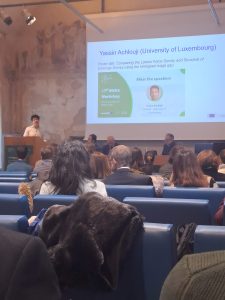
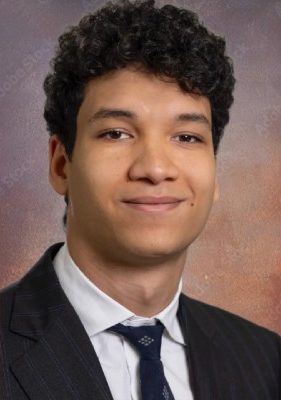
Yassin Achlouji, a student in the Master in Quantitative Economics and Finance at the University of Luxembourg, was selected to present his research at the 11th EMOS Workshop, organised by Eurostat and held in Bergamo on 20-21 November 2025.
European Master in Official Statistics (EMOS) workshops bring together representatives of EMOS master programmes, organisations producing official statistics, and EMOS students and graduates. They provide a space for the community to share experiences, discuss new ideas, and follow recent developments in official statistics.
This year’s workshop focused on new data sources and technologies for official statistics, gathering students and experts working on innovative statistical methods. Yassin presented his work titled “Comparing the Labour Force Survey and Structure of Earnings Survey using the Immigrant wage gap.”
A closer look at wage gaps in Luxembourg
Yassin holds a Bachelor in Economics and recently graduated from the Master in Finance and Economics – Financial Economics track, both at the University of Luxembourg. During the Faculty Partnership event in November 2025, he received the DZ Privatbank Award for Best Student in the Master in Finance and Economics (Financial Economics track) and the Investas Prize for Best Master’s Thesis in the same track.
His study examines wage disparities between natives, immigrants and second-generation immigrants in Luxembourg using two official European datasets: the Labour Force Survey (LFS) (2021-2024) and the Structure of Earnings Survey (SES) (2022). While both describe the same labour market, results deviate significantly opening an interesting discussion about differences between official datasets with similar purposes. The SES, which uses employer-reported wage data, shows a much larger immigrant–native wage gap than the LFS, where wages are self-reported.
Methodology and key insights
Yassin’s interest in the topic began with simple curiosity about Luxembourg’s diverse workforce. As he explains, many foreign nationals move to Luxembourg for strong job opportunities, and long-term economic stability depends in part on whether they choose to stay. Understanding where wage differences come from, how they vary across income groups and whether policy can address them is central to ensuring fairness in the labour market.
Using analytical tools such as the Blinder–Oaxaca decomposition, Recentred Influence Function (RIF) regression and Ñopo matching for robustness, as well as a decomposition excluding the public administration and education sectors, Yassin analyses how wage differences evolve across the income distribution.
According to his research, the decomposition results reveal stark differences between the two datasets. The SES shows an average immigrant–native wage gap of 26%, compared with just 15% in the LFS. Yassin also finds strong explanatory power at the extremes of the income distribution in both datasets. Among men, the average gap is lower (20% in the SES and 10% in the LFS), while among women it is higher (35% and 18%). The average gap between natives and second-generation immigrants is around 11%. Excluding the public administration and education sectors reduces the wage gap across all decompositions. His findings highlight the need to further investigate discrepancies between the datasets and to provide clearer guidance on which is most suitable for wage analysis.
A meaningful experience
Reflecting on presenting his research during EMOS workshop, Yassin says:
‟ It was an incredible honour for me to present my work. I never thought me wanting to satisfy my curiosity could bring me to such an opportunity. However, the most valuable part of the workshop was the people I met. Many students from different walks of life and all passionate and talented gave me a different perspective on life in general. It truly was an invaluable experience.”