

 Faculty of Science, Technology and Medicine
 Faculty of Law, Economics and Finance
 Faculty of Humanities, Education and Social Sciences
 Interdisciplinary Centre for Security, Reliability and Trust
 Luxembourg Centre for Systems Biomedicine
 Luxembourg Centre for Contemporary and Digital History
 Luxembourg Centre for European Law
 Luxembourg Centre for Socio-Environmental Systems
Talking Borders

A citizen-science initiative on borders, memory, and the emotional topographies of belonging.
Talking Borders is a multilingual citizen-science initiative that emerged from the 2nd World Conference of the Association for Borderlands Studies in Vienna in 2018. Initiated by Machteld Venken, the project brings together scholars, activists, and citizens to reflect on how borders—both visible and invisible, historical and contemporary—structure lived experience, mediate belonging, and shape social imaginaries with shifting border regimes around the globe.
Through a series of audio-recorded interviews conducted in multiple languages, Talking Borders captures the lifeworlds of border scholars and borderland inhabitants whose memories, research trajectories, or migration biographies are entangled with shifting border regimes around the globe. These narratives do not merely recount personal experiences; they reveal borders as emotional and symbolic terrains—spaces where mobility, exclusion, identity, and power are continuously negotiated. Hosted as an open-access collection on Zenodo, Talking Borders contributes to an emerging form of transnational historiography that values listening as much as analysis, and curation as much as critique. The project invites audiences to rethink the world from its borders rather than its centres, and to trace the enduring role of borders in shaping collective memory and the cultural politics of inclusion and exclusion.
Context and Background of the Digital Exhibition
The Talking Borders digital exhibition presented here emerged from an advanced Master’s seminar in Public History, jointly taught by Machteld Venken and Klaus Behnam Shad at the University of Luxembourg during the Winter Term 2025. The digital exhibition was prepared for the 50th anniversary of the Association for Borderlands Studies.
Building on the original Talking Borders collection, the seminar pursued an experimental approach to oral history research and teaching. Rather than treating interviews solely as sources for retrospective interpretation, students were encouraged to engage with them as analytical material.
Within the context of the digital exhibition and publication process, the instructors, Machteld Venken and Klaus Behnam Shad, assumed an explicit editorial role. This involved curating and presenting selected interviews and analytical materials that most clearly convey both the diversity of narrative positions within the collection and the interpretive logic developed during the seminar. The exhibition does not claim exhaustiveness or definitive interpretation; instead, it foregrounds transparency, reflexivity, and analytical openness.
Central to this approach was the ambition to visualise qualitative coding processes. The project therefore combined transcription technologies with advanced qualitative and visual analytical methods, allowing coding structures, thematic relations, and interpretive decisions to remain visible and traceable throughout the exhibition. Conceived at the intersection of teaching, research, and digital experimentation, the exhibition reflects an effort to rethink how oral history analysis can be conducted, documented, and communicated in a digital environment. The Talking Borders digital exhibition can be consulted here.
Narrative Diversity and Analytical Orientation
The Talking Borders oral history collection composed at the Association for Borderlands Studies 2nd World Conference in Vienna in 2018 brings together a heterogeneous corpus of narrative interviews exploring experiences of borders, mobility, and belonging. Rather than striving for representational uniformity, the collection deliberately foregrounds diversity across biographical trajectories, narrative forms, emotional registers, and interpretive perspectives. This plurality is not treated as methodological noise, but as a core analytical resource for qualitative inquiry. For the purposes of this digital exhibition, the original interview dialogues have been editorially reassembled into thematically focused monologues of border scholars from around the world. Through this process, only the voices of the interviewed border scholars are presented, allowing each participant to articulate, in a coherent narrative form, what borders mean to them individually. These curated monologues constitute the primary exhibited materials and form the basis for the accompanying analytical visualisations.
Coding, Visualisation, and Analytical Transparency
Within Talking Borders, coding is conceived as a reflexive analytical practice that operates across distinct interpretive levels. At the first level (L1), coding remains primarily descriptive, capturing recurrent themes, motifs, and narrative references as they appear in the interviews. At the second level (L2), these descriptive codes are analytically interpreted and synthesised into broader overall narratives and thematic patterns that cut across individual monologues.
The visualisations of the coding process play a central epistemic role in making this distinction visible. In the coding trees, relational mappings, and thematic diagrams, L2-level categories are explicitly marked as overarching themes or overall narratives, representing the interpretative patterns identified through cross-monologue analysis.
A Living Digital Research Archive
The Talking Borders collection and digital exhibition are conceived not as closed analytical products but as living digital research archives. Interviews, codes, and visualisations are presented as interrelated layers that document both empirical material and analytical reasoning. The collection contributes to broader debates on transparency, reflexivity, and complexity in oral history and qualitative social research.
Citation
Behnam Shad, Klaus & Venken, Machteld (2026). Talking Borders. Digital Exhibition: An Introduction. In Behnam Shad, Klaus and Venken, Machteld (eds.) Talking Borders. Digital Exhibition. Luxembourg Centre for Contemporary and Digital History (C²DH), University of Luxembourg. https://doi.org/10.5281/zenodo.18816392
Illustrations
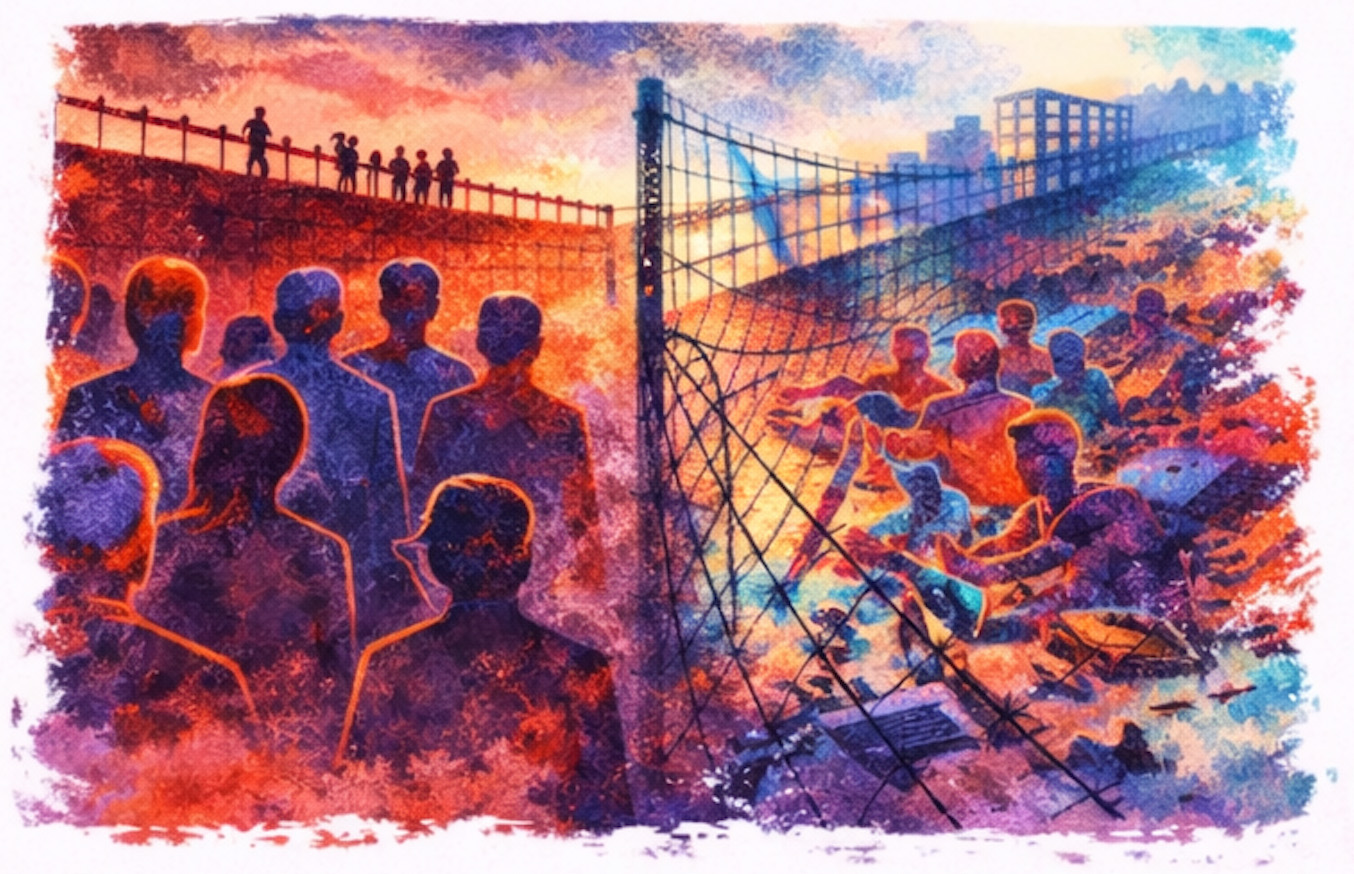
The illustrations were created with DALL·E (OpenAI), drawing on original sketches from the Talking Borders conference booklet (Vienna, 2018).1
1 Original drawings: Talking Borders Conference Booklet, Association for Borderlands Studies 2nd World Conference, Vienna, 2018.