Faculty of Science, Technology and Medicine
 Faculty of Law, Economics and Finance
 Faculty of Humanities, Education and Social Sciences
 Interdisciplinary Centre for Security, Reliability and Trust
 Luxembourg Centre for Systems Biomedicine
 Luxembourg Centre for Contemporary and Digital History
 Luxembourg Centre for European Law
 Luxembourg Centre for Socio-Environmental Systems
The Three Pillars
Our Digital Research Infrastructure is built on three core pillars: Open Science, Data Governance, and AI & Research Software. Together, they ensure DRI’s three main goals through transparent research practices, responsible data management, and cutting-edge digital tools that empower our scientific community.
Open Science
The DRI is committed to the values of open science through use of open software and focus on reproducible workflows. Projects are developed using open-source tools and although license selection remains project-dependent, the overall infrastructure—open repositories, shared workflows, and clear documentation—promotes reproducibility and knowledge transfer within and beyond the institution.
Our approach to open access publishing encompasses three complementary initiatives across different scholarly formats.
Data Governance
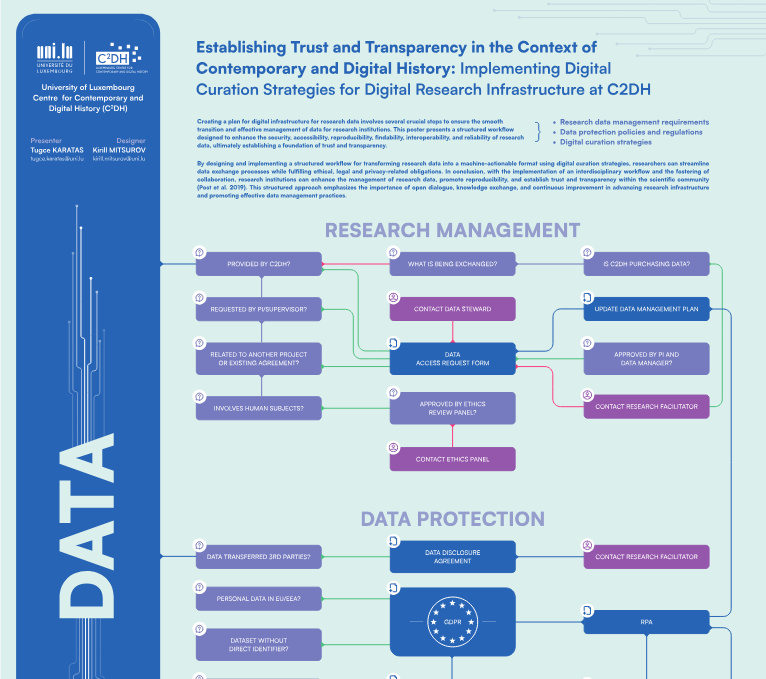
At the DRI, we handle diverse historical datasets — digitised archives, oral history recordings, corpora, and computational outputs — each requiring different levels of access, protection, and long-term stewardship. Data is stored and versioned in structured repositories with role-based access controls, ensuring that sensitive materials remain protected while open datasets are published under clear licensing terms aligned with GDPR. Metadata standards follow FAIR (Findable, Accessible, Interoperable, Reusable) and CARE principles, enabling our tools and collections to connect with European infrastructures such as DARIAH (The Digital Research Infrastructure for the Arts and Humanities).
Explore
AI & Research Software
At the DRI, we develop research software at the intersection of machine learning, computational linguistics, and digital humanities. Where AI and machine learning pipelines are used — for text analysis, image recognition, or pattern detection — model decisions are documented in line with our commitment to algorithmic transparency. All tools are released as freely licensed, open-source software, and AI components are developed with rigorous attention to ethical oversight, reproducibility, and responsible deployment. We are equally attentive to the interpretive dimensions of algorithmic approaches, examining how they shape discovery, analysis, and the research process itself.
Explore