

 Faculty of Science, Technology and Medicine
 Faculty of Law, Economics and Finance
 Faculty of Humanities, Education and Social Sciences
 Interdisciplinary Centre for Security, Reliability and Trust
 Luxembourg Centre for Systems Biomedicine
 Luxembourg Centre for Contemporary and Digital History
 Luxembourg Centre for European Law
 Luxembourg Centre for Socio-Environmental Systems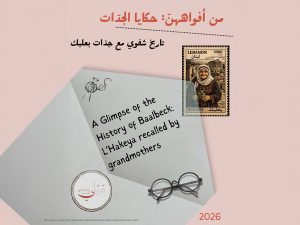
The History of Baalbeck co-produced with Grandmothers: Levantine Storytelling Oral Tradition as a Public History Medium
The Public History as a New Citizen Science of the Past (PHACS) project has the pleasure to announce a new collaboration with Mayli Library and Cafe for Women in Baalbeck-Lebanon, led by Yara Ayoub, researcher and project manager. Drawing on their experience as academics and public history practitioners, Mayli’s team will launch the conversation with women in Baalbeck, around the importance and uses of oral history among women-led communities, in response to the methodology developed by PHACS, specifically based on the LOVÓ project. In the coming months, various methods of co-production will be implemented in L’Hakeya project, including capacity building, oral history interviews and artistic interpretations. The project focuses on highlighting the collective memory of women as a part of re-telling the history of Baalbeck. It will also represent this history to the public through the old Arabic and levantine tradition of Hakawati (storytelling).
Since 2020, The FNR ATTRACT project PHACS has been developing public history and participatory models for interpreting and communicating the past beyond academia in Luxembourg and Europe. Led by Prof. Thomas Cauvin, the PHACS’ team has been proposing, developing, constructing, and evaluating innovative participatory public history frameworks to engage and empower groups, associations, and users.
In 2025, PHACS embarked on an extended mission to tailor this knowledge further with practitioners, partner initiatives and institutions on the international level, focusing on the production of history with a public perspective beyond Luxembourg.
This new partnership is part of a series of pilot projects that Dr. Myriam Dalal and prof. Cauvin will accompany, with practitioners of public history from across the globe. The practitioners will each work on a specific project that they built and that uses one of the PHACS previous sub-projects as a model to challenge, tailor, reflect on and further develop. We hope that each of our new partners will help enrich the practice of public history for public audiences and academics alike.
Follow Mayli on: