

 Faculty of Science, Technology and Medicine
 Faculty of Law, Economics and Finance
 Faculty of Humanities, Education and Social Sciences
 Interdisciplinary Centre for Security, Reliability and Trust
 Luxembourg Centre for Systems Biomedicine
 Luxembourg Centre for Contemporary and Digital History
 Luxembourg Centre for European Law
 Luxembourg Centre for Socio-Environmental Systems
Exploring African agency through pre-colonial commodity trading
Although her initial doctoral research at the C²DH focused on the spread and trade of guns and gunpowder across pre-colonial Africa, Lauren Coetzee realised there was a much broader story to be told about how Africa leveraged its agency in global trade. She shares more about her journey from South Africa to Luxembourg and her findings.
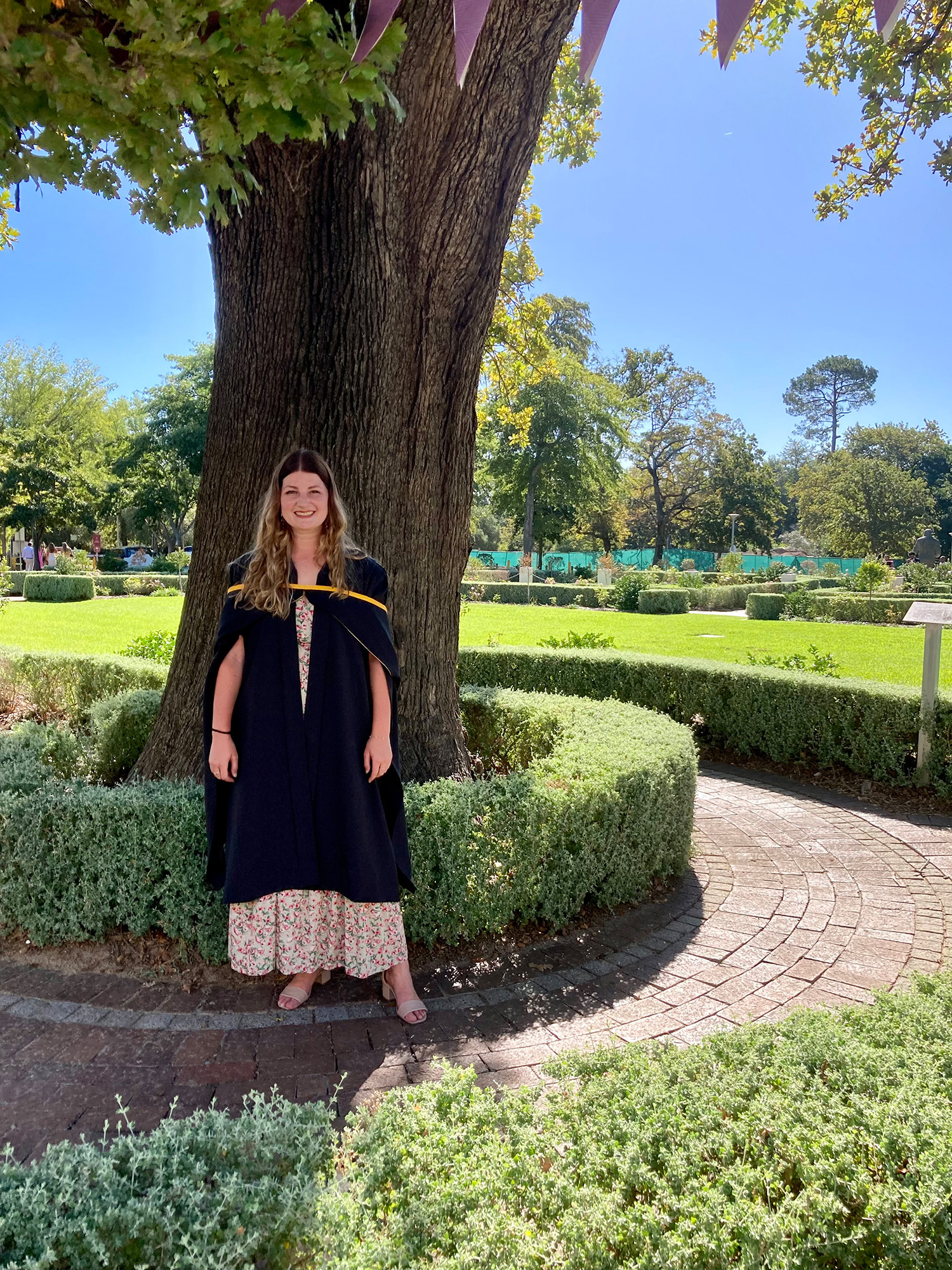
Nestled within the mountainous wine region near Cape Town is Stellenbosch University, one of the top-ranked higher education institutions in Africa. It’s also South Africa’s oldest university – and one steeped in history. This is where C²DH doctoral researcher Lauren Coetzee completed her Master’s degree in history, and where she began to develop a deep appreciation of how researchers build off each other’s work.
At Stellenbosch, Coetzee’s focus was on the Anglo-Boer War, as she was interested in learning more about those who “didn’t have such a loud voice in that narrative”. She contributed to the “Biography of an Uncharted People” project, led by economic historian Johan Fourie. Although her background was in history, the project used quantitative methods to help fill gaps in the “histories of marginalised groups”, transcribing sources like death and marriage certificates and voting records. “When you quantify them, you start to see trends that are different from what you see with normal narrative projects,” Coetzee adds. “It was so exciting. It touched on that sense of justice, trying to have those voices embedded and emphasised in my research.”
Heading to Luxembourg
After her Master’s, Coetzee did a pre-doc with the Time Traveller project, of which she is now the research manager. The project uses open-source online resources together with digital history methods and traveller accounts to research various topics related to Africa’s past. It was an easy transition to move from exclusively war-related South African history to a more broad focus on African history before 1900.
Written sources about Africa from pre-colonial periods are scarce. There was no directory of travellers to Africa, so the Time Traveller project built one, compiling approximately 3,500 documents in a bid to bridge some of the knowledge gaps.
Coetzee says the work is fascinating and rich in detail – the accounts are from travellers to Africa who describe their encounters and experiences within the continent, revealing more about the people and places they visited and including details about things such as pottery, artefacts and architecture. But she is all too aware that these sources are just one way of studying the past and that they need to be combined with archives, archaeological sites, oral histories, art and other primary sources to build a more comprehensive picture of people and their interactions. Additionally, personal bias are important factors to take into account when studying pre-colonial Africa. Incorporating digital humanities methods in the research process can help researchers identify any biases while still gaining an insight into life in Africa during the period.
Keen to build on her work in digital history, Coetzee joined the C²DH in 2023 for a PhD focusing on trade in guns and gunpowder in pre-colonial Africa. “You couldn’t complete a trade deal between Africans and Europeans without certain commodities being part of that trade, and guns were one of those,” she says. Seeing the potential in such technology, some states became more powerful, controlled trade routes or made alliances.
Though her research started with a focus on the impact of the spread of guns and gunpowder across societies in pre-colonial Africa, it has extended to commodity currencies used during this period. One such currency was beads, which came in different shapes, colours and sizes. Beads can be found in various regions across the African continent, and they have piqued her curiosity. “The monetary systems were so dynamic, so sophisticated, and made a lot more sense to the local economy than some of the European currencies later imposed on these societies,” Coetzee reveals. By quantifying mentions of beads in sources, she hopes to be able to build a picture of price indices and exchange rates for baskets of goods and trade assets for this period. She also very much hopes that her work might inspire other researchers.
Settling in easily
Coetzee says that coming to the C²DH and Luxembourg more generally has been a fairly smooth experience. She describes the C²DH team as a social bunch, and there are plenty of networking events to foster a sense of community. “When people get a new position or project, everyone cheers each other on,” she adds. “It’s great to be part of a team that has high standards but isn’t so competitive, to have the space to aim high and know you’re being supported.”
‟ It’s great to be part of a team that has high standards but isn’t so competitive, to have the space to aim high and know you’re being supported.”
Doctoral researcher
Although she can’t yet be certain whether she will remain in the country after her PhD, she is certainly not against the idea. She has made friends easily, including some fellow South Africans. “Luxembourg is quite similar to home, in a sense, because South Africa is also very multicultural and international. It’s almost like a lot of the good of South Africa is reflected in Luxembourg: people have strong work ethics and are passionate about what they’re doing. We also have vineyards!”