

Lecture by Cássia Takahashi Hosni
On January 8, 2023, supporters of former Brazilian president Jair Bolsonaro, rejecting the recent inauguration of President Luiz Inácio Lula da Silva, stormed and vandalized the Planalto Palace, the National Congress, and the Supreme Federal Court in Brasília, in an attack aimed at undermining democratic institutions and contesting the transfer of power.
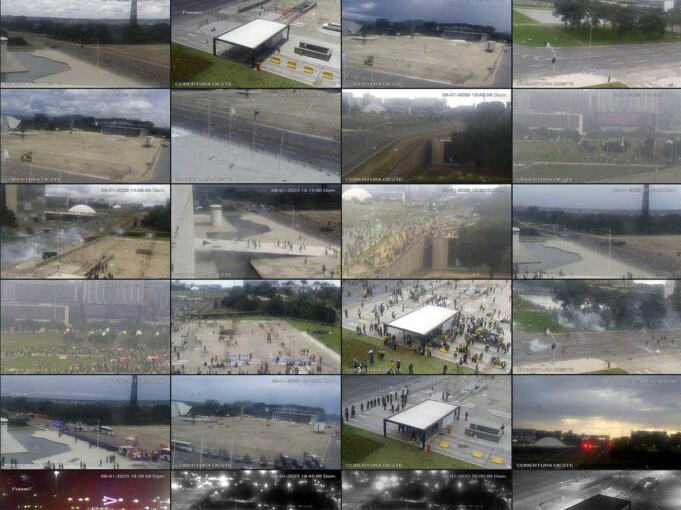
Later that year, by order of the Supreme Federal Court, the Institutional Security Cabinet (GSI) released footage of the attempted coup recorded by the 33 surveillance cameras of the Planalto Palace. Drawing on this public archive, in 2024 the FAPESP-funded project Digital Archives and Research, coordinated by artist and researcher Giselle Beiguelman, developed a digital interface that uses computer vision to process more than 500 hours of video.
The platform enables users to navigate the footage by time, space, and objects, opening new ways to understand the events of January 8 — from the architecture of Brazil’s seat of government to the gestures, movements, and behavior of the insurrectionists. More than a technical tool for organizing images, the interface acts as a mediator in the construction of public memory. Its algorithmic modeling and use of artificial intelligence do not merely classify or make the records accessible; they also shape the possible connections, interpretations, and narratives that may emerge from these public and political images.
Cássia Hosni is Postdoc Visiting Fellow at the Luxembourg Centre for Contemporary and Digital History (C²DH) – Université du Luxembourg and has a Postdoc Fellowship at the Museum of Contemporary Art, University of São Paulo (MAC-USP).
This research was financed by the São Paulo Research Foundation (FAPESP), Brazil. Process Number 2022/05946-9 and 2025/28842-2. The opinions, hypotheses, and conclusions or recommendations expressed in this material are the responsibility of the author and do not necessarily reflect the views of FAPESP.