Faculty of Science, Technology and Medicine
 Faculty of Law, Economics and Finance
 Faculty of Humanities, Education and Social Sciences
 Interdisciplinary Centre for Security, Reliability and Trust
 Luxembourg Centre for Systems Biomedicine
 Luxembourg Centre for Contemporary and Digital History
 Luxembourg Centre for European Law
 Luxembourg Centre for Socio-Environmental Systems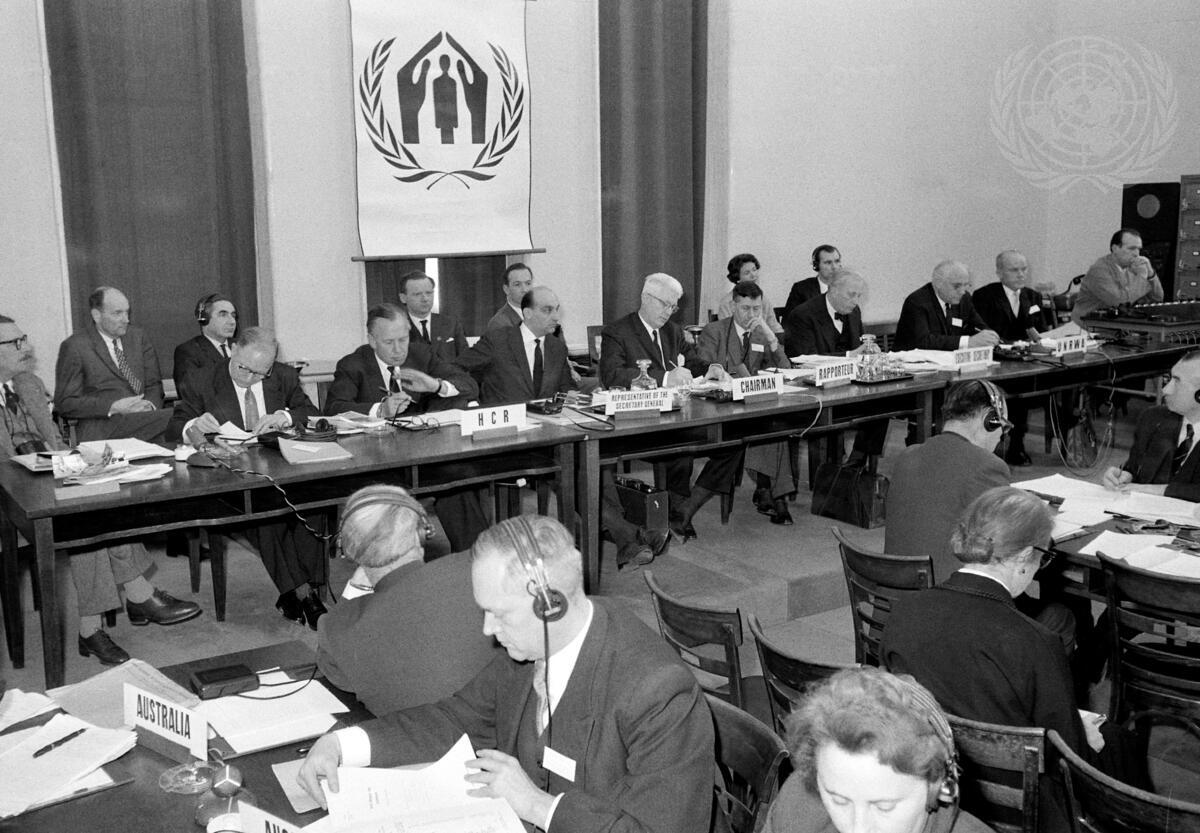
About the conference
For more than a century, the reception of refugees has given rise to tensions between humanitarian imperatives, national sovereignty and international regulations. Migration crises resulting from armed conflicts, political persecution, decolonisation and natural catastrophes have consistently revealed contradictions between universal standards and national practices.
In the 1930s, when there was no binding legal framework for refugee protection yet, countries set their own often restrictive and arbitrary admission policies, and protection was based on political networks, charities and local initiatives. After the Second World War, the 1951 Geneva Convention laid down the notion of refugee in international law, but state sovereignty continued to play a central role. Countries could select refugees based on political or social criteria, and administrative bureaucracy became a key instrument of control. From the 1990s to the present day, the securitisation of migration policies at national, European and global level has led to radical changes in relations between refugees and states. Growing bureaucratisation, the introduction of temporary statuses or “half-statuses”, and the reversal of the burden of proof have radically altered administrative practices and the actual rights of refugees. These developments raise questions as to the ability of international legal frameworks to provide effective protection for refugees in a context dominated by national sovereignty and security-based rationales.
The aim of the conference is to explore continuity and change in reception policies in Europe through comparative and transnational analyses that combine history, sociology, political science and law.
Organisers
- History and Migrations Chair, Luxembourg Centre for Contemporary and Digital History (C²DH), University of Luxembourg
- UFR Sciences humaines et sociales, Université de Lorraine
- Documentation Centre for Human Migration (CDMH), Dudelange
- City of Dudelange
Organising committee
- Tiago Flores, Documentation Centre for Human Migration (CDMH), Dudelange
- Piero-D. Galloro, UFR Sciences Humaines et Sociales, Université de Lorraine
- Heidi Martins, CDMH, Dudelange
- Antoinette Reuter, CDMH, Dudelange
- Daniel Richter, C²DH, University of Luxembourg
- Denis Scuto, History & Migrations Chair, C²DH, University of Luxembourg
- Sarah Maya Vercruysse, C²DH, University of Luxembourg
Programme
-
8.30
Welcome
Coffee and breakfast
-
9.00
Opening of the conference
Denis Scuto
Holder of the Chair in History and Migrations, C²DH, University of LuxembourgTiago Flores
President of Documentation Centre for Human Migration (CDMH)Dan Biancalana
Member of the Chamber of Deputies and Mayor of Dudelange -
9.30
Morning Keynote
The International Geneva Convention of 1951 and 75 years refugee policy in Europe
Frank Caestecker, University of Ghent -
10.30
Coffee break
-
11.00
Prior to the Geneva Convention
Refugees and Nansen-Passport holders in Luxembourg in the interwar time: Migration, Legal Status, and Everyday Life
Inna Ganschow, C²DH, University of LuxembourgDirectives nationales et pratiques locales : l’accueil des réfugiés espagnols en France à travers le cas du Puy-de-Dôme (1937-1940)
Olivia Salmon Monviola, Université Clermont-AuvergneDerrière la promesse de Pierre Dupong : la réalité du retour des Juifs étrangers au Luxembourg en 1944–1945
Blandine Landau / Denis Scuto, C²DH, University of Luxembourg -
12.15
Lunch
-
14.00
Administrative policies and practices surrounding asylum
La rationalisation du récit d’exil : de la co-rédaction d’une histoire de vie à la requête juridique.
Khadija Noura, independentD’un « pays d’émigration » vers un « pays d’immigration » : la « crise des migrants » et les politiques migratoires bulgares
Radoslav Gruev, University of LorraineInteractions des normes nationales, européennes et internationales en matière d’accès aux droits liés à la protection internationale : le cas de la réunification familiale des mineurs non-accompagnés (MNA) en France.
Cloé Furdyna / Jade Rondelez, University of Lorraine -
15.15
Coffee break
-
15.30
Present status and ongoing issues
Qui doit assumer la responsabilité des « réfugiés climatiques » ?
Aziz Sadik, University Mohammed 5, RabatPays sûr, pas d’asile ? Le cas de la Tunisie
Sofiane Bouhdiba, University of TunisThe Migration Crisis as a Weapon. A Comparative Analysis of Stalin’s Use of Refugee Flows to Destabilize Europe (1945–1948) and Putin in Contemporary Conflicts
Alexander Gogun, Free University Berlin -
16.45
Coffee break
-
17.00
Afternoon Keynote
Le droit international et les réfugiés : retour sur un siècle de pratique juridique
Michel Erpelding, Max-Planck-Institute, Frankfurt/Main -
18.10 -20.00
Inauguration of the Camp Rellent Memorial
Participants are invited to join the inauguration of a monument in Dudelange (10-to-15-minute walk, departing at 6.10 pm from outside the Town Hall.)
Inauguration of a monument dedicated to the memory of Soviet forced labourers during the Second World War at a place known as ‘op Rellent’.
The memorial was created as part of the exhibition ‘OST – The vanished traces of the forced labourers from Ukraine, Russia & Belarus in Luxembourg (1942–1944)’ and will be erected near the site of one of the labour camps in which they were confined.
The inauguration will be followed by a reception.
-
9.00
Welcome
Coffee and breakfast
-
9.30
The evolution of asylum rights in Luxembourg
Le droit d’asile au Luxembourg de la fin du 19e siècle jusqu’au projet de loi 8684
Adolfo Sommarribas, European Migration Network (EMN), LuxembourgL’asile en chiffres sur les dernières décennies
Sylvain Besch, Centre for Studies and Intercultural and Social Training (CEFIS)Le rôle du European Migration Network au niveau national et au niveau européen et général
Zané Rozenberga, European Migration Network (EMN), Luxembourg -
10.45
Coffee break
-
11.00
Perspectives on refugee reception in Germany, France and Luxembourg
tbc
L’accompagnement des bénéficiaires de protection internationale en France aujourd’hui
Fatima Mezzouj, Université Grenoble Alpestbc
Mohammed Zanboa, University of Luxembourg -
12.15
Lunch
-
14.00
Round table
Reflections on the history of the reception and defence of refugees’ rights in Luxembourg (1980s and 1990s)
Serge Kollwelter, first president of the Support Association for Immigrant Workers (ASTI)
Agnès Rausch, former head of the Caritas Luxembourg refugee service
Guy Thomas, lawyer and member of the Committee for the Protection of Refugees and Against Forced Returns
tbc
Moderated by: tbc
-
16.30
Closing
Participation is open to all and free of charge. Due to limited space, registration is recommended.