

 Faculty of Science, Technology and Medicine
 Faculty of Law, Economics and Finance
 Faculty of Humanities, Education and Social Sciences
 Interdisciplinary Centre for Security, Reliability and Trust
 Luxembourg Centre for Systems Biomedicine
 Luxembourg Centre for Contemporary and Digital History
 Luxembourg Centre for European Law
 Luxembourg Centre for Socio-Environmental Systems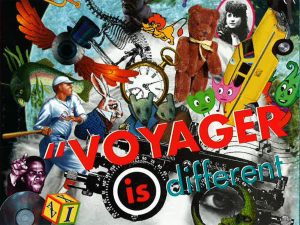
In 1989, Bob Stein launched one the very first cultural CD-ROMs in history: an interactive exploration of Beethoven’s Ninth Symphony. Between 1989 and 2000, Voyager Company explored the possibilities of CD-ROM, while pushing the boundaries of multimedia and books. Their slogan? “Bring your brain.” Their original motto said it all: a book transforming into a disc. Stein didn’t wish to replace the book, but to extend it.
Bob Stein and the Obsession with the Augmented Book
Before Voyager, Stein had already grasped the essential: new media don’t kill books, they transform them. In the 1980s, he had acquired the rights to Citizen Kane and King Kong for laserdisc. That’s when he created The Criterion Collection, the world reference for collector film editions.
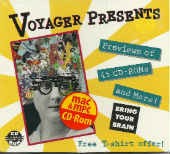
Cover of the “Voyager Presents” promotional disc (1995), showcasing the publishing house’s productions. © Internet Archive
The CD-ROM arrived in the late 1980s. Massive storage capacity, interactivity… Stein envisioned the future. In 1989, with Robert Winter (UCLA), he released Beethoven’s Symphony No. 9 CD Companion. The concept? To listen to the symphony while following an animated score, reading musicologists’ commentaries, exploring themes one by one. It was rudimentary, coded in HyperCard, but for the first time, a disc became an exploratory space.
Voyager continued with CD Companions for music (Dvořák, Subotnick), then literature, cinema, history. In 1992, Maus by Art Spiegelman went interactive. In 1993, A Hard Day’s Night sold 100,000 copies – it was their biggest commercial success.
Technical Innovations
Voyager experimented constantly. In 1992, the Expanded Book Toolkit enabled the creation of electronic books on floppy discs. They adapted Random House’s Modern Library: the foundations of the modern e-book were there, well before the Kindle.
In 1995 appeared CDLink. The concept was technically innovative. One could synchronize an audio CD in its CD-ROM drive with web pages. It allowed to listen to an album while “multimedia liner notes” displayed in real-time – lyrics, biographies, photos, videos. Launched on 12 July 1995 at the Knitting Factory (New York), it was co-sponsored by Rykodisc and SPIN.
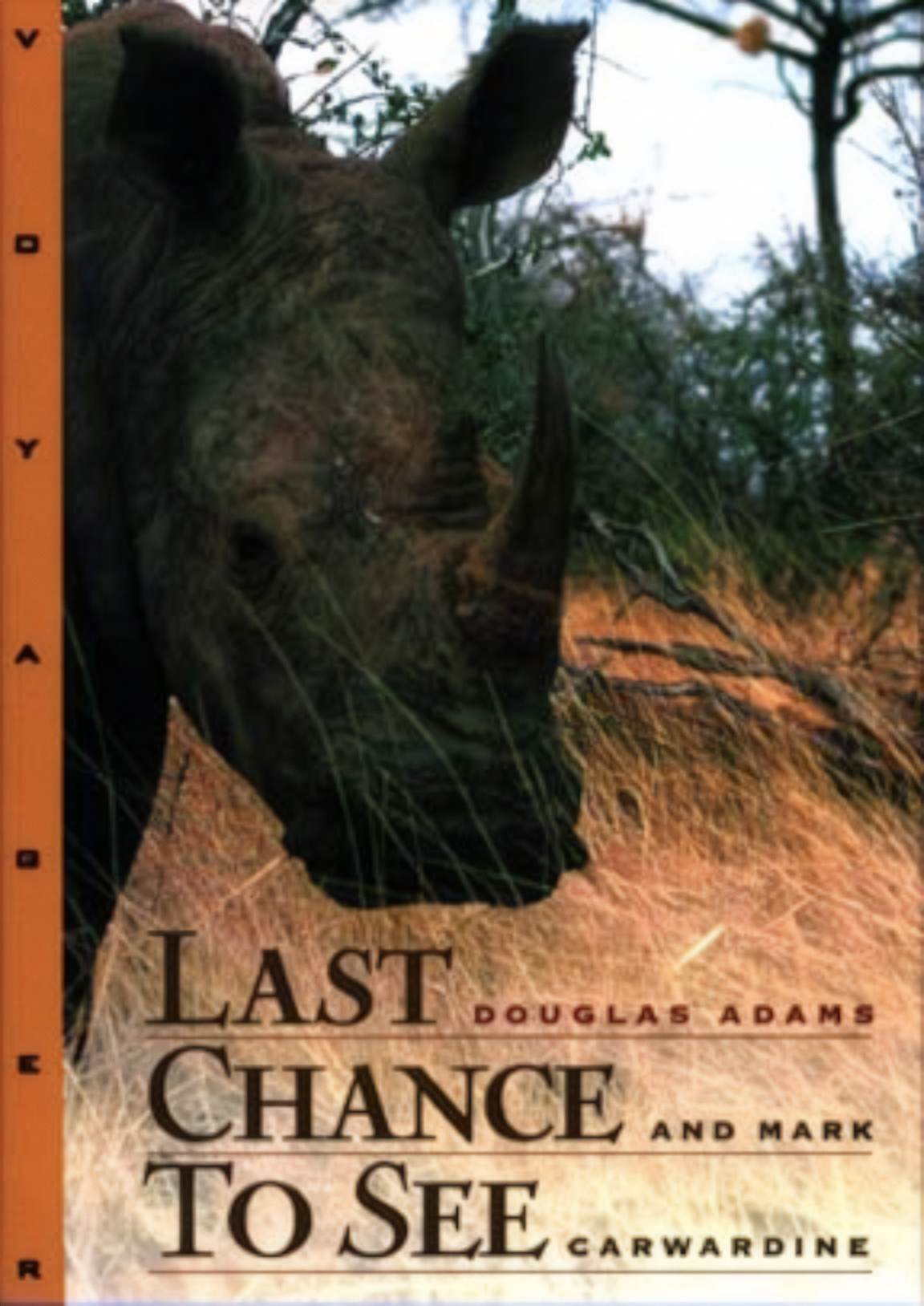
“Last Chance to See” by Douglas Adams (1992), one of Voyager’s successes combining complete audio narration and over 800 photographs. © The Voyager Company / Internet Archive
But reality caught up with Voyager: in 1995, 36% of American households owned a computer, 48% had a CD-ROM drive, and 20% of internet users were on AOL (incompatible with CDLink). It was too early.
Over 70 websites used the technology. The first 25 websites were created in a few days by “liberal arts graduates with text editors”. There was no need to be an engineer. Around 50% of CDLink sites were co-productions with labels.
Voyager also innovated with “mixed-mode” CD-ROMs: audio tracks (Red Book standard: PCM-encoded music playable on any CD player) combined with data tracks (Yellow Book standard: interactive content and executable instructions only playable on compatible computers). Clever and hybrid, these discs initially posed preservation challenges.
1989-2000: A Narrow Window
The CD-ROM encountered success for a decade. Between commercial emergence (late 1980s) and disappearance (early 2000s), Voyager rode the entire wave. But the wave receded quickly.
From 1995-1996, the web exploded. People discovered they could access multimedia content without buying a $50 CD-ROM. Microsoft launched Encarta in 1993. In 1994, von Holzbrinck partially acquired Voyager. It wasn’t enough. By 2000, it was over. However, a catalogue of approximately 80 CD-ROMs had been released. Some titles remain landmarks: Maus, A Hard Day’s Night, Last Chance to See (Douglas Adams), Our Secret Century (Prelinger Archives). In 1993, 17 of the 50 best CD-ROMs listed by MacUser bore the Voyager signature. But critical acclaim didn’t pay the bills.
A Fragile Legacy
Stein didn’t give up. In 2004, he created the Institute for the Future of the Book (supported by the MacArthur Foundation, which provided a generous grant). His objective was to continue reflecting on “the transition from the printed page to the networked screen”. This time on the web, not on what would become an obsolete physical media.
Preservation initially posed specific challenges for mixed-mode CD-ROM’s: early emulators could not handle these hybrid disc images (BIN/CUE format).Woods and Brown’s research (2012) at Indiana University documented these technical obstacles and developed solutions by modifying open-source emulators SheepShaver and Basilisk II to successfully read mixed-mode images, enabling access to landmark titles… Fortunately, some institutions acted. In 2019, Stein donated 53 CD-ROMs to the Electronic Literature Lab (Washington State University), which digitised them and put them online (“The Voyager Company Showcase”). The Internet Archive hosts several emulated titles. In 2015, during the “Welcome to the Future!” exhibition at iMAL (Brussels), Stein gave a 42-minute lecture on Voyager’s history, followed by a roundtable with former electronic publishing actors from the 1990s.
These initiatives saved part of Voyager’s heritage. But much remains inaccessible. Mixed-mode CD-ROMs pose particular technical challenges.
Voyager’s story illustrates a recurring paradox: being a pioneer doesn’t guarantee success. In 1989, Voyager anticipated the challenges of interactive multimedia publishing we know today – enriched books, narrative podcasts, web documentaries.
Today, Voyager is a reference in media archaeology and digital publishing history. Their CD-ROMs are studied as cultural objects in their own right. They stand as witnesses to an era when people believed the future of books would involve silver discs on a shelf. This history resonates with the CD-HIST project, which explores the memory of these hybrid objects, which are simultaneously obsolete and visionary.
Some references
Articles and books
- ARDEN Sasha, “Resurrecting the Digital Past: Access to Artistic Content on CD-ROMs”, Tate Collection Care Research, 2022, consulted on 10 January 2026. https://www.tate.org.uk/research/collection-care-research/resurrecting-the-digital-past-access-to-artistic-content-on-cd-roms
- BROWN Geoffrey, “Developing Virtual CD-ROM Collections: The Voyager Company Publications”, International Journal of Digital Curation, vol. 7, n° 2, 2012, p. 3-20, consulted on 10 January 2026. https://doi.org/10.2218/ijdc.v7i2.226
- PIPER Keith and MERCER Kobena, Relocating the Remains, London, Institute of International Visual Arts (Iniva), 1997.
- WOODS Kam and BROWN Geoffrey, “Creating Virtual CD-ROM Collections”, International Journal of Digital Curation, vol. 4, n° 2, 2009, p. 184-198, consulted on 10 January 2026. https://doi.org/10.2218/ijdc.v4i2.107
Web Articles and Online Publications
- BELL Eamonn, “Information Overload: The Strange Journey of CDLink and the Rediscovery of Music Information Retrieval””, Eamonn Bell Blog, 8 September 2021, consulted on 10 January 2026. https://www.eamonnbell.com/blog/2021/09/08/information-overload-cdlink/
- DIGITAL FORENSICS AND PRESERVATION, “The Voyager Company: Bob Stein’s Voyage”, eLearning Industry, 12 May 2021, consulted on 10 January 2026. https://elearningindustry.com/voyager-company-bob-steins-voyage
- MAHER Jimmy, “The Best of Voyager, Part 1”, The Digital Antiquarian, 18 June 2021, consulted on 10 January 2026. https://www.filfre.net/2021/06/the-best-of-voyager-part-1/
- STEIN Bob, “The Beethoven’s Ninth Symphony CD Companion”, Institute for the Future of the Book (blog), October 2005, consulted on 10 January 2026. https://www.futureofthebook.org/next/text/2005/10/the_beethovens_ninth_symphony.html
Institutional and Archival Resources
- CRITERION COLLECTION, “What’s in a Name”, Criterion Current, consulted on 10 January 2026. https://www.criterion.com/current/posts/751-what-s-in-a-name
- ELECTRONIC LITERATURE LAB, “The Voyager Company Showcase”, Washington State University, consulted on 10 January 2026. https://the-next.eliterature.org/collections/2
- HISTORY OF INFORMATION, “The Voyager Company Develops ‘Expanded Books’ ”, consulted on 10 January 2026. https://www.historyofinformation.com/detail.php?id=4785
- HISTORY OF INFORMATION, “The Voyager Company Provides the Tools for Anyone to Publish an ‘Expanded’ or Electronic Book”, consulted on 10 January 2026. https://www.historyofinformation.com/detail.php?id=5422
- INSTITUTE FOR THE FUTURE OF THE BOOK, official website, consulted on 10 January 2026. https://www.futureofthebook.org/
- INTERNET ARCHIVE, “Voyager Presents” collection, consulted on 10 January 2026. https://archive.org/details/voyager-presents
- INTERNET ARCHIVE, “Last Chance to See CDs”, consulted on 10 January 2026. https://archive.org/details/Last_Chance_To_See_CDs
- INTERNET ARCHIVE, “Prelinger Archives”, consulted on 10 January 2026. https://archive.org/details/prelinger
- iMAL CENTER FOR DIGITAL CULTURES AND TECHNOLOGY, “From CD-ROM Revolution to the Future of Electronic Publishin”, Exhibition documentation, 2015, consulted on 10 January 2026. https://legacy.imal.org/fr/activity/from-cd-rom-revolution-future-electronic-publishing
Multimedia and Video Sources
- STEIN Bob, “Bob Stein at iMAL Brussels”, video lecture (42 minutes), YouTube, 2015, consulted on 10 January 2026. https://www.youtube.com/watch?v=LwTeUGVZP5c
- Several Wikipedia articles (on Bob Stein, Douglas Adams, Encarta, HyperCard, Red Book for instance) were also consulted for general background and technical definitions.
Author(s)
Pierre Mahé