

 Faculty of Science, Technology and Medicine
 Faculty of Law, Economics and Finance
 Faculty of Humanities, Education and Social Sciences
 Interdisciplinary Centre for Security, Reliability and Trust
 Luxembourg Centre for Systems Biomedicine
 Luxembourg Centre for Contemporary and Digital History
 Luxembourg Centre for European Law
 Luxembourg Centre for Socio-Environmental Systems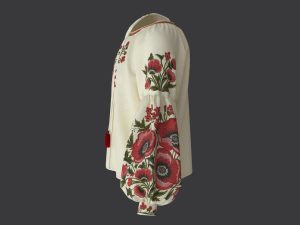
C²DH research scientist and award-winning writer Inna Ganschow shares her experience of using AI to generate costume designs for the Luxembourg-based dance group Berehyni.
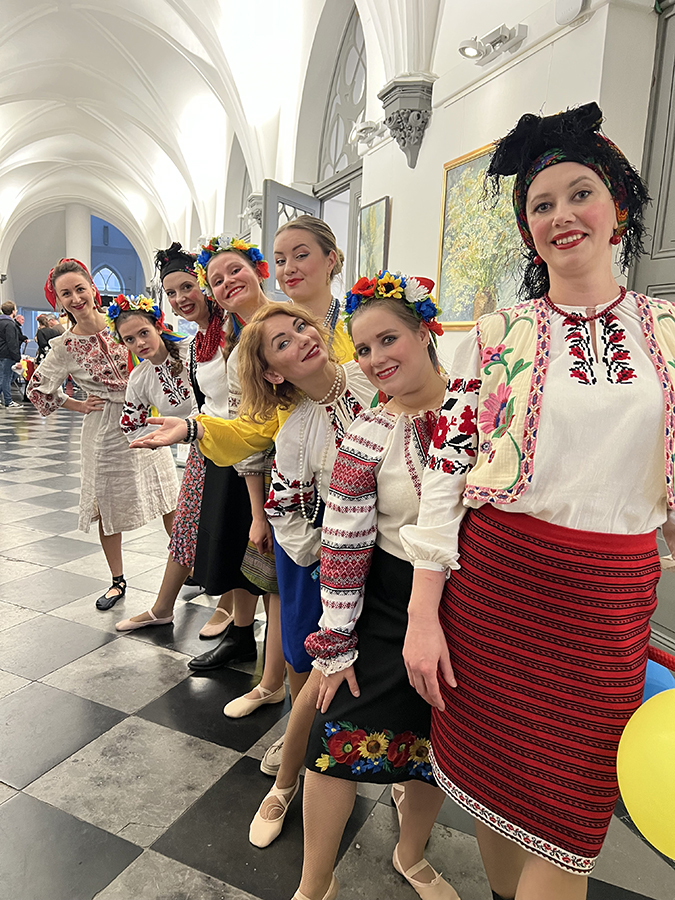
Following the Russian invasion of Ukraine in February 2022 and the influx of refugees to Luxembourg, Inna Ganschow co-founded the Luxembourg Ukrainian Research Network, or LURN, to give visibility to Ukrainian researchers who had been displaced as a result of the war. Scholars naturally have hobbies and passion projects outside their work, and so several Ukrainian organisations soon popped up in Luxembourg. One of these was the Berehyni dance group, led by choreographer Yurii Skobel, who formerly taught at a dance academy in Ukraine.
The Berehyni dancers purchased most of their own costumes, apart from the blouses. “A Ukrainian embroidered blouse for dancing, festivities, even daily life, is a very expensive piece of clothing because of the number of hours someone has to put in to produce it,” Ganschow explains. “Even if you’re using an embroidery machine, it still takes a lot of hours.”
For some time, Berehyni borrowed blouses from Ukraine and then washed, ironed and returned them after performances – creating a number of logistical and financial challenges, given that Berehyni likes to perform for free.
Thinkering Grant opens new doors
Ganschow and her fellow C²DH researcher, Kateryna Zakharchuk, both of whom are dancers in the group, decided to set their minds to the problem and successfully applied for the C²DH Thinkering Grant, designed to promote experimentation with digital tools and methods. The pair were curious as to whether AI could design an embroidery pattern for their blouses which could then be programmed into an embroidery machine, and so the VYSH (short for vyshyvanka, the Ukrainian word for this style of embroidered top) project kicked off in 2023.
“Our creative and academic challenge was to define what should be on the blouse and how to communicate this to AI,” Ganschow explains. Back then, she admits, they thought using AI would be as simple as searching with keywords on Google, but this wasn’t the case. The team tested two platforms, Midjourney and Stable Diffusion. Although both produced beautiful image outputs, they soon realised that Midjourney would be better tailored to what they needed, as it provided “cleaner, detailed, more realistic” results.
Since they wanted something that looked historically Ukrainian, they first had to define what they meant by “historic” and “Ukrainian”. As Ganschow says, “Especially with a hand-crafted object, you first have to define the historical epoch. The further back in time you go, the further it will be from today’s understanding.”
Each era had its own traditions and styles when it came to fabrics and colouring methods. Furthermore, the definition of the territory of Ukraine has changed over the years, and Soviet and neighbouring country influences have had an impact on culture. There were further considerations about the fact that different socio-economic classes could afford different materials or patterns.
The team also considered taking typical patterns in each of the 25 regions of Ukraine to determine embroidery features they had in common, but Ganschow says this turned out to be “a disaster. The merging process was not controllable back then with our prompts.”
While choreographer Skobel respected the discourse around historical accuracy, Ukrainian identity and inclusion, at one point he told them he just wanted something aligned with the tradition of on-stage dance costumes, which needed to be flashy enough to be visible from the farthest seats in the venue and should feature traditional white blouses with poppy flowers. “That’s the beauty of interdisciplinarity,” Ganschow adds. “You can always double check your ideas because someone else will have a different background, priorities, knowledge and motivations.”
‟ That’s the beauty of interdisciplinarity. You can always double check your ideas because someone else will have a different background, priorities, knowledge and motivations.”
Research scientist
And so the prompt changed to focus on the visual impact and the red poppies, and the team selected one of the first designs generated. The design was sent to LESIA, an embroidery company in Ukraine, which helped deconstruct the pattern into different elements and then used Embroidery-Studio to convert it so that it could be read by the embroidery machine. The team then received a 3D simulation of the blouse and, happy with the results, ordered 14 blouses for the dance group.
Other AI considerations
At one point, a dancer in the group pointed out that similar blouses with poppy patterns were appearing on Ukrainian shopping sites, with different colour and fabric options. And so, in a sense, the blouse has now also become a part of modern Ukrainian culture.
Ganschow says that the team learned a lot more about AI than she had anticipated at the outset of the VYSH project.“AI won’t produce something better than what’s in your mind, but it may be that what’s in your mind cannot be communicated to the machine,” she says. “If we can’t describe what we want, it won’t give us the expected results.”
‟ “Critical thinking is more important than ever before because only a human can decide which task to give to AI, and you will still need a human to evaluate the results delivered by it”
Ganschow is no stranger to using digital tools and methods in her research. Her most recent book, Keiner weinte, es gab keine Tränen mehr (No Tears Left to Cry), won the non-fiction category of the Lëtzebuerger Buchpräis (Luxembourg Book Prize) in 2025. And, although she would never outsource her work or writing to AI, she sees the technology as “a very gifted child”, one that can be trusted with certain tasks, but whose output must always be double-checked and verified by the task giver. She thinks AI should be seen as an assistant, not a teacher, and that it is crucial to consult other sources as well. “You have to read, to analyse,” she adds. “Critical thinking is more important than ever before because only a human can decide which task to give to AI, and you will still need a human to evaluate the results delivered by it.”