

 Faculty of Science, Technology and Medicine
 Faculty of Law, Economics and Finance
 Faculty of Humanities, Education and Social Sciences
 Interdisciplinary Centre for Security, Reliability and Trust
 Luxembourg Centre for Systems Biomedicine
 Luxembourg Centre for Contemporary and Digital History
 Luxembourg Centre for European Law
 Luxembourg Centre for Socio-Environmental Systems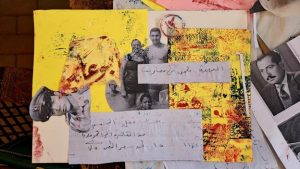
Shubra’s Archive partnership with PHACS, Status Check!
At the C²DH, and since 2020, prof. Thomas Cauvin, Principal Investigator of the Public History as a New Citizen Science of the Past” (PHACS) project has been developing public history and participation beyond Luxembourg and Europe. PHACS aims to empower groups, associations, and users to learn from each other by developing, proposing, constructing and evaluating participatory public history frameworks. Since 2025, Dr. Myriam Dalal has been managing multiple international partnerships between PHACS and practitioners, collectives as well as institutions that are interested in exploring the questions of public history practices and community archiving from a Global South perspective.
One of these collaborations happens to be in Egypt, where Dr. Mina Ibrahim and Yasmin T. Ismail lead the first community archiving initiative in one of Cairo’s neighborhoods. As part of this collaboration, PHACS and Shubra’s Archive (or the Center for History and Social Research SARD) have been jointly leading discussions, events and workshops in Cairo Egypt, in Esch sur Alzette in Luxembourg, and online.
‟ Shubra’s Archive is not meant to accumulate documents – it is meant to open a space for the community and the neighborhood to speak about what has been researched and collected.”
Community archiving is, in essence, a co-production of curation and history for the present and the future. It proves to the “everyday people”, that regardless of their cultural capital, their social background, their family status and where they sit on this fictional societal ladder, it tells them that their histories are valuable not only in their individual and small family history, but also in building and shaping the collective memory of their neighbourhood, the history of their city and their country. Community archiving is also a way to ensure that things that matter to these people are not forgotten in an everchanging and unstable world, where political tensions or the digital abundance may lead to archival loss.
In building such a sense of collective curation of the past, communities can therefore come together and discuss the process of community archiving.They can make decisions together to ensure that future generations will have access to their roots before this precious history no longer exists.
The neighbourhood of Shubra has constituted a hub for academic research in historical, anthropological, and sociological fields for a few decades now, however it sometimes seems that all that research did not successfully reach or impact on the local population. And for Shubra’s Archive, this was a main concern and one of the things that SARD’s team tries to counter in their public programming strategies. For PHACS, this collaboration helped in understanding the importance of both public history and community archives in popular neighbourhoods where people are always busy doing a million things other than archiving their past. Thanks to the community in Shubra that SARD has been working with for the past couple of years, the creation of an open-access public site to both produce and consume an archive for the community was made possible and continues to grow.
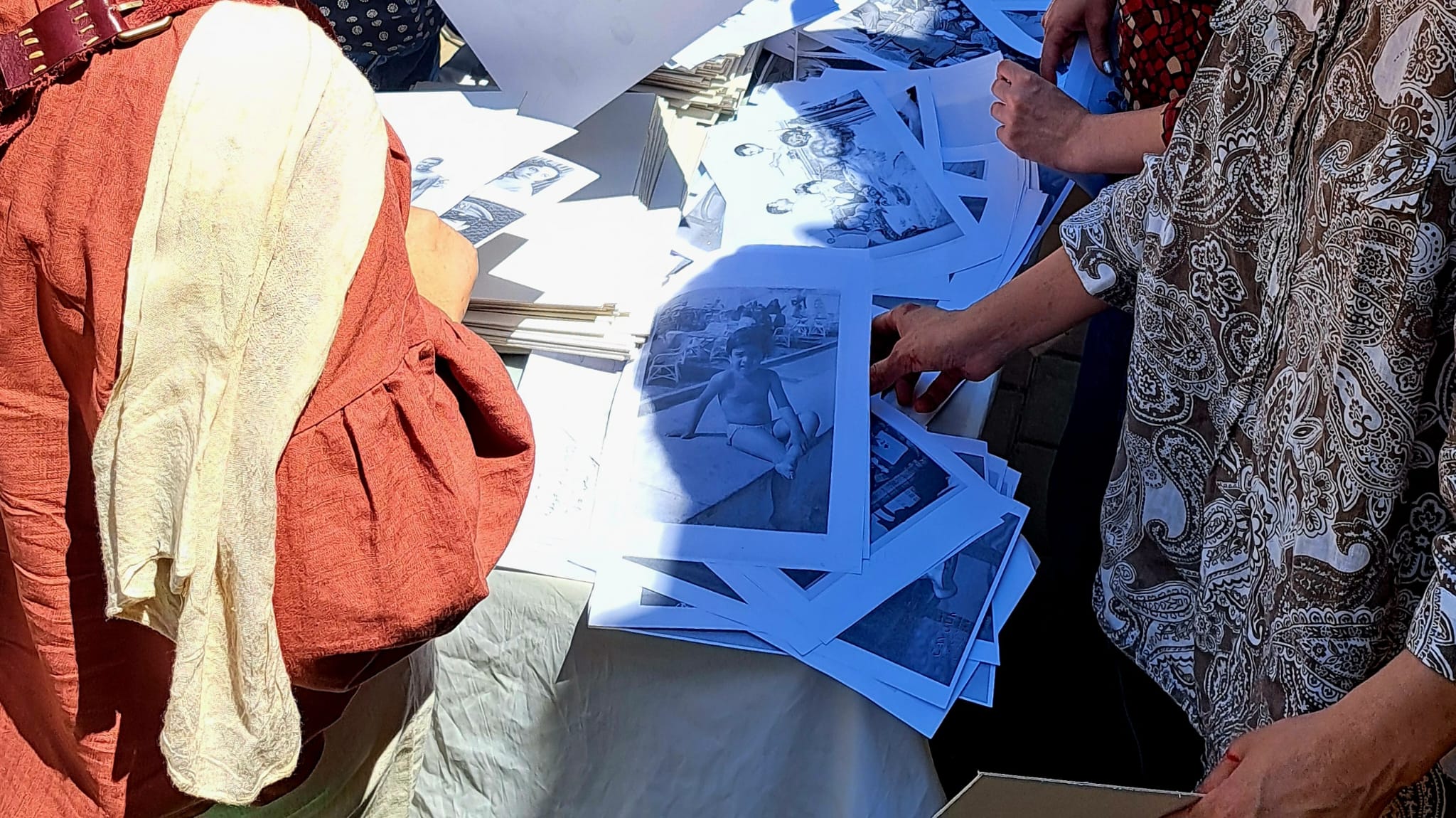
View from the public history workshop conducted by PHACS in Cairo in May 2025. Myriam Dalal.
Dr. Mina Ibrahim first visited the C²DH as part of the Global South fellowship program in 2025. His lecture on Archival Practices: In Praise of Silence, Inaccessibility, and Incompleteness presented Shubra’s Archive and what it means to do community archiving in such a neighbourhood. And since the new collaboration started between both parties in Luxembourg and Egypt, the past few months have been a learning experience for both the PHACS team and the Shubra’s Archive team. In addition to a series of workshops and events, PHACS supported a series of community scanning days, where the team in Cairo invited people in the community to bring their personal archives to help them digitize and document them.All of this can be seen on Shubra’s Archive website which PHACS is proudly the main sponsor!
In this video, Prof. Thomas Cauvin and Dr. Myriam Dalal, talk about the collaboration with SARD to a local online newspaper in Egypt (Al Ahram Online).
The PHACS team also conducted a public history workshop on site in Cairo, followed with an online talk a few weeks later between the PHACS team and Shubra’s Archive team to reflect on the partnership and the particularities of each of the two projects PHACS and SARD.
The talk, titled “Aligning Public History Narratives with Community Archiving Practices in Shubra (Egypt) and Esch-sur-Alzette (Luxembourg)” presented a comparison of practices between the cities of Esch-sur-Alzette and Shubra, as well as discussions on ethical concerns. The discussion also included questions from the communities from both places.
During the discussion, Dr. Mina Ibrahim noted how “Shubra’s archive is not meant to accumulate documents – it is meant to open a space for the community and the neighborhood to speak about what has been researched and collected”. A couple of years ago, and after seeing so many initiatives around the world, the question on his mind was “Why is there no Shubra’s Archive, even though there is academic research on Shubra?”.
For him and the SARD team, the goal has always been to make the archiving process an ethical, professional, affordable, and accessible community process. Slowly but surely, the community in Shubra started trusting in the project, and contributed with their personal archives, joining in the discussions and workshops.
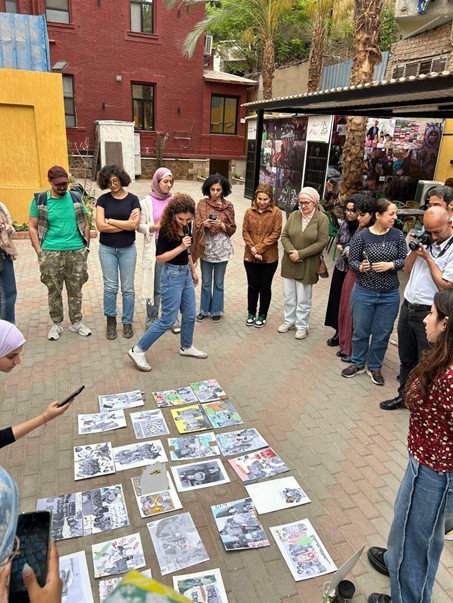
Discussion on the results of a workshop, led by Dr. Myriam Dalal
The work in Shubra’s Archive never stops! Just recently, and as part of a series of collective writing workshops that PHACS funded, a guide on community archiving practices in Arabic has been produced. This manual will be launched and distributed for free soon, so stay tuned.
Both Luxembourg and Shubra are archiving and learning from each other by finding new solutions to community archives together. That is, making it sustainable so communities can have access, be part of it, and tell their stories. It allows for the involved communities to have the agency to preserve what is meaningful to them. Additionally, it enables a deeper understanding of public history and community archives. As previously stated, this aligns with the PHACS project goals to develop, construct, and evaluate different participatory public history initiatives so as to learn from each other. It becomes increasingly clear that community archiving encourages preserving precious history before it no longer exists.
More updates to come soon!
Author(s)
Monyck DE SÁ SANTOS, Student engaged in the Master in Digital and Public History