

 Faculty of Science, Technology and Medicine
 Faculty of Law, Economics and Finance
 Faculty of Humanities, Education and Social Sciences
 Interdisciplinary Centre for Security, Reliability and Trust
 Luxembourg Centre for Systems Biomedicine
 Luxembourg Centre for Contemporary and Digital History
 Luxembourg Centre for European Law
 Luxembourg Centre for Socio-Environmental Systems
The CD-ROM is often remembered as a symbol of 1990s home computing. When we think of it today, we usually imagine it within the environment of a family computer, with encyclopedias, games, language courses, and bulky plastic jewel cases stacked next to the monitor. But that story is only part of the picture.
Before CD-ROMs became common in private households, many people first encountered them elsewhere: in museums, libraries, exhibitions, fairs, trade shows, and other public spaces — and sometimes without even realizing it. At the beginning of the decade, CD-ROM drives were still making their way into homes and were often sold as expensive “multimedia upgrade kits.” In other words, the CD-ROM was not immediately or exclusively a domestic media. It has also been one of the invisible technical components used, for instance, by various services to “interface” with customers and visitors through an interactive kiosk.
More than just a screen in a box
Interactive kiosks are part of a long lineage of earlier technologies, including vending machines, ATMs, and ticket machines. Typically, they combined a computer fitted into a cabinet, a hidden CD-ROM drive, and a screen (sometimes a touchscreen), with a trackball or a trackpad. The CD-ROM storage capacity made it possible to combine text, sound, images, and sometimes video on a single support and to deliver them on demand in real time. In addition, buttons, menus, and navigation paths were carefully structured into a navigable environment through custom authoring software. This made the CD-ROM an ideal tool not only for presenting content, but also for demonstrating projects and promoting multimedia products.
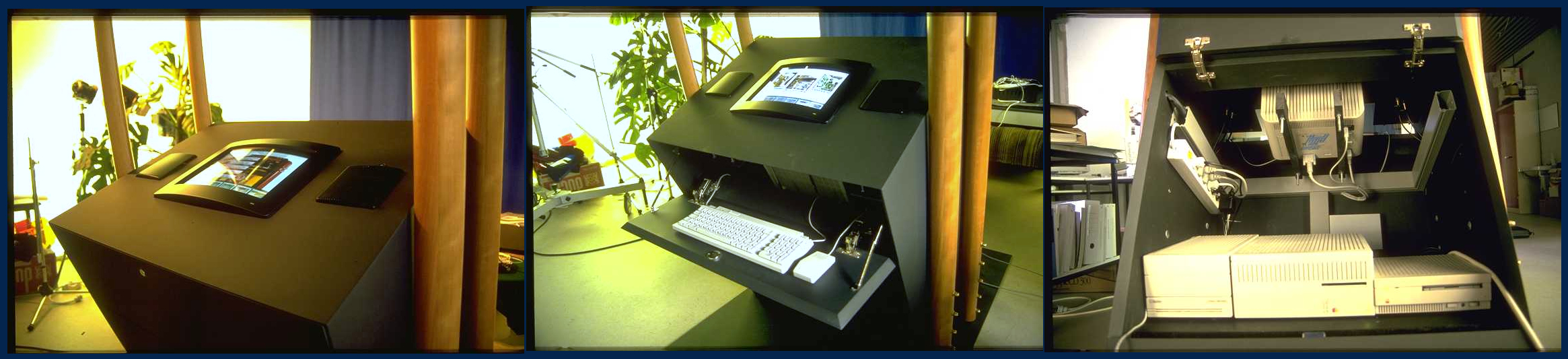
An interactive kiosk presenting the “The Family of Man” exhibition and additional content during its 1993 relaunch in Clervaux (in this particular setting, GINA’s interactive software was operated from the hard drive while the CD-ROM drive only played the audio tracks).. Courtesy of Nico Mack.[

CD-i player, advertising display kiosk, c. 1995 © Royal Philips / Philips Company Archives
Two uses of the interactive kiosk
Broadly speaking, these kiosks offered two kinds of experience. The first one was access to databases. In information centres, libraries, and trade shows, they allowed users to consult large quantities of data in ways that had previously been difficult to make available with such flexibly and so quickly. The second one was cultural mediation. In exhibitions and museums, kiosks introduced visitors to collections, enriched their understanding of a display, and offered multimedia access to cultural content.
Obviously, early interactive multimedia did not come up with established habits or routines; it had to be learned, demonstrated, and guided. In this way, interactive kiosks have allowed people to discover a new kind of content and how to navigate through it. Yet even then, human assistance often remained necessary.
Luxembourg examples: GINA and ENA
Luxembourg offers some particularly revealing examples of the development of interactive kiosks. A leading force in the country’s multimedia innovation was the Centre de Recherche Public Henri Tudor (CRP Henri Tudor), founded in 1987. Within it, the Centre de Ressources Multimédia (CR-MM) was established in 1989 to develop expertise in integrated computer-based multimedia. One of CR-MM’s main ambitions was to make these emerging technologies accessible to broader publics.
A clear outcome of this effort was GINA (Generic Interactive NAvigator), a joint project between the Centre national de l’audiovisuel (CNA) and CR-MM, designed in 1993 to accompany Edward Steichen’s The Family of Man exhibition in Clervaux. GINA took the form of a multilingual and multimedia touchscreen kiosk. Inspired by the idea of a digital version of the “virtual museum” implemented by Apple on CD-ROM, INA allowed visitors to explore the exhibition interactively and deepen their experience through an innovative interface, with buttons, menus and a 3D representation of the space.

Multimedia Eine neue Technologie auf der Suche nach ihren Anwendungsgebieten. In: d’Letzeburger Land, 40. Jg., nº 42 (22.10.1993), p. 23. Digitised by the National Library of Luxembourg.
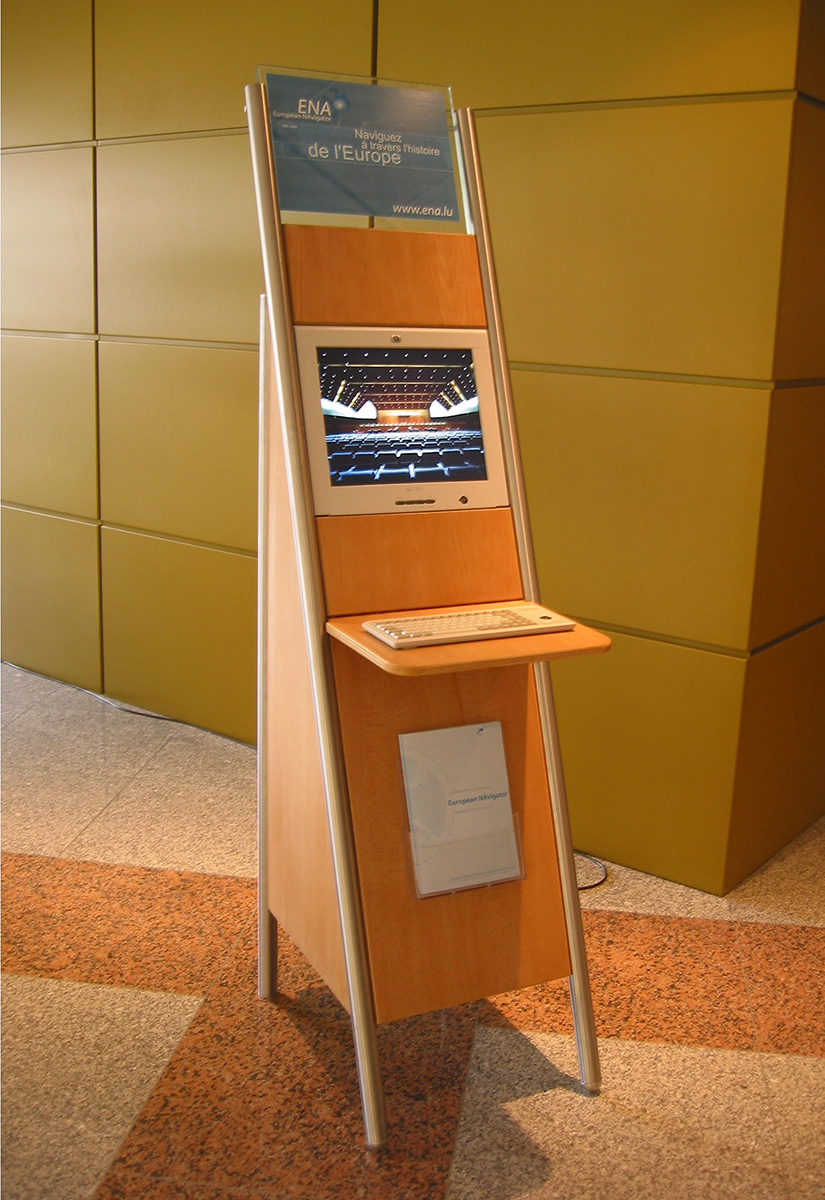
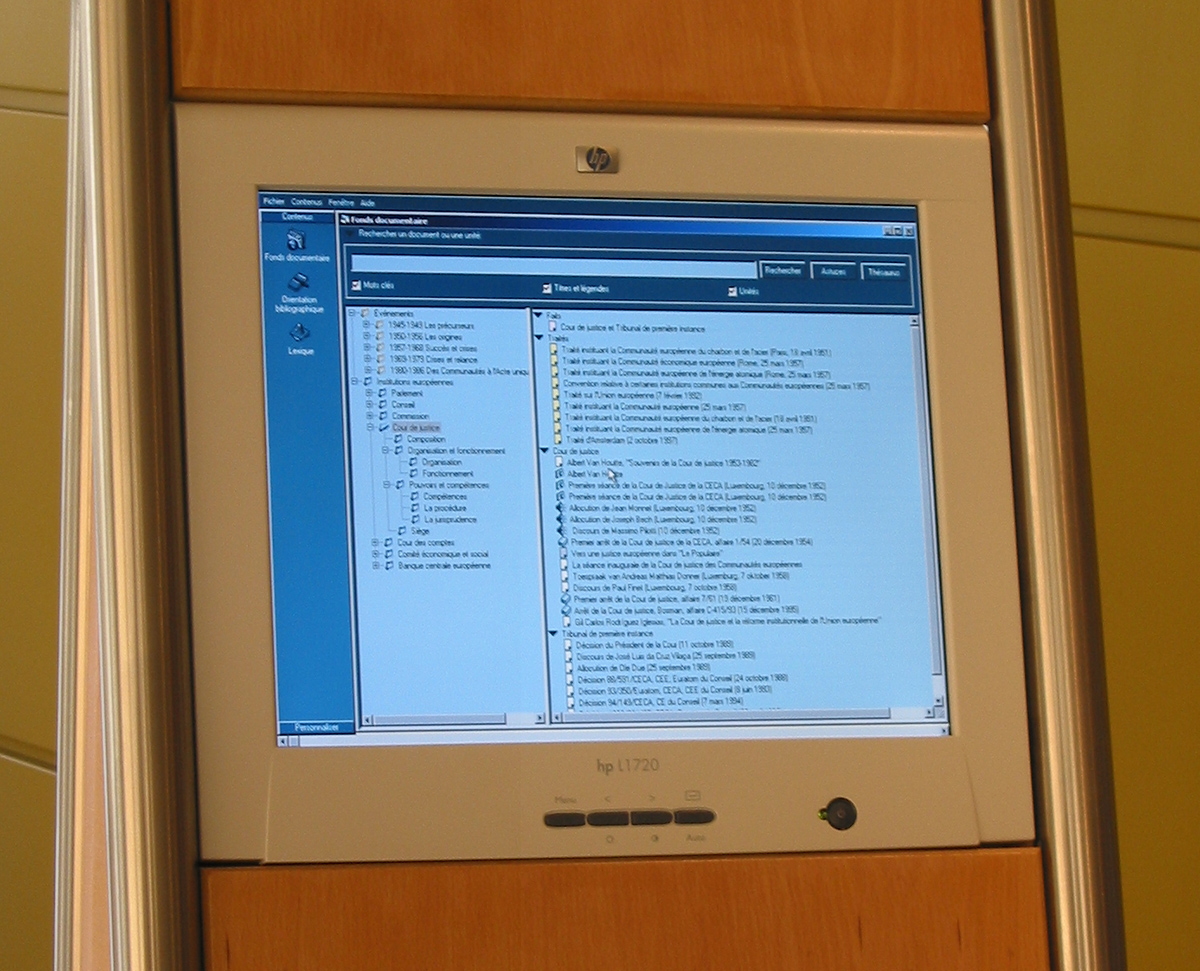
ENA’s kiosks. Source: Archives ENA, cvce.eu by uni.lu
European NAvigator (ENA) extended this multimedia logic beyond the museum setting. Initiated in 1992 by Marianne Backes, ENA was conceived as a multilingual digital library on the history of European integration, targeting mainly students, teachers, researchers, and journalists. Built around thematic files combining historical documents and audiovisual materials, the software offered multiple pathways for navigation such as a tree structure, a search engine, and a thesaurus.
Benefiting from the technical and conceptual support of CRP Henri Tudor, ENA drew directly on the model established by GINA, notably through its authoring system and its use of kiosks. The ENA prototype, completed in 1998, marked a technological shift from GINA’s hard-drive-based system through its implementation on CD-ROM. However, it was never commercially released and instead went online in 2001. Public kiosks nonetheless remained an important part of ENA’s dissemination strategy, serving as demonstration devices in public and institutional spaces.
Another? history of the CD-ROM
Seen from the specific experience of the interactive kiosk, the history of CD-ROM looks rather different. Instead of treating it only as a short-lived domestic medium, we can see it as an almost invisible support for public communication and dissemination. It stored large amounts of multimedia material, made them available on demand, and allowed institutions and companies to test interfaces, study how users reacted, engage consumers and visitors, and demonstrate projects or products.
The continued presence of kiosks even after the rise of the internet further suggests that the CD-ROM should not be understood as a simple object within a succession of obsolete media but rather as a versatile technology, flexible enough to become at the same time part of an infrastructure for data circulation and part of professional and domestic multimedia environments.
Sources and references:
Daniel Thierry, « L’usage des automates interactifs dans les lieux publics », Communication [online], Vol. 29/1 | 2011, published online on 19 June 2013, consulted on 29 April 2026. https://doi.org/10.4000/communication.2381
Miller, G., Hoffert, E., Chen, S.E., Patterson, E., Blackketter, D., Rubin, S., Applin, S.A., Yim, D. and Hanan, J. (1992), The virtual museum: Interactive 3D navigation of a multimedia database. J. Visual. Comput. Animat., 3: 183-197.
KIBIS. ‘The Doctrine of Kiosks: How Kiosks Evolved over Time?’ KIBIS, 19 June 2019. https://medium.com/kibis/the-doctrine-of-kiosks-how-kiosks-evolved-over-time-1425cde6b9cd
Kiosk Industry: Self-Service Kiosks, Digital Signage, and Unattended Retail. ‘History of Kiosks: A Comprehensive Overview’. Accessed 29 April 2026. https://kioskindustry.org/kiosk-about-2023/kiosk-history/
Kiosk Industry: Self-Service Kiosks, Digital Signage, and Unattended Retail, ‘Los Alamos Kiosk Report Table of Contents’. Accessed 29 April 2026. https://kioskindustry.org/los-alamos-kiosk-report-table-of-contents/
TIPSSuperUser. ‘A Journey through the History of Kiosks’. DynaTouch News, 9 June 2024. https://news.dynatouch.com/a-journey-through-the-history-of-kiosks/