

 Faculty of Science, Technology and Medicine
 Faculty of Law, Economics and Finance
 Faculty of Humanities, Education and Social Sciences
 Interdisciplinary Centre for Security, Reliability and Trust
 Luxembourg Centre for Systems Biomedicine
 Luxembourg Centre for Contemporary and Digital History
 Luxembourg Centre for European Law
 Luxembourg Centre for Socio-Environmental Systems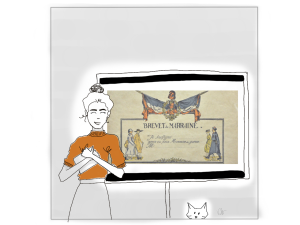
Aliénor Gandanger, a Doctor of History who completed a joint PhD at the University of Caen and the University of Luxembourg, researches war godmothers and explores innovative ways of telling their stories.
In France, “war godmothers” (marraines de guerre) became hugely popular fictional figures from 1915 onwards. They were everywhere, featuring in novels, songs, poems, plays and cartoons. In real life, the role of these women was to write to troops engaged in combat. The basic premise was that these volunteers, far from the front lines, would strike up a letter-writing relationship with a soldier who they had generally never met. The women would offer support, distraction, an attentive ear, prayers – anything that might help the soldier to cope with life at the front or in a prisoner-of-war camp. As a social practice, the concept of war godmothers is striking, intriguing, appealing, and maybe also unsettling. War godmothers have been largely overlooked by research, and since the initial popularity surrounding them they have been neglected in both scholarly and fictional publications. Why is this? As there is no lack of archives, could it perhaps be because we have yet to find the right way to tell their story?
Since 2021, Aliénor Gandanger, a Doctor of History who completed a joint PhD at the University of Caen and the University of Luxembourg, has been researching this topic, combining historical analysis and narrative experimentation by developing a comic book in collaboration with an illustrator. Realising that PhD theses gain little interest beyond academic circles, Aliénor is convinced of the need to imagine different ways of telling the story of war godmothers. Their ubiquitous presence during the First World War is easy to understand: war godmothers were an easy sell in the popular media of the time. They fitted seamlessly with the dominant narrative registers of patriotism, sentimentality, melodrama and adventure. It was easy to weave them into a story; they were ready-made popular characters. War godmothers naturally lent themselves to universal storylines; they generated narratives. The initial pitch was that a war godmother was a woman who wrote letters to an unknown soldier, but this basic scenario could easily be spiced up with a dose of curiosity, anticipation, surprise, expectation, misunderstanding or sentimentality, the magic of a real-life encounter, the potential for situation comedy. After 1918, these formats gradually disappeared from the landscape. From the 1920s to the present day, war godmothers have generally been excluded from accounts of the war. The visibility of a historical phenomenon like the French war godmother scheme depends on the existence of suitable narrative, cultural and media vehicles through which it can be presented. As long as society had suitable formats to tell their story, it could be told. After extensive research in around a hundred archive centres in France, Aliénor Gandanger can confirm that it was not the archives that went silent; rather there was simply no longer a suitable form to convey the narrative.
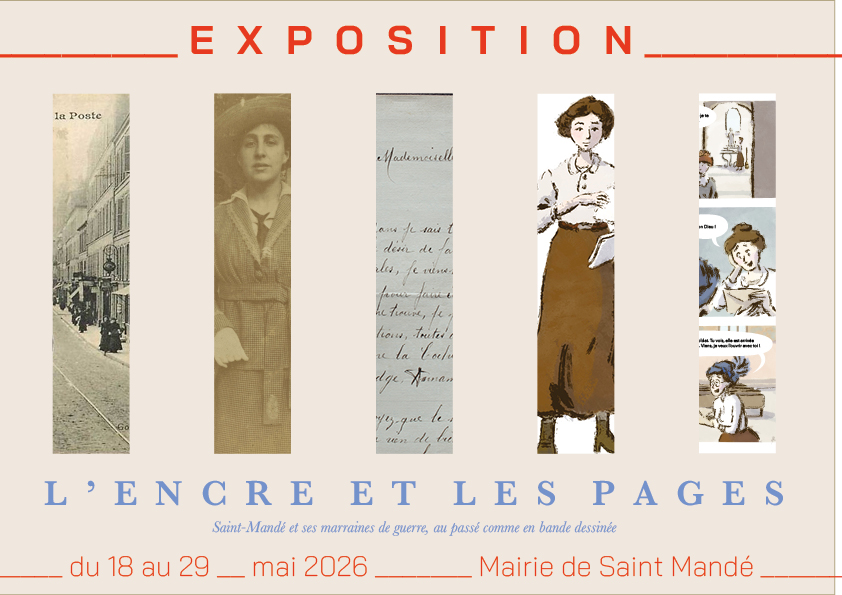
Cover page of the brochure for the exhibition project – Copyright ©Valentine Gandanger – 2025-2026.
Reinstating war godmothers in the history of gender and war is not as simple as just analysing the archives and producing a scholarly text. We need to recreate formats through which the subject can be brought back to life. This multi-format approach is not about fragmentation; rather it is a methodological choice. Each different format reveals different dimensions of a relational phenomenon characterised by writing, trust, waiting, imagination and ambiguity. Over a five-year period, several formats began to take shape, to different degrees. An exhibition entitled L’encre et les pages (“Ink and pages”), due to be held from 18 to 29 May 2026 in Saint-Mandé Town Hall in the Greater Paris region, will provide the first ever opportunity to showcase the story of war godmothers in a physical setting by presenting the experience of one godmother through her diaries, letters and photographs. A children’s book is also under preparation – an illustrator is currently developing a number of different graphic approaches to test out the story during the workshops for children (aged 7-9) held alongside the exhibition. Aliénor’s research has also involved a number of other experiments, especially the Gazengel series, launched in autumn 2021 to present the story behind the research and explain the subject.
In spring 2024, the book Adopte un soldat!, published by Mauconduit, was released as a first attempt to engage the general public with the topic. After completing training in public history, Aliénor was inspired to draw on the expertise of her fellow trainees and explore how extracts from the diaries of a war godmother and letters from soldiers might be voiced in a podcast. As part of her PhD, a comic book seemed a promising idea, but the plot had yet to be traced out and time was needed to come up with a convincing storyline.
It is by reinventing, trying and testing these different forms that Aliénor Gandanger hopes to bring to light the experience of war godmothers for a new audience – not as a forgotten curiosity but as a relatable, compelling and complex way of presenting the experience of war and exploring relationships between men and women in this context. After a series of sometimes successful, sometimes aborted attempts, the conclusion is clear: why stick to a single format in telling the story of war godmothers, figures who themselves did not fit into a single category?
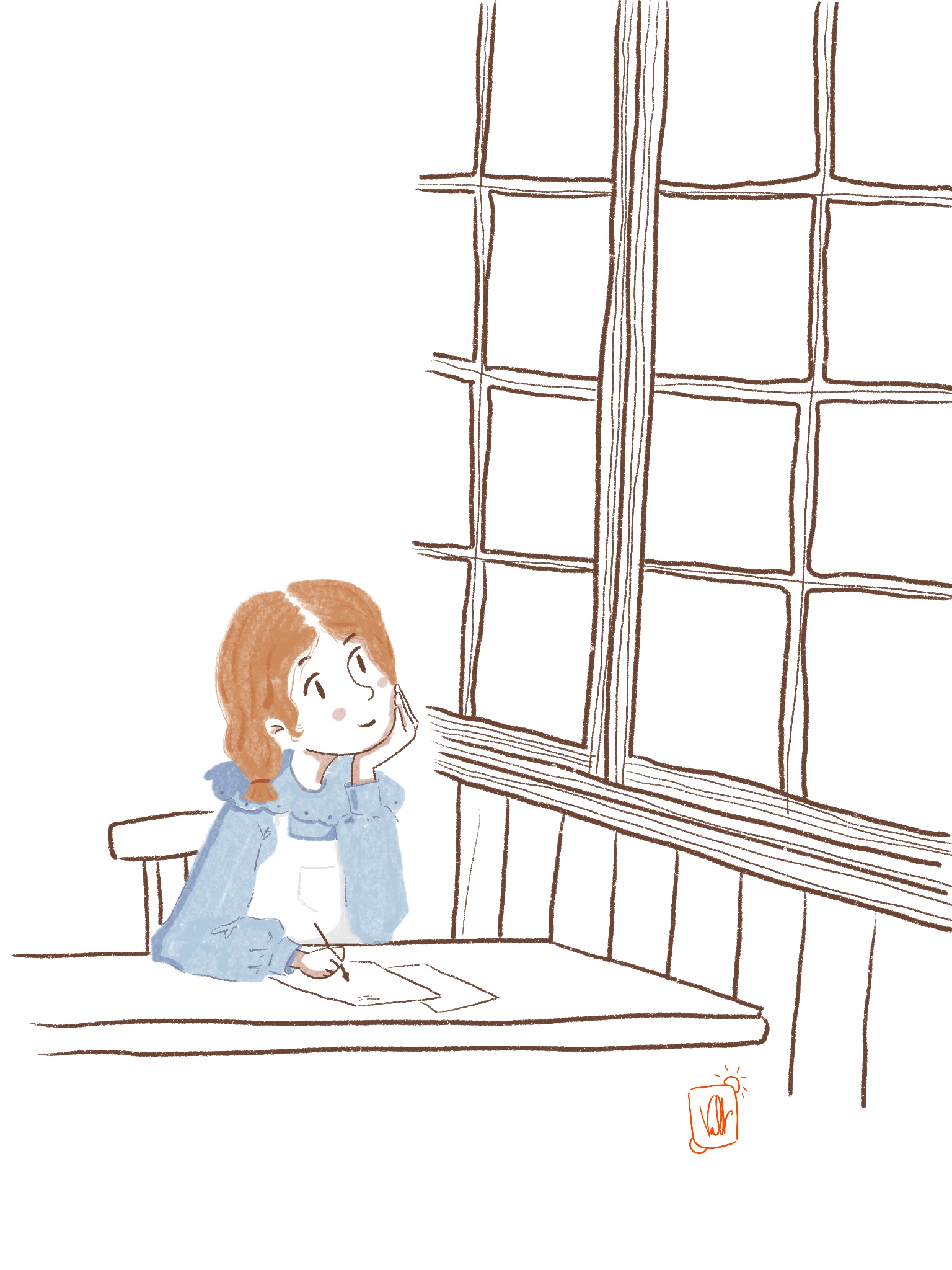
Children book project of Aliénor Gandanger – Copyright ©Valentine Gandanger – 2026.
Author(s)
Aliénor Gandanger