

 Faculty of Science, Technology and Medicine
 Faculty of Law, Economics and Finance
 Faculty of Humanities, Education and Social Sciences
 Interdisciplinary Centre for Security, Reliability and Trust
 Luxembourg Centre for Systems Biomedicine
 Luxembourg Centre for Contemporary and Digital History
 Luxembourg Centre for European Law
 Luxembourg Centre for Socio-Environmental Systems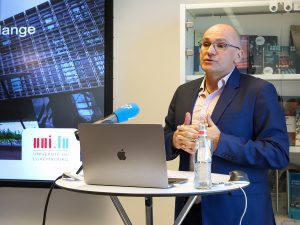
On 27 January 2026, the free daily newspaper L’essentiel published an article about the role of historians in interpreting the world today, based on an interview with Denis Scuto, an Associate Professor at the C²DH. Although undoubtedly relevant, the article, headlined “Social media platforms offer a springboard for indoctrination”, provides merely a brief summary of the responses given in the interview. It can therefore serve as an instructive example, helping us understand the role of a mainstream media journalist and also highlighting the potential for a mismatch between the words spoken by an academic and the way they are presented in an article.
The full interview given by historian Denis Scuto:
With the far right on the rise in several countries and Presidents and other Heads of State incorporating false truths into their political speeches, what do you consider to be the role of a historian?
For me, the historian’s role is to critically reflect on these false truths, on the way in which history is manipulated and misused for political purposes, and to use scientific knowledge and the latest research findings to counter them. We then need to share this knowledge via as many communication channels as possible.
Do you also see yourself as a guarantor of democracy? Do historians today have a duty to be more present on the public stage to prevent the atrocities of the past from repeating themselves?
Both historians and researchers in other disciplines, together with anyone else who has a public platform, must play an active role in the public arena in gathering together all those who, regardless of their political or ideological views, defend the broad principles of democracy and the rule of law – principles that today are under direct threat, including from the elected President of the United States.
How can historians deal with the misinformation that is becoming increasingly pervasive, in particular as a result of social media and “political influencers” who put their subjective truth before historical facts?
The emergence of the digital age in the 21st century, with social media and 24/7 news channels that are increasingly dominated by autocratic tech billionaires and their “engineers of chaos”, has made mass indoctrination even easier than during the totalitarian regimes of the 1930s. This involves the widespread distribution of simplistic far-right ideas based on prejudice and fake news. In the interwar period, far-right ideologues already recognised that the key to power did not lie in the political arena – parliaments or governments – but rather in gaining control over technical and communication infrastructures. The major challenge for all those who are committed to the rule of law today is to bring technology under control and subject it to democratic regulation. If democratic nations continue to tolerate algorithms that encourage and normalise prejudice and intolerance, they will undermine the very foundations on which they are based.
Some people see similarities between ICE in the United States and the Gestapo during the Nazi regime. Are they right? Do you think that we can observe similar trends?
The goal of Donald Trump and the far-right strategists around him is to remove the United States from the democratic sphere during his second term. Normalising authoritarianism, arbitrary action and violence within the country, in particular the killings perpetrated by ICE, and also outside the country with the intervention in Venezuela and the threats on Canada and Greenland, do indeed allow a historical comparison with the policies and objectives of the Nazi and Fascist regimes of the 1930s.
Author(s)
Assoc. Prof Denis SCUTO
Associate professor / Chief scientist 2 in Contemporary Luxembourgish History