

 Faculty of Science, Technology and Medicine
 Faculty of Law, Economics and Finance
 Faculty of Humanities, Education and Social Sciences
 Interdisciplinary Centre for Security, Reliability and Trust
 Luxembourg Centre for Systems Biomedicine
 Luxembourg Centre for Contemporary and Digital History
 Luxembourg Centre for European Law
 Luxembourg Centre for Socio-Environmental Systems
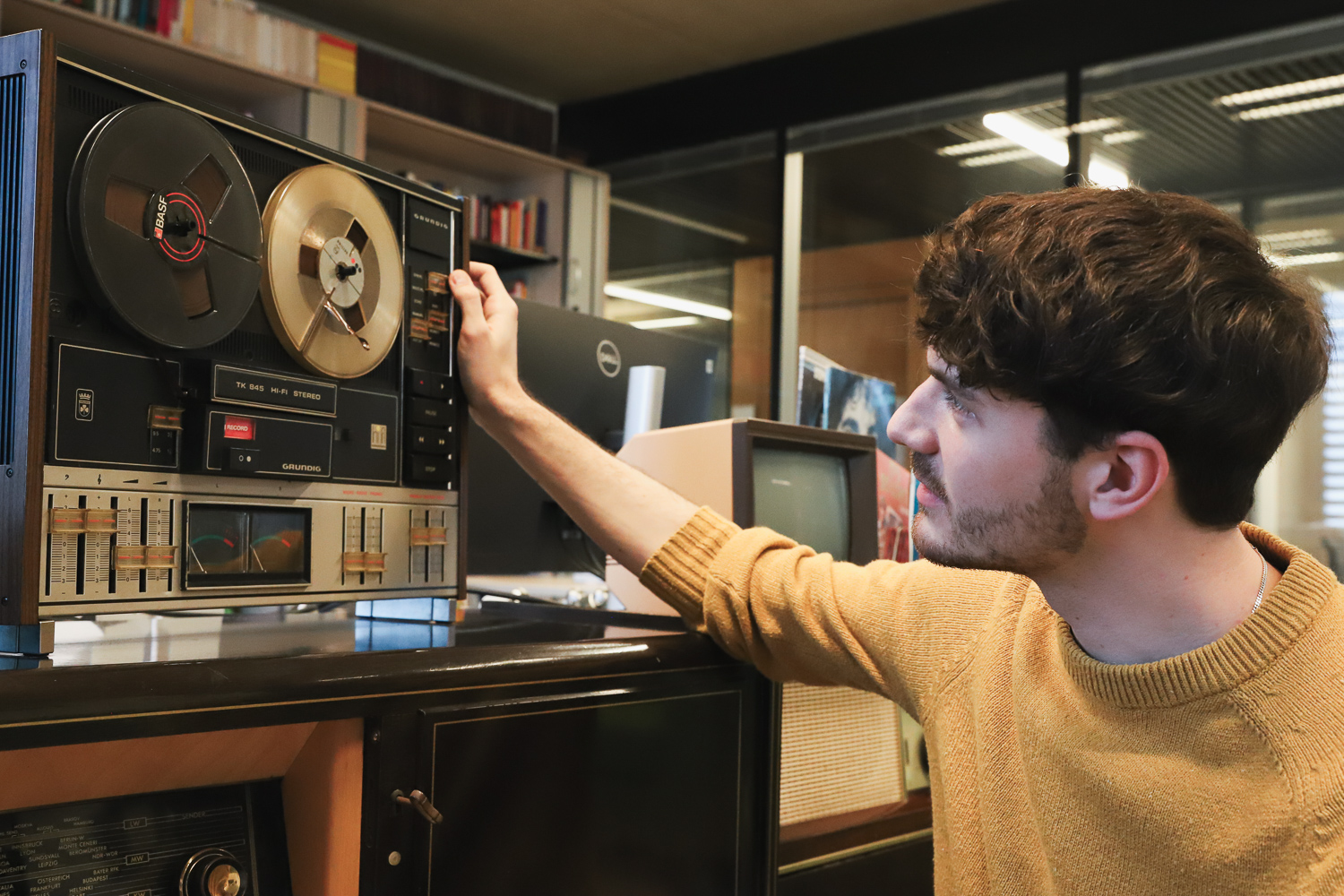
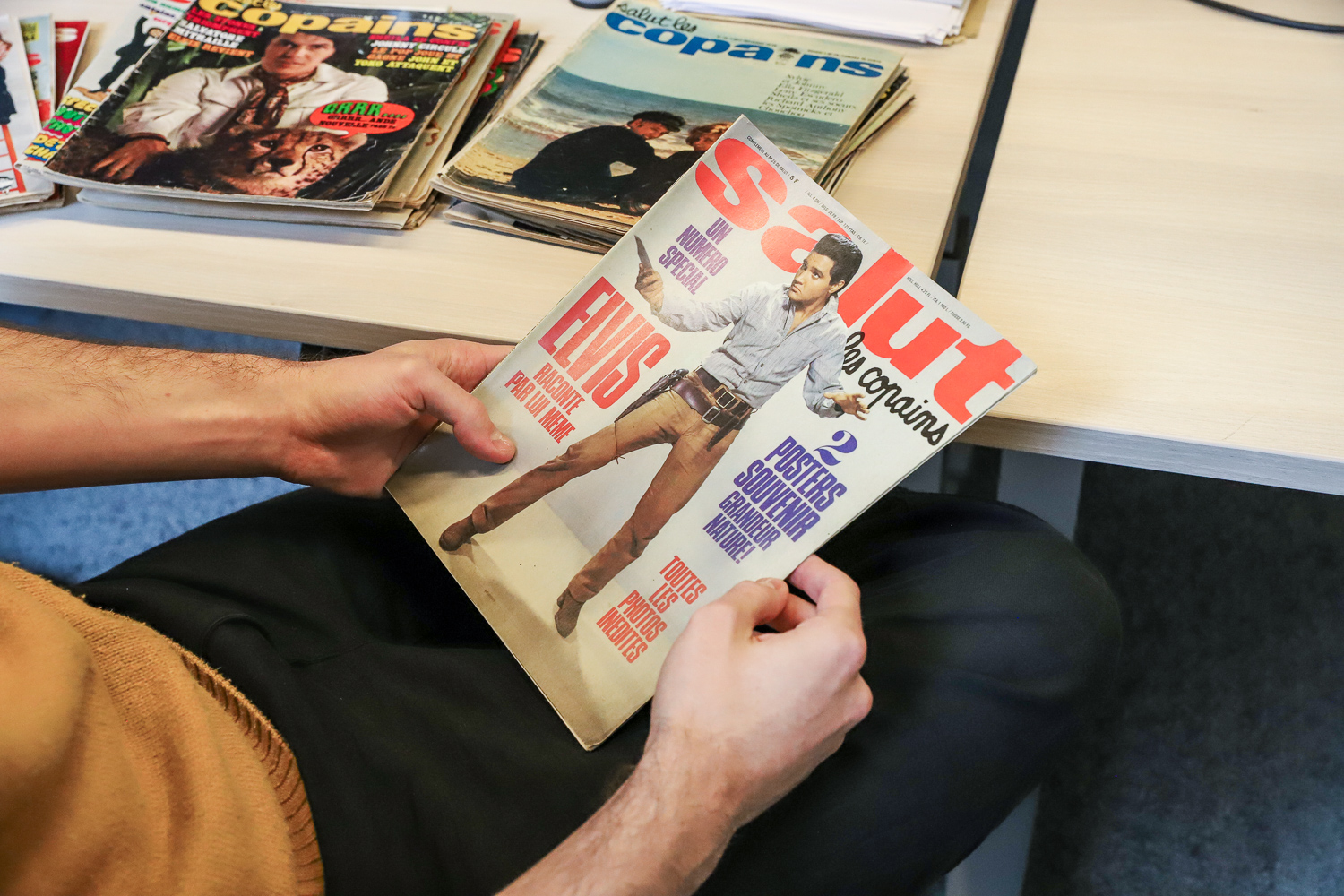
As part of the PopKult60 project, Matthias Höfer, a doctoral researcher with a background in media and communication history, is exploring how companies popularised and advertised consumer electronics in Germany, France and Luxembourg in the 1960s.
The consumer electronics Matthias Höfer is focusing on – radios, televisions, record players and cassette recorders – are goods which, apart from radio, “were not really common in households in the 1950s, but gradually gained in popularity over the next couple of decades.”
Advertising for consumer electronics goods in the 1960s was intrinsically linked to the possibilities they offered people. This meant, for example, that advertisements for record players would depict a group of friends having a party listening to vinyl discs, while television sets would be advertised by showing people watching major sporting events such as the Olympics. So the ways in which media artefacts were advertised and marketed to consumers were related to the (media) content those consumers watched, recorded or listened to.

Höfer, originally from northern Bavaria, completed a Master’s in History at the University of Bamberg with a dissertation about public rituals of penance in the 13th century and their role as public forms of communication and conflict resolution in a semi-oral society. As part of his Bachelor’s in History and Communication Science, he investigated a transnational media event during the Seven Years’ War.
It was during his Master’s that he decided to join the C²DH as a PhD researcher, in part because of his background studying transnational phenomena and media.
Transnational insights
Höfer has been busy analysing sources from company archives, advertisements and statistics. Sourcing historical data on his topic, however, can be challenging for several reasons: the types of archival material available can vary considerably between countries, for instance, and statistical data is often not easily comparable on a transnational scale.
Nevertheless, his persistence seems to be paying off, as he has plenty of interesting findings to share. “The last thing I wrote was on the implementation and introduction of German brands in France. What I found very interesting was the extent to which advertising is also connected to the economy and external factors as a whole,” he says.
In the late 1950s and 1960s, for instance, with the accelerated push for European integration, German consumer electronics brands began to advertise and market their products more widely in France. However, as Höfer explains, “It wasn’t just German manufacturers that exported their products to France; retailers began to buy directly from wholesalers in Germany and sell to French consumers.”
Consumer electronics manufacturers were unhappy about these practices and tried to prevent them. There was even a European court case about it. But these were the realities of the Common Market. Retailers importing the products “took advantage of advertising by companies which were not in a position to undercut them,” Höfer explains. “This is not something that you see from individual ads, but if you look at the whole picture, it’s often more interconnected, even on a transnational level, than you might think.”
Luxembourg is the most difficult of the three country cases to analyse, as there is less material than in Germany or France. Höfer has nonetheless managed to identify certain aspects that are quite particular to Luxembourg. For instance, television sets sold in Germany were incompatible in France, and vice versa. “Luxembourgish people, however, spoke both German and French and were interested in receiving television from both countries, so they required specific products that were capable of receiving multiple standards from multiple countries,” Höfer explains. This meant that advertising in Luxembourg could focus on the promise of receiving multiple channels. Furthermore, Luxembourgers sometimes banded together to buy a communal aerial which could receive and convert transmissions to household TV sets.
PopKult60 collaboration and other opportunities
Höfer’s research is part of the broader PopKult60 project, supported by the German Research Foundation (DFG) and the Luxembourg National Research Fund (FNR). The project focuses on transnational popular culture in Europe in the long 1960s and will culminate in a joint publication due to be released by the of end of 2026.
Coming from a more conventional research background, Höfer says the C²DH has pushed him to reflect on how to incorporate digital history methods into his research.
‟ There are certain projects where digital history can bring added value and really improve your work if you use the right approach. Reflecting on these questions is crucial.”
He says he also values the social aspects of the C²DH, particularly the team spirit andthe opportunities to work collaboratively. The supportive and friendly atmosphere has helped him tackle some tricky research challenges and made him feel part of a wider community.