

 Faculty of Science, Technology and Medicine
 Faculty of Law, Economics and Finance
 Faculty of Humanities, Education and Social Sciences
 Interdisciplinary Centre for Security, Reliability and Trust
 Luxembourg Centre for Systems Biomedicine
 Luxembourg Centre for Contemporary and Digital History
 Luxembourg Centre for European Law
 Luxembourg Centre for Socio-Environmental Systems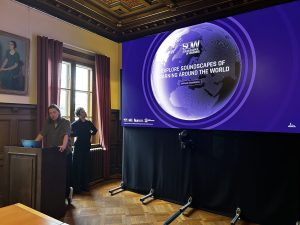
Visualising What We Don’t Want to Hear
Introduction
“What is a warning sound? A sharp tone, a rising siren, a mechanical wail? Designed to seize attention and signal danger, warnings may seem universal, but they differ across time, place, and culture. What counts as a warning reflects specific historical, political, and technological contexts.” — Johan Malmstedt
We meet thanks to sirens
A few months ago, I stopped by Martin Düring’s office seeking a new topic for my summer Erasmus+ project. He recommended I contact Marie Cronqvist and Johan Malmstedt, who were former collaborators on the Impresso project. Right after the first call with Marie, we decided to create a spin-off of the SOW (Soundscapes of Warning) project. It was a perfect match, as Johan was already part of it. Daniele Guido joined us as a senior developer—essentially because he didn’t have a choice as one of the creators of 3DStories!
Glimpses of uncertainty, inspiration from experience
First of all, I would like to ask you a question: “What does the sound of a warning mean to you outside of the immediate context of danger?” I was perplexed when trying to answer this question. It’s just an unbearable noise that you try to avoid hearing. Apparently, this overview didn’t help generate a compelling idea for the project. Plus, we lacked experience in sound visualisation. During the second call, Johan showed me a 3D-printed model of a soundscape that he had created for his PhD dissertation. It was an “aha” moment. We decided to develop the idea of forming sound through a three-dimensional structure; moreover, it was a perfect showcase for the 3DStories project.
Touching the sound
However, how could we convert a promising idea into an interactive visualisation that invites user exploration? The solution popped up from one of the biggest advantages of 3D web applications: real-time interaction. We transposed the main audio control features directly into the 3D model. As a result, the audio navigation slider was no longer needed. The user can control the current time simply by clicking on the 3D model. The entire concept was ready; we were prepared for the next step.
The trip to Sweden: Fika time is an appropriate tool for research and creativity
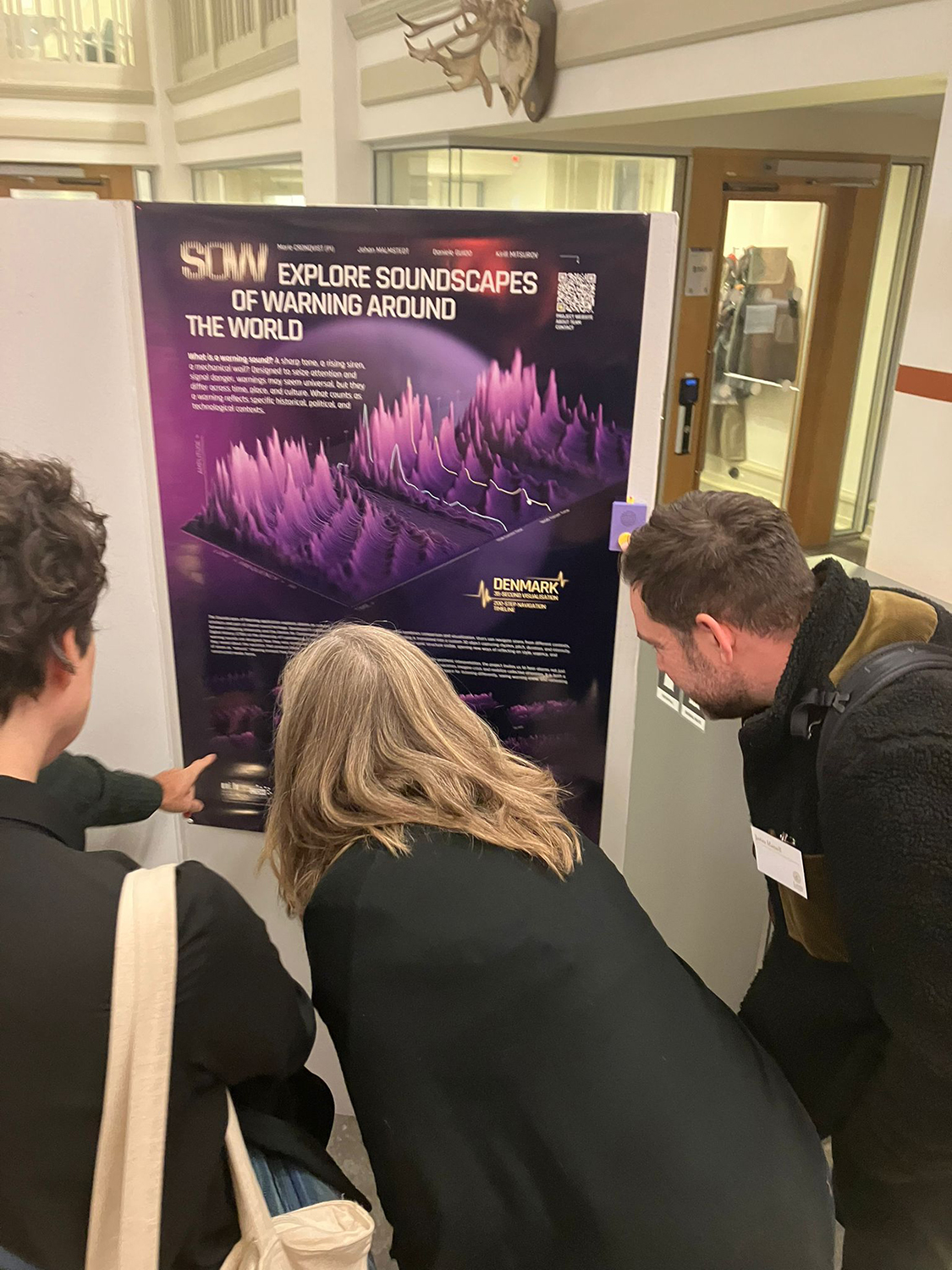
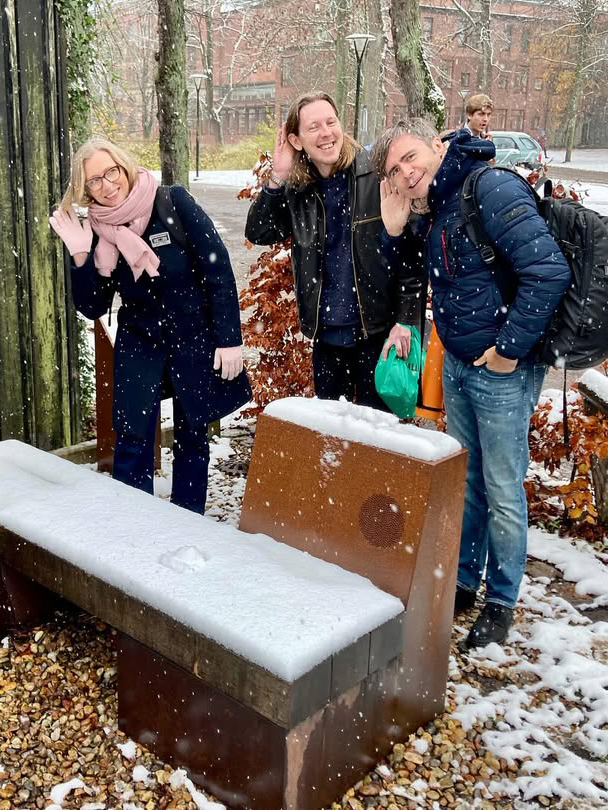
I arrived at Linköping University with a complete plan for how the application should look and be developed. The time we saved allowed us to organise a few presentations, including the SOW workshop with the full team in person and a presentation of 3DStories at the University of Gothenburg. Writing about Sweden, I cannot miss the opportunity to mention “Fika time,” which continuously nourished our workflow with homemade apple pies and insightful conversations.
The Research Challenge
From the very beginning, I understood that we could not develop the app based solely on classic 3D modelling and texture rendering. My previous experience working on the 3DStories “Molecules” edition was a starting point. There, we combined classic 3D mesh integration with a custom point texture generated by code (a shader texture). In the SOW project, we went even further and generated everything via code. It allowed us to free the work from physical 3D limitations and get closer to the non-physical world of sound.
Application Features that you will love
Despite a limited budget and tight timeframes, we developed a robust audio visualisation framework that you will appreciate. I’ll be happy to present all the features during a lunch session in early 2026. During this presentation, I would just like to highlight features such as flexible navigation, a prebuilt audio player, and a consistent camera position across the visualisation assets for the comparative mode.
Create your own soundscapes
If your research incorporates meaningful audio data that you would like to visualise, our framework is a good tool to use. We can adapt almost all the parameters of soundscape visualisation (model complexity, physical size, audio duration, and so on) to render models for your comparative research.
No stories without support
All 3DStories projects would never have been published without the support of Erasmus+ and the C²DH. Thank you, Karin Langumier, for the travel assistance. Thank you, Andreas Fickers, for allowing us to conduct research related to 3D technologies.
Special thanks to the full Soundscapes of Warning team, especially Marie Cronqvist and Johan Malmstedt, for project management and data research support.
3DStories – what’s next
We plan to develop the project from different perspectives. One of the main directions is to create our own library of 3D models for digital heritage and future reuse. We aim to implement the latest 3D scanning, generation, and modelling innovations to produce high-resolution objects or environments that will assist historians in their research. Our best practices for integrating 3D models will help you choose the appropriate rendering methods and avoid displaying raw scans with default settings.
I would also like to take this opportunity to mention the 3DStories seminars, where we will present our latest project and explain the innovations, techniques, and history of the evolving 3D industry.
More interesting stories are coming.