
 Faculté des Sciences, des Technologies et de Médecine
 Faculté de Droit, d’Économie et de Finance
 Faculté des Sciences Humaines, des Sciences de l’Éducation et des Sciences Sociales
 Interdisciplinary Centre for Security, Reliability and Trust
 Luxembourg Centre for Systems Biomedicine
 Luxembourg Centre for Contemporary and Digital History
 Luxembourg Centre for European Law
 Luxembourg Centre for Socio-Environmental Systems
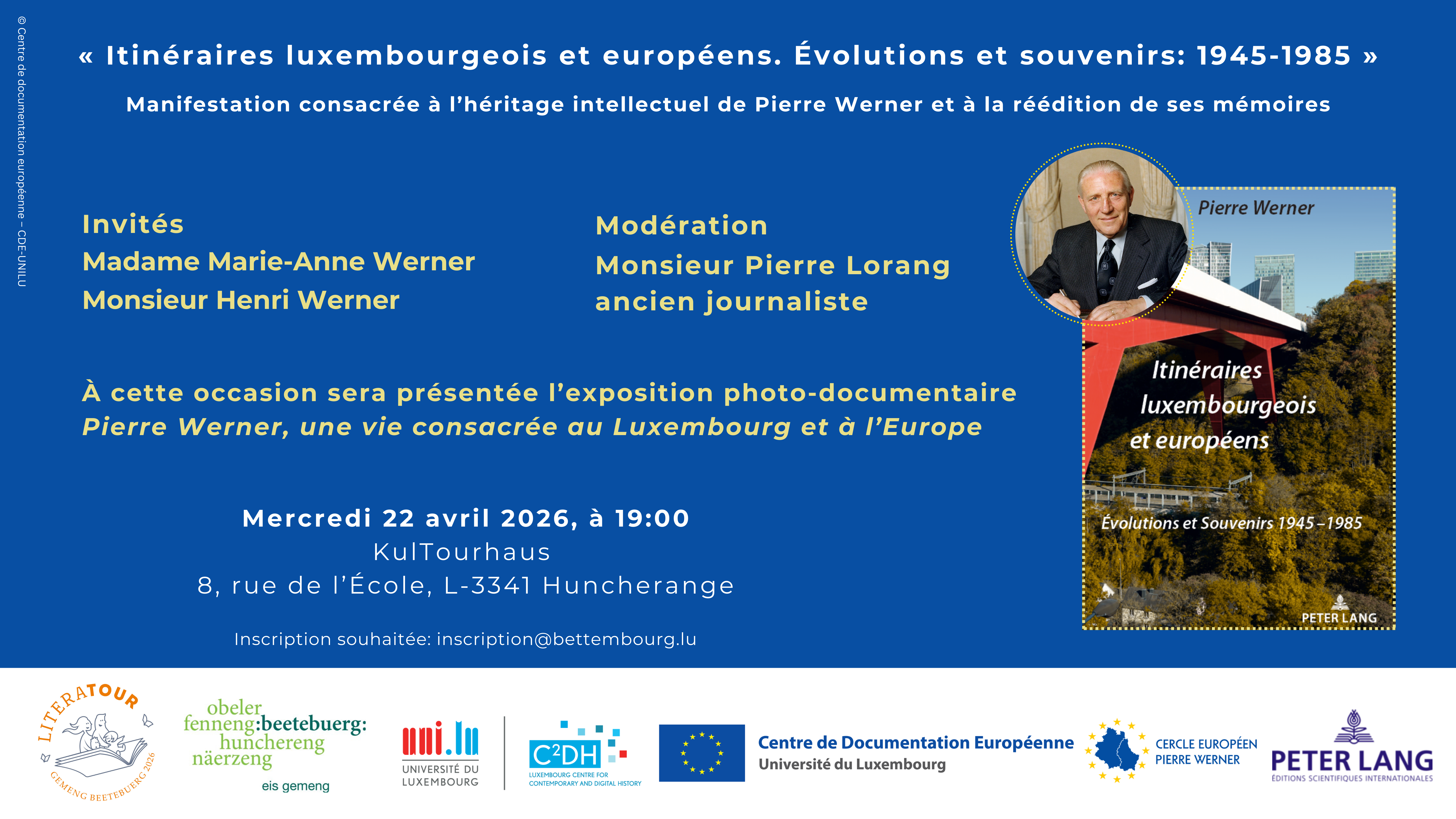
Dans le cadre du festival littéraire « LiteraTOUR 2026 », le Centre de Documentation Européenne de l’Université du Luxembourg (CDE-UNILU) et le Collège échevinal de la commune de Bettembourg, ensemble avec leurs partenaires – l’Université du Luxembourg, le Luxembourg Centre for Contemporary and Digital History, le Cercle européen Pierre Werner et la maison d’édition universitaire internationale P.I.E. Peter Lang – ont le plaisir de vous inviter à une soirée dédiée à l’héritage intellectuel de Pierre Werner.
Organisée à l’occasion de la réédition de ses mémoires intitulées
« Itinéraires luxembourgeois et européens. Évolutions et souvenirs : 1945–1985 »
cette rencontre réunira Madame Marie-Anne Werner et Monsieur Henri Werner, en dialogue avec Monsieur Pierre Lorang, ancien journaliste.
Un échange avec le public clôturera la rencontre.
A cette occasion sera également présentée l’exposition photo-documentaire « Pierre Werner, une vie consacrée au Luxembourg et à l’Europe ».
La manifestation aura lieu le mercredi 22 avril 2026 à 19h00 au KulTourhaus,
situé 8, rue de l’École, L-3341 Huncherange.
Inscriptions par e-mail à l’adresse suivante : inscription@bettembourg.lu
Informations complémentaires
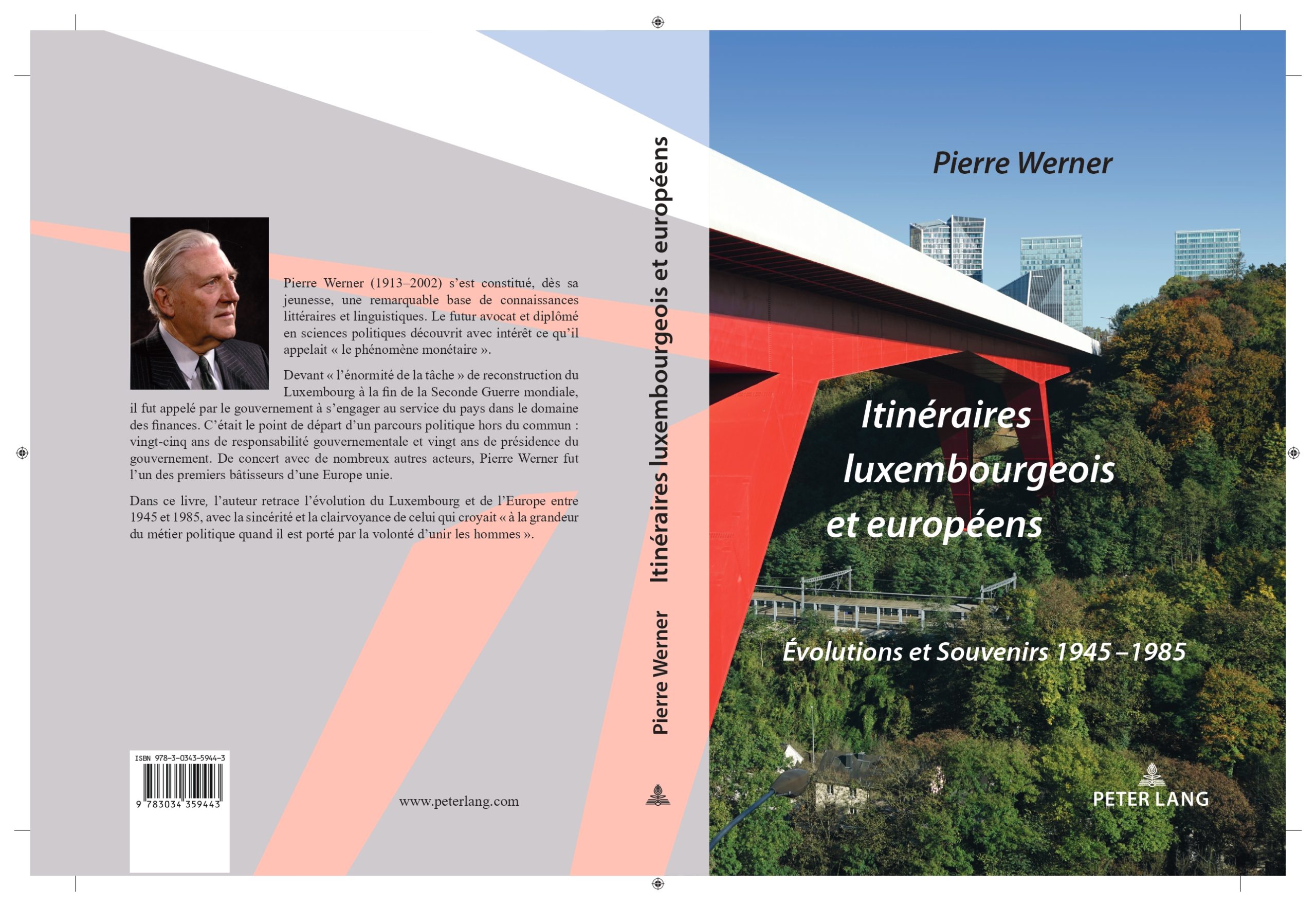
« Itinéraires luxembourgeois et européens. Évolutions et souvenirs : 1945–1985 », par Pierre Werner
À travers la nouvelle édition des mémoires de Pierre Werner (29 décembre 1913 – 24 juin 2002) – qui est le fruit de la coopération entre le projet Europe Direct de l’Université du Luxembourg (2021-2025), les archives familiales de Pierre Werner et la maison d’édition universitaire internationale P.I.E. Peter Lang – sont mis en lumière son parcours personnel, son héritage intellectuel et son rôle dans l’histoire du Luxembourg et de l’Europe, dont le « Rapport Werner », présenté officiellement le 8 octobre 1970 avait tracé les contours de l’Union économique et monétaire et jeté les bases de l’euro.
Exhibition Pierre Werner (1913-2002) – A life dedicated to Luxembourg and Europe
As a long-standing senior civil servant, minister and Prime Minister from the end of the Second World War until the mid-1980s, Pierre Werner gave his country, the Grand Duchy of Luxembourg, a voice that would be heard beyond its borders. He was closely involved in integration and policy-making efforts at the national, regional and European levels. He was an excellent listener and known for his skills of understanding and reconciling apparently incompatible positions. He was committed to defending the vital interests of Luxembourg and Europe over the long term. Pierre Werner is unanimously recognised as one of the main architects of Economic and Monetary Union: the 1970 Werner Report sketched out the fundamental features of what would later become the euro.
Based primarily on Pierre Werner’s private collections, alongside relevant Luxembourgish and European archives, including the Historical Archives of the European Union (HAEU), the exhibition presents a multifaceted portrait of Pierre Werner. It highlights his personality, his role as a father and family man, his social and intellectual interests, and his achievements as a politician and committed European. Through this collaborative initiative, previously undisclosed archival sources relating to the history of Luxembourg and the Economic and Monetary Union are brought to light, making them accessible and compelling to a broader audience, while highlighting their enduring historical significance and contemporary relevance.
The date of 8 October 2025 marked the 55th anniversary of the “Stage-by-Stage Plan for Economic and Monetary Union (EMU) within the European Community,” better known as the “Werner Report” or the “Werner Plan”.
Drawn up by a committee of experts chaired by the Prime Minister and Minister of Finance of Luxembourg, Pierre Werner (1913–2002), and officially presented on 8 October 1970 in Luxembourg, this reflection document outlined the main principles, framework, and steps toward an Economic and Monetary Union (EMU) based on the principle of irreversibility and an approach rooted in perfect symmetry between its economic and monetary dimensions, with political union as the ultimate objective. It envisaged the creation of a “decision-making centre for economic policy” that would be “politically accountable to a European Parliament” elected by direct universal suffrage, as well as a “Community system for central banks.”
The Werner Report provided the definition of a complete and symmetrical EMU, and many of its recommendations remain on the European agenda to this day.
Based primarily on Pierre Werner’s private collections, alongside relevant Luxembourgish and European archives, including the Historical Archives of the European Union (HAEU), this exhibit, brought to life through Henri Werner’s combined scholarly and artistic work, was developed in partnership with Europe Direct at the University of Luxembourg – a competitive public history project co-funded by the European Union (2021 to 2025) – and the Luxembourg Centre for Contemporary and Digital History (C²DH).
Design, texts and layout: Henri Werner
© 2022 Luxembourg Centre for Contemporary and Digital History
All rights reserved